Vai al contenuto

An electrostatic air filter is an air cleaning device that utilizes electrostatic attraction to capture airborne particulates. Instead of relying solely on dense, woven mechanical fibers to trap particles like a sieve, an electrostatic filter charges airborne contaminants and pulls them toward oppositely charged collection surfaces like a magnet.
In today’s heating, ventilazione, and air conditioning (HVAC) applicazioni, these systems range from budget-friendly residential washable screens to engineered, commercial-grade active electronic precipitators developed by specialized manufacturers like DTAF Air Filtration to handle high airflow volumes with minimal fan energy loss.
How Does an Electrostatic Air Filter Work?
The physics behind electrostatic filtration relies on Coulomb’s law: opposite electrical charges attract.
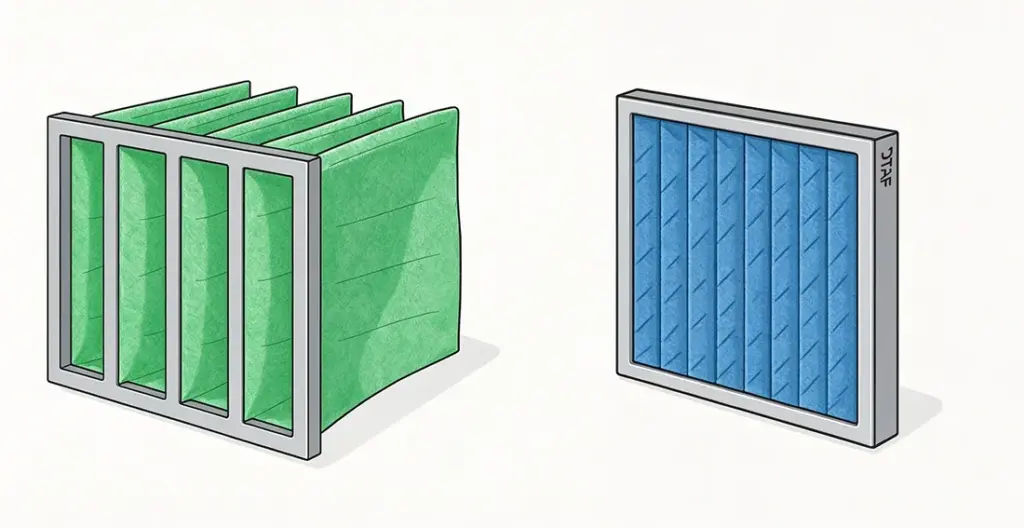
In traditional mechanical air filters (such as fiberglass panels or high-MERV pleated filters), the air must force its way through a tight web of fibers. This creates immediate airflow resistance.
In contrast, an electrostatic air filter keeps air passages relatively open. As air travels through the filter assembly:
- Airflow Ionization / Contact Charging: Particulates such as dust, pollen, soot, and particulate matter (PM2,5) carry or acquire an electrical charge.
- Opposite-Charge Attraction: The charged particles enter an electrical collection field where conductive collector plates or polarized layers carry the opposing charge.
- Capture & Retention: The particles are drawn directly out of the airstream and bound to the collector plates until the unit is washed and serviced.
Passive vs. Active Electrostatic Filters: A Crucial Distinction
When researching air filters, people frequently confuse two entirely different technologies under the same label:
- Passive Electrostatic Filters (Friction-based): These are common 1-inch to 2-inch residential washable filters. They require no electrical wiring. Instead, air passing through layered synthetic media (such as polypropylene) generates small static charges via friction (the triboelectric effect). Their filtration capacity is generally limited to MERV 6 A 8.
- Active Electrostatic Cleaners (Electronic Air Cleaners / ESP): These are engineered units hardwired to an electrical power supply. A built-in high-voltage power supply energizes an ionization zone (producing 6 kV to 8 kV) and a collection zone (3 kV to 4 kV). This continuous, regulated voltage provides high-efficiency particulate removal without suffering from performance drops caused by ambient humidity.
Types of Commercial Electrostatic Air Cleaners
For commercial facilities, offices, hospitals, and high-occupancy buildings, active electrostatic filtration splits into two leading configurations:
1. Two-Stage Electrostatic Precipitators (ESP)
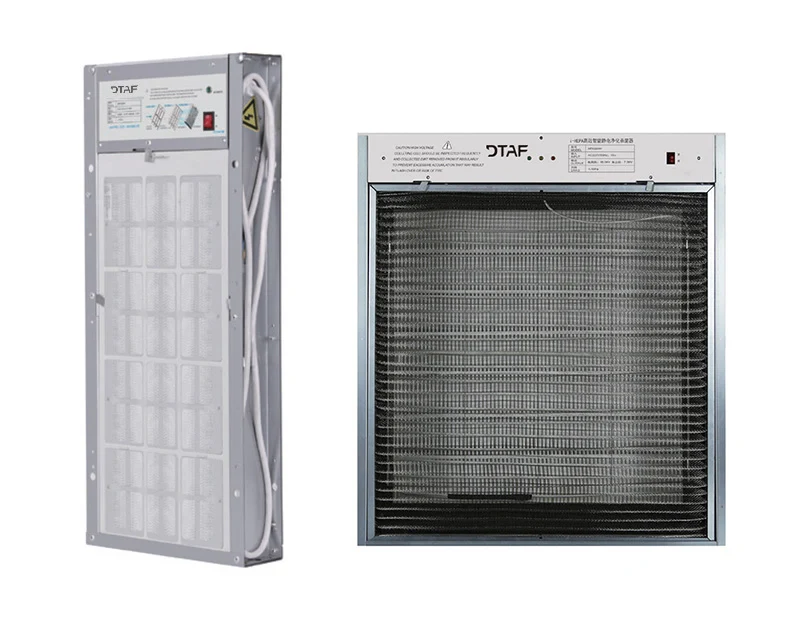
Standard in central air handling units (UTA) and primary fresh air supply ducts, engineered solutions like our two-stage electrostatic filter for high-efficiency air purification utilize tungsten ionizer wires to charge incoming micro-particles before trapping them on grounded aluminum collection plates.
- First Stage (Ionizer): Tungsten ionizer wires or needles create an active corona discharge, putting a positive charge on incoming micro-particles.
- Second Stage (Collector): Alternating grounded and high-voltage aluminum collection plates capture the charged debris.
- Key Advantage: Washable aluminum cells last for years, eliminating recurring filter replacement costs while delivering low static pressure drop across massive airflow rates.
2. Micro-Electrostatic (MESP) Technology
Traditional high-voltage ESPs can occasionally spark or produce trace ozone if neglected. Modern Micro-Electrostatic (MESP) purifiers solve this by utilizing dense dielectric micro-channels instead of open high-voltage wires.
- Key Advantage: Operates with near-zero ozone emissions, stable continuous fields, and compact form factors.
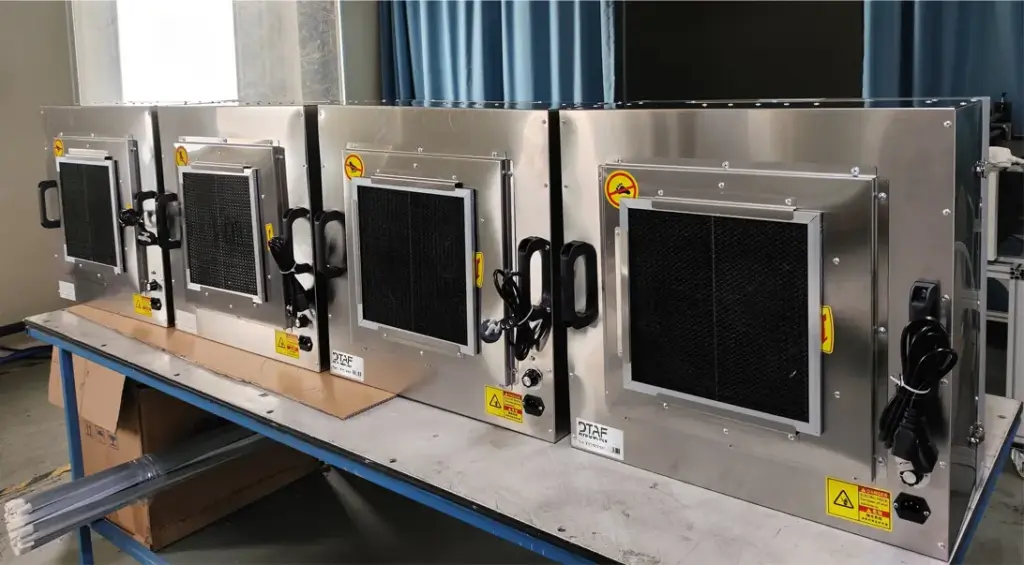
- Applicazione: For occupied spaces requiring whisper-quiet operation and zero-ozone emissions, units like the inlet-type electrode microstatic air purifier fit directly into ceiling return air grilles (FCU), protecting luxury hotels, schools, and corporate offices without altering existing ductwork.
Performance Benchmark: Electrostatic vs. Disposable Pleated & HEPA Filters
To understand why commercial operators switch from traditional pleated filters to active electrostatic systems, look at the actual operational benchmarks over an HVAC lifecycle:
| Parameter | Standard Disposable Pleated (MERV 8) | High-Efficiency Pleated (MERV 13) | Two-Stage Commercial ESP (Lavabile) | Micro-Electrostatic MESP (Ceiling/AHU) |
|---|---|---|---|---|
| Caduta di pressione iniziale (Papà) | 65 – 85 Papà | 110 – 145 Papà | 25 – 45 Papà | 35 – 55 Papà |
| Final Loaded Resistance (Papà) | 250 Papà (requires change) | 350 Papà (requires change) | 80 – 100 Papà (pre-wash) | 90 – 120 Papà (pre-wash) |
| PM2.5 Removal Efficiency | 20% – 35% | 85% – 90% | 92% – 98% | 95% – 99% |
| Filter Service Life | 1 – 3 Months (Monouso) | 3 – 6 Months (Monouso) | 10+ Years (Washable cell) | 8-10+ Years (Washable core) |
| Fan Energy Penalty | Moderare | Alto | Extremely Low | Very Low |
| Recurring Consumable Cost | Recurring quarterly | High ongoing expense | $0 (Water wash only) | $0 (Water wash only) |

What Electrostatic Filters Cannot Do (And How to Address It)
No single filtration technology solves every air quality challenge. While electrostatic precipitators excel at solid and liquid particulates (dust, pollen, bacteria carriers, oil mist, smoke), they cannot trap or neutralize gaseous contaminants or chemical odors.
If an environment contains volatile organic compounds (COV), formaldehyde, or pungent odors, a hybrid system provides complete coverage:
- For Particulates & Aerosol: Use an Inlet-Type ESP or Micro-Electrostatic Cell at the front end to remove 95%+ of PM2.5 at minimal pressure drop.
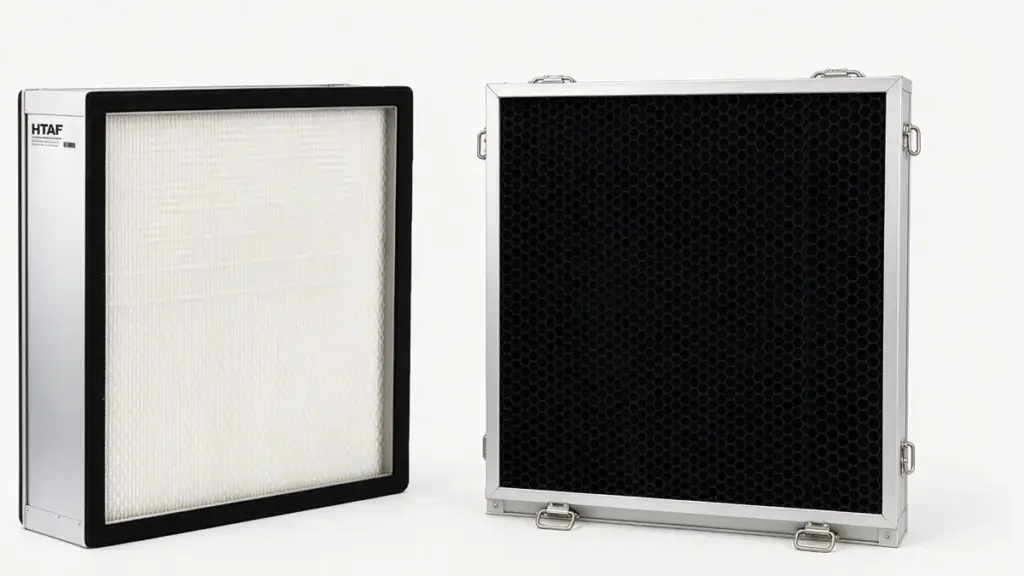
- For TVOCs & Odors: Pair the electrostatic stage with an inlet-type full-section nano photocatalytic air purifier, using UV-activated TiO2 honeycomb grids to break down gaseous molecules into trace H2O and CO2.
- For Proactive Airway Disinfection: Add a plug-in ultraviolet and hydrogen ion air purification and disinfection device inside the supply air branch to actively distribute cleansing oxidizers into the conditioned space.
Recommended Maintenance: How to Clean an Electrostatic Cell
Proper maintenance keeps collection efficiency above 95% and avoids electrical arcing.
- Safety First: Disconnect power from the control box. Wait 60 seconds for residual high voltage to bleed off.
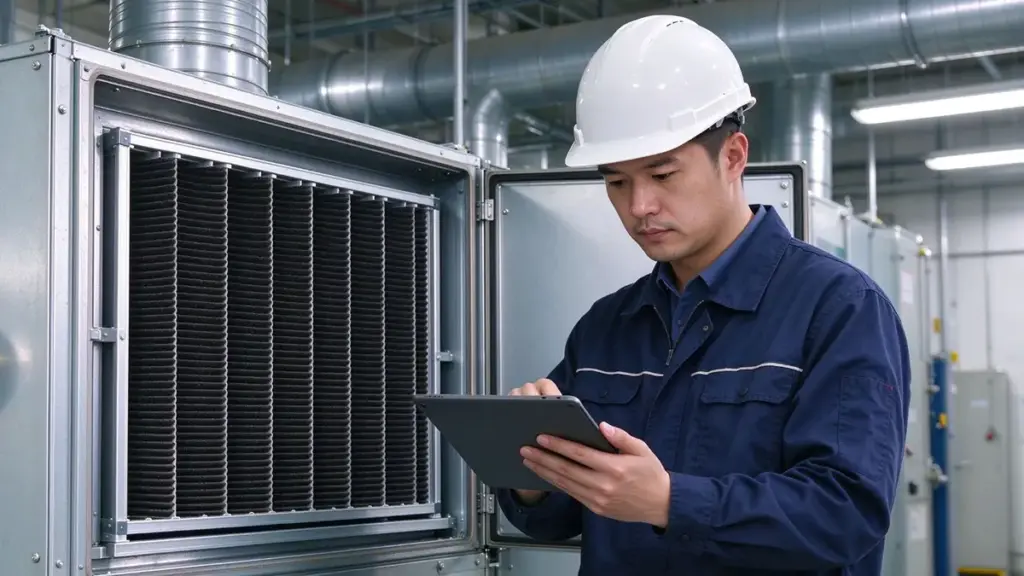
- Extraction: Open the unit access door and slide the cell collection modules out along the guide tracks.
- Chemical Soak & Rinse: Spray the collection plates with a mild, non-corrosive alkaline degreaser. Allow it to sit for 5 A 10 minutes, then flush with a low-pressure water hose from the clean-air side backward through the dirty side.
- Complete Drying (Crucial): Let the cell air dry completely in a well-ventilated area for 12 A 24 ore. Reinstalling damp cells causes short circuits, high-voltage tripping, or power pack damage.
- Re-engage: Seat the dry cells back into the cabinet matching the airflow direction arrows and latch the cabinet tight.
Domande frequenti (Domande frequenti)
1. Do commercial electrostatic air filters produce harmful ozone?
Traditional high-voltage electrostatic precipitators (ESP) could generate trace amounts of ozone if tungsten ionization wires spark due to excessive dust accumulation or poor maintenance. Tuttavia, modern commercial systems comply with strict international standards (such as UL 867 and UL 2998 for zero ozone emissions). Furthermore, advanced Micro-Electrostatic (MESP) filters utilize high-dielectric micro-channels and uniform low-intensity micro-fields, virtually eliminating corona arcing and achieving true zero-ozone operation suitable for human-occupied spaces.
2. Can an electrostatic air filter replace a traditional HEPA filter in commercial buildings?
In most commercial facilities—such as office towers, hotels, shopping malls, and schools—active electrostatic precipitators or MESP modules can effectively replace MERV 13 to HEPA filters for general PM2.5 capture and dust management. They deliver 95%+ particulate efficiency while running at roughly one-third of the air resistance, cutting fan power consumption drastically. Tuttavia, for ultra-critical cleanrooms (per esempio., Classe ISO 5 semiconductor fabs or surgical operating theaters), electrostatic filters are primarily installed as ultra-low-resistance pre-filters to prolong the service life of terminal HEPA/ULPA filters.
3. How often do commercial electrostatic cells need to be cleaned?
Under typical commercial HVAC operating conditions, aluminum ESP cells and MESP modules require washing every 60 A 90 giorni. Facilities in heavy industrial zones, commercial kitchens with grease exhaust, or high-smog urban centers may need cleaning intervals of 30 A 45 giorni. Built-in pressure sensors or power-pack warning indicators signal when the collection plates are saturated and airflow resistance begins to rise.
4. Can electrostatic air filters capture viruses and bacteria?
SÌ. Although viruses are microscopic (often 0.02 A 0.3 microns), they rarely travel alone; they attach to airborne aerosols, droplets, and dust particles measuring 0.5 A 5 microns. Active electrostatic filters capture these carrier particles with high efficiency. Additionally, the localized high-voltage electric field can disrupt microbial cellular walls and protein coats. To achieve medical-grade active room sterilization, engineers frequently combine electrostatic units with in-duct photocatalytic oxidation (PCO) or hydrogen ion devices.
5. Can active electrostatic filters be retrofitted into existing HVAC ductwork?
SÌ. Commercial active ESP and MESP modules are designed in standard modular dimensions (such as 24″×24″ or custom AHU cross-sections) to slide directly into existing filter tracks. Retrofitting typically only requires a dedicated power hookup (110V/220V AC) and minimal cabinet wiring, making them an ideal energy-saving upgrade for aging building HVAC systems without replacing existing duct runs.