Vai al contenuto

Surgical site infections remain one of the most expensive complications in hospital care, and the air above the operating table is one of the few controls the hospital fully owns. A terminal operating room HEPA filter unit sits at the end of the ventilation system and is the last component the air touches before it reaches the wound.
This guide explains why hospitals place filtration at the ceiling rather than in the plant room, and how these terminal units are built. It closes with the specifications an infection control committee should hold suppliers to.
Why Terminal HEPA Filtration Is Used in Operating Rooms
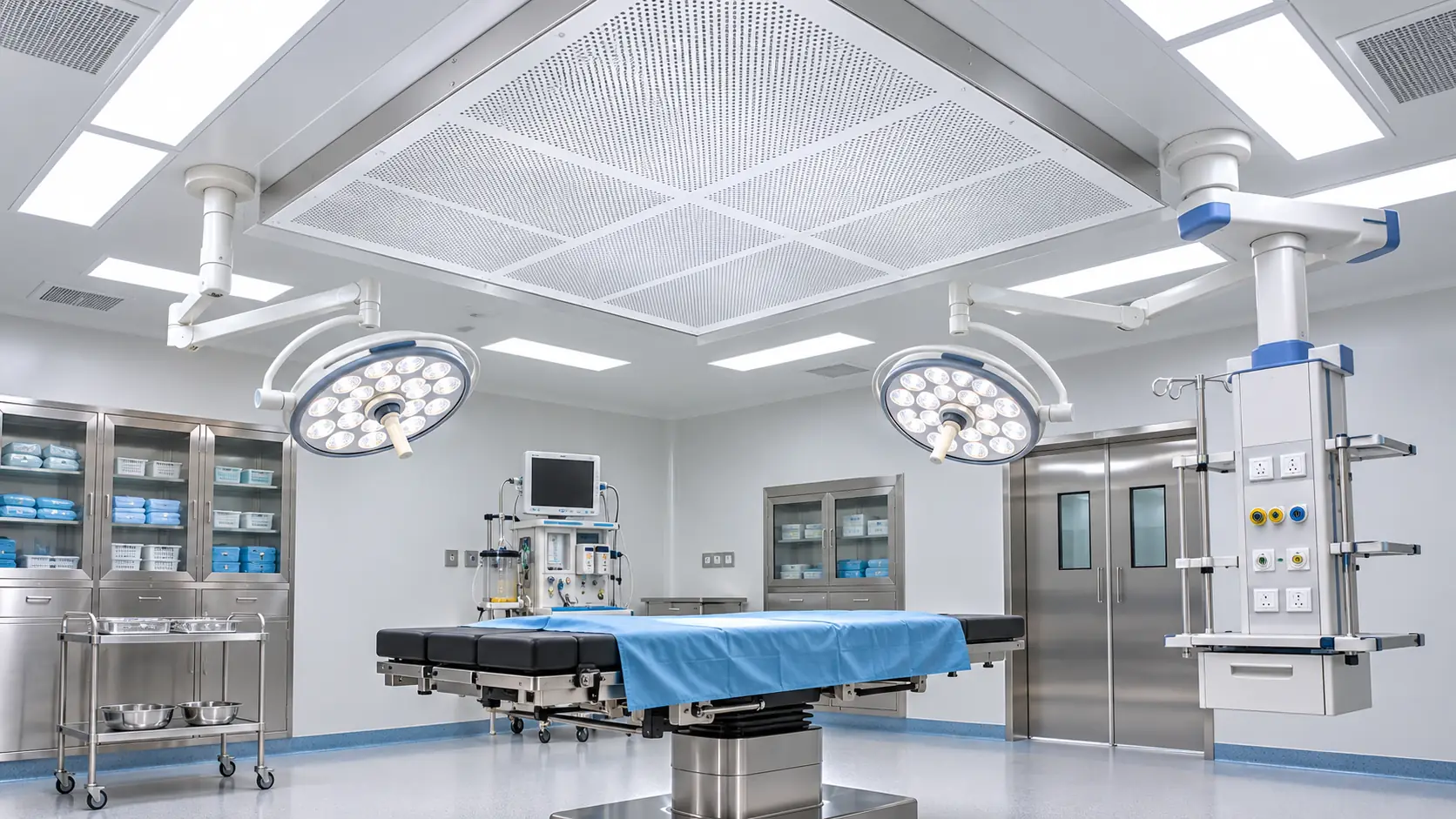
The filter at the ceiling is the last thing standing between the air and the incision.
Operating room air carries skin flakes, polvere, and droplets from everyone in the room, and each of those particles can carry bacteria into a surgical wound. Filtration at the terminal end removes these particles from the air immediately before it enters the sterile field. Placing the filter there, instead of only in the air handling plant, removes the ductwork between the clean filter and the wound as a contamination path.
Infection Control Logic
Bacteria in air ride on dust and skin flakes that are far larger than 0.3 micron, so a Filtro HEPA traps them with efficiency well above its rated MPPS figure. Viral aerosols behave similarly because they travel attached to larger droplets. The same filtration therefore protects both bacterial and viral transmission routes in the protected zone.
Standards Behind the Practice
Hospital ventilation guidance in most countries specifies terminal HEPA filtration for orthopedic and transplant surgery in particular, where the consequences of a wound infection are most severe. The specification usually covers the protected zone size, air change rate, and filter grade together rather than one number at a time. Suppliers who can document all three in one test report save the hospital committee real time during qualification.
Why the Terminal Position Matters
A HEPA filter in the plant room can be undone by a leaky duct crossing half the building. The terminal position shortens that clean path to centimeters and lets the hospital test the assembly as it operates. Infection control audits accordingly treat the ceiling unit, not the plant room report, as the reference point.
How Terminal HEPA Filter Units Are Designed
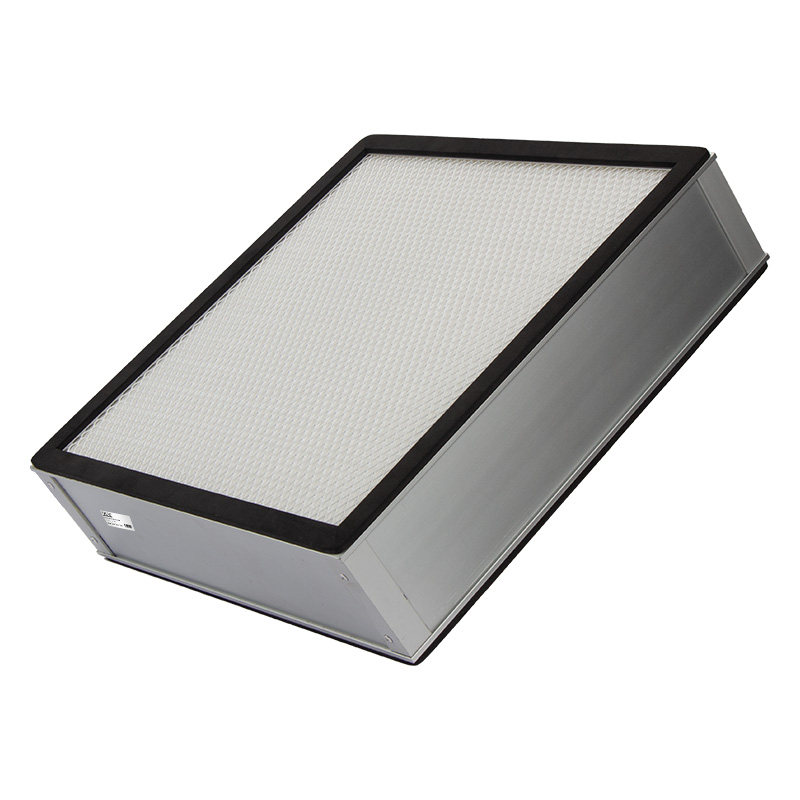
A terminal unit is a filter, a housing, a plenum, and a diffuser engineered as one sealed box.
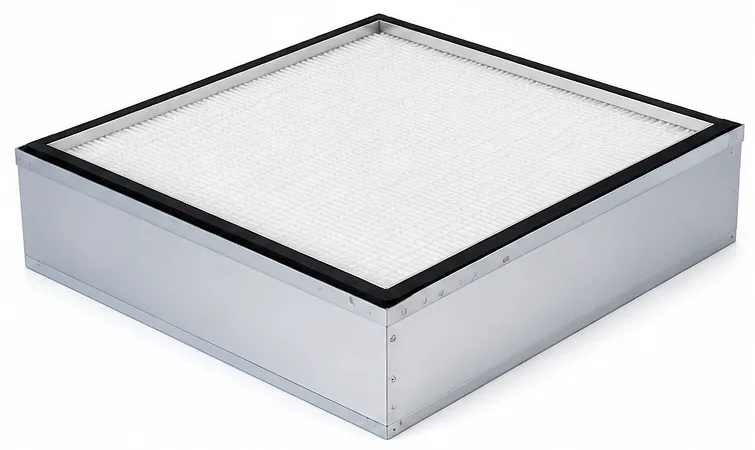
The complete assembly has four working parts. A supply duct or plenum brings filtered air to the box. The HEPA filter itself does the final cleaning, an internal plenum distributes the air evenly, and a diffuser plate hands the air to the room as a smooth sheet. Hospital versions are built for wash-down surfaces, access from the room side, and testing without removing the unit.
Housing and Access
Housings are typically powder coated steel or stainless steel with a hinged or removable diffuser so the filter can be scanned and replaced from below. Sealing between filter and housing uses compression gaskets or a gel channel, with gel sealing preferred where leakage would be intolerable. Test ports let the hospital inject aerosol upstream and scan downstream without dismantling anything.
In-place testing defines modern hospital practice. A hospital injects aerosol upstream of the filter through one port and scans the diffuser face with a probe through the room side, proving the whole assembly at operating conditions. Units designed with that workflow in mind make annual requalification a routine afternoon instead of a shutdown project.
Filter and Diffuser Interface
The diffuser does more than look tidy, because its perforation pattern sets the velocity profile under the unit. Swirl-type diffusers spread air over a wider area for mixed ventilation, while low-induction perforated plates preserve the parallel streams a protected zone needs. The filter grade inside is selected first, and the diffuser is chosen to protect the flow pattern that grade makes possible.
Ceiling-Mounted HEPA Filter Layouts in Operating Rooms
Most operating rooms put one large canopy over the table and let the room air system handle the rest.
The standard layout places a single large HEPA canopy centered over the operating table, sized to cover the wound, the instrument tables, and the scrubbed team. Peripheral air outlets around the room walls supply the lower cleanliness background. The canopy then forms a protected zone inside the room rather than a uniformly clean box.
Canopy Size and Coverage
Canopy dimensions are matched to the footprint the procedure actually uses, commonly in the range of 2.4 di 2.4 meters up to 3 di 3 meters for orthopedic work. Undersizing pulls room air into the zone at the edges, which defeats the design. Sizing therefore follows the surgeon and instrument layout, not the ceiling grid.
Layouts by Surgery Type
Orthopedic implant and joint replacement theatres specify the largest canopies because the prosthesis tolerates no contamination at all. General surgery runs a smaller protected zone with higher room air changes, and cardiac theatres fall between the two. The filter unit itself rarely changes across these layouts, which is exactly why hospitals standardize the box and vary only the canopy size.
Room-Level Coordination
Air exits through low-level extracts at the walls, and the room holds slight positive pressure against adjacent corridors. Recovery and set-up modes run higher air change rates, and the system reverts to the protected-zone pattern during surgery. The terminal filters are part of this choreography, and their airflow rating sets what the room system can achieve.
Airflow Distribution Around Terminal HEPA Filters

Clean air is only clean where it lands, and the landing pattern is designed, not automatic.
Laminar airflow sweeps a curtain of filtered air over the surgical wound, carrying particles away before they can settle in the incision. The goal is a protected zone around the operating table where the air is cleaner than the room around it. Filtered air is supplied through a large ceiling diffuser at low velocity and leaves near the floor, moving as parallel streams that do not mix much with room air. Because the streams stay parallel, particles released inside the curtain are pushed down and out instead of drifting across the table.
Vertical and Horizontal Flow Patterns
Vertical laminar flow descends from the ceiling over the table and is the standard in modern operating rooms, while horizontal laminar flow pushes filtered air across the room from one wall. Vertical systems protect the wound directly, and horizontal systems avoid obstacles above the surgical team. The two main types of laminar flow therefore suit different room geometries, and most new operating rooms specify vertical.
Mixed Ventilation and Where Filtration Still Helps
Not every theatre buys a laminar canopy, and a well designed mixed ventilation room still relies on terminal HEPA filters for all of its supply air. In those rooms the filters deliver cleanliness while diffusers add mixing, and the infection control benefit comes from air change rate instead of a protected zone. Either way, the filter specification is the same, which keeps maintenance training simple across the hospital.
Disturbances the Design Must Survive
Surgical lights, booms, and the plume of body heat under the canopy all disturb the downward stream, and the design accounts for them by adjusting diffuser velocity and canopy position. Equipment too close to the curtain edge creates entrainment that pulls dirty room air inward. Commissioning verifies the pattern with tracer tests, because drawings alone do not prove the zone.
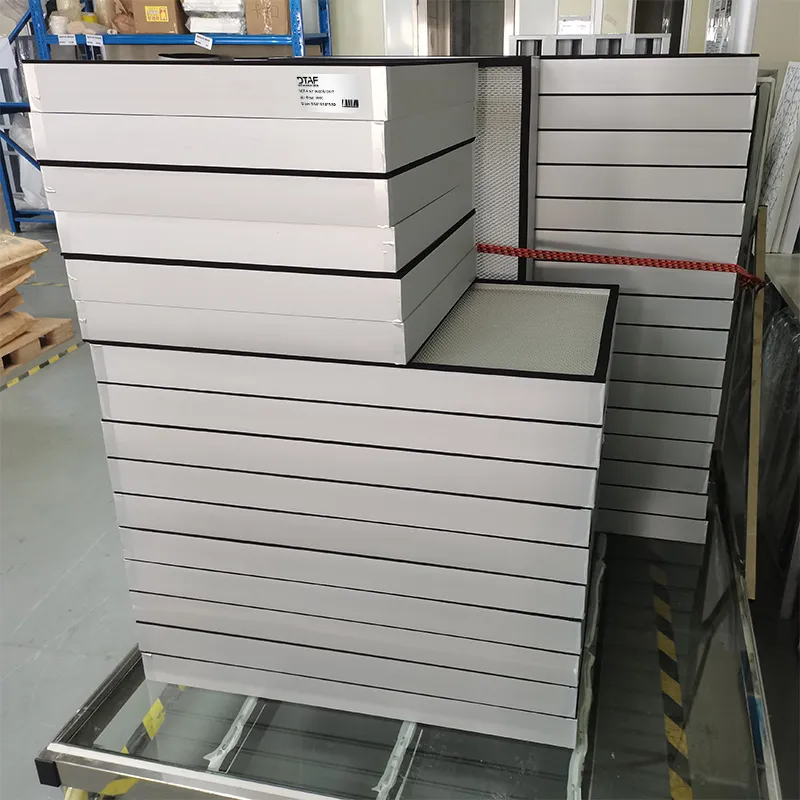
Specify the Terminal Unit Once, Supply It for Every Theatre
Key Specifications for Operating Room HEPA Filters
Hospital specifications read like containment specs: grado, leak rate, rumore, and testability.
A HEPA filter is a pleated glass microfiber filter tested to capture at least 99.97% di particelle a 0.3 micron, the historical reference size. Hospital specifications usually demand the higher H14 grade, which captures 99.995% at the most penetrating particle size. The comparison between those grades, including the pressure drop cost, is covered in our article on H13 versus H14 HEPA filters.
| Specifica | Hospital Requirement | Typical Value |
|---|---|---|
| Filter grade | Final filtration at the ceiling | H14 at 99.995% MPPS |
| Airflow per unit | Set by room air changes | 2000 A 4000 metri cubi all'ora |
| Caduta di pressione iniziale | Fan energy for the life of the filter | Around 110 A 140 Papà |
| Sigillatura | Leak-limited at the ceiling | Gel seal preferred |
| Noise | Speech and monitor limits in theatre | Around 50 dB(UN) or below |
Noise and Fan Coordination
The canopy can add resistance that the air handling unit must overcome for years, so initial pressure drop appears in tender documents next to the noise limit. A quieter theatre is also a calmer one, and surgical teams notice fan strain before facilities management does. Selecting a lower resistance H14 pack is usually the cheapest way to buy back both margin and silence.
Testing and Change-Out Practice
Operating room filters are usually replaced on a planned cycle of about three to five years, or sooner when pressure drop or an integrity test says so. Hospitals track the pressure gauge across the filter rather than waiting for a visible problem. In-place scanning after installation confirms the seat as well as the media, and hospitals that keep one frame standard across theatres simplify both stocking and testing.
The efficiency ladder behind these grades, from HEPA into ULPA territory, is explained in our guide to HEPA versus ULPA filters. Most theatres stay at H14 because the next step raises resistance and noise for cleanliness the wound cannot use. The formal HEPA definition and its capture figures are published by the US EPA, and remain the common reference in tender documents.
FAQ About Operating Room Terminal HEPA Filters
What is the role of laminar air flow in operating rooms?
Laminar airflow sweeps a curtain of filtered air over the surgical wound, carrying particles away before they can settle in the incision. The goal is a protected zone around the operating table where the air is cleaner than the room around it.
How does laminar airflow work?
Filtered air is supplied through a large ceiling diffuser at low velocity and leaves near the floor, moving as parallel streams that do not mix much with room air. Because the streams stay parallel, particles released inside the curtain are pushed down and out instead of drifting across the table.
What are the two main types of laminar flow?
Vertical laminar flow descends from the ceiling over the table and is the standard in modern operating rooms, while horizontal laminar flow pushes filtered air across the room from one wall. Vertical systems protect the wound directly, and horizontal systems avoid obstacles above the surgical team.
What counts as a HEPA filter?
A HEPA filter is a pleated glass microfiber filter tested to capture at least 99.97% di particelle a 0.3 micron, the historical reference size. Hospital specifications usually demand the higher H14 grade, which captures 99.995% at the most penetrating particle size.
Do HEPA filters catch bacteria?
Bacteria in air ride on dust and skin flakes that are far larger than 0.3 micron, so a HEPA filter traps them with efficiency well above its rated MPPS figure. Viral aerosols behave similarly because they travel attached to larger droplets.
How often should HEPA filters be changed?
Operating room filters are usually replaced on a planned cycle of about three to five years, or sooner when pressure drop or an integrity test says so. Hospitals track the pressure gauge across the filter rather than waiting for a visible problem.
Conclusione
Terminal HEPA filtration in operating rooms works because it puts the final filter directly over the wound, seals it into a testable housing, and arranges the airflow into a protected zone. The canopy layout, the flow pattern, and the specification sheet all serve the same purpose: air that reaches the incision has met nothing unclean since the filter.
Hospitals that standardize the unit size, seal type, and test procedure across their theatres get simpler maintenance and faster infection control audits. For suppliers, the ability to deliver scan-tested H14 filters in a repeatable housing interface is what wins the tender and keeps it.