Vai al contenuto

Semiconductor manufacturing requires strict control of airborne particles. Even a small particle on a 300 mm wafer can cause defects and affect product quality. This makes semiconductor cleanroom HEPA filters an essential part of contamination control in wafer fabrication facilities.
Filter performance depends on more than particle removal efficiency. Placement, flusso d'aria, filtration requirements, and integration with fan filter units (FFU), recirculation systems, and make-up air systems all affect cleanroom performance.
Why Semiconductor Cleanrooms Use HEPA Filters
Every defect map tells the same story first: particles that the air system let through.
A wafer fab is among the cleanest industrial environments on earth, with photolithography zones running at ISO 3 and below. That is cleaner than a hospital operating room by roughly two orders of volume, and the air may change completely hundreds of times per hour. The reason is yield, because at advanced nodes a particle smaller than a virus can bridge a circuit feature and kill the die.
Particles That Matter at Advanced Nodes
Feature sizes measured in single-digit nanometers put the critical particle diameter far below anything visible. Yield models track killer defect density per layer, and airborne particles are the largest single contributor that the air system can control. HEPA and ULPA filtration is the last line before that physics decides the economics of the fab.
How Far Cleanliness Actually Goes
True ISO 1 rooms are rare and mostly exist in research and metrology rather than volume manufacturing. Even advanced fabs usually stop at ISO 2 all'ISO 3, because the energy cost of the last log step outweighs its yield benefit. Zoning the fab so that only the wafer path pays for the tightest classes is what keeps the power bill survivable.
Beyond Particles: Molecular Contamination
Airborne molecular contamination, or AMC, adds a second dimension that particles alone do not capture. Acid and amine vapors from adjacent processes corrode copper lines and bake haze into photoresist, so fabs pair particle filtration with chemical filters on the recirculation path. A filter program that ignores AMC protects yield only halfway.
Where HEPA Filters Are Installed in Semiconductor Facilities

The filter map of a fab follows the airflow: make-up air, recirculation air, and the ceiling above the tools.
Outside air enters through make-up air handlers, where coarse and fine prefilters remove most ambient dust before the air ever reaches the cleanroom. From there the air joins the recirculation loop, and the final filtration happens directly above the process tools.
Make-Up Air and AHU Stages
Make-up air units carry the dirtiest air in the facility, so they are staged with panel prefilters and bag or V-Bank secondary filters sized for heavy loading. Their final stage protects the recirculation loop rather than the wafer directly. Because these units see the full outdoor dust load in every season, their filters are chosen for lifetime cost instead of for the lowest quoted price.
Fan Filter Unit Ceilings
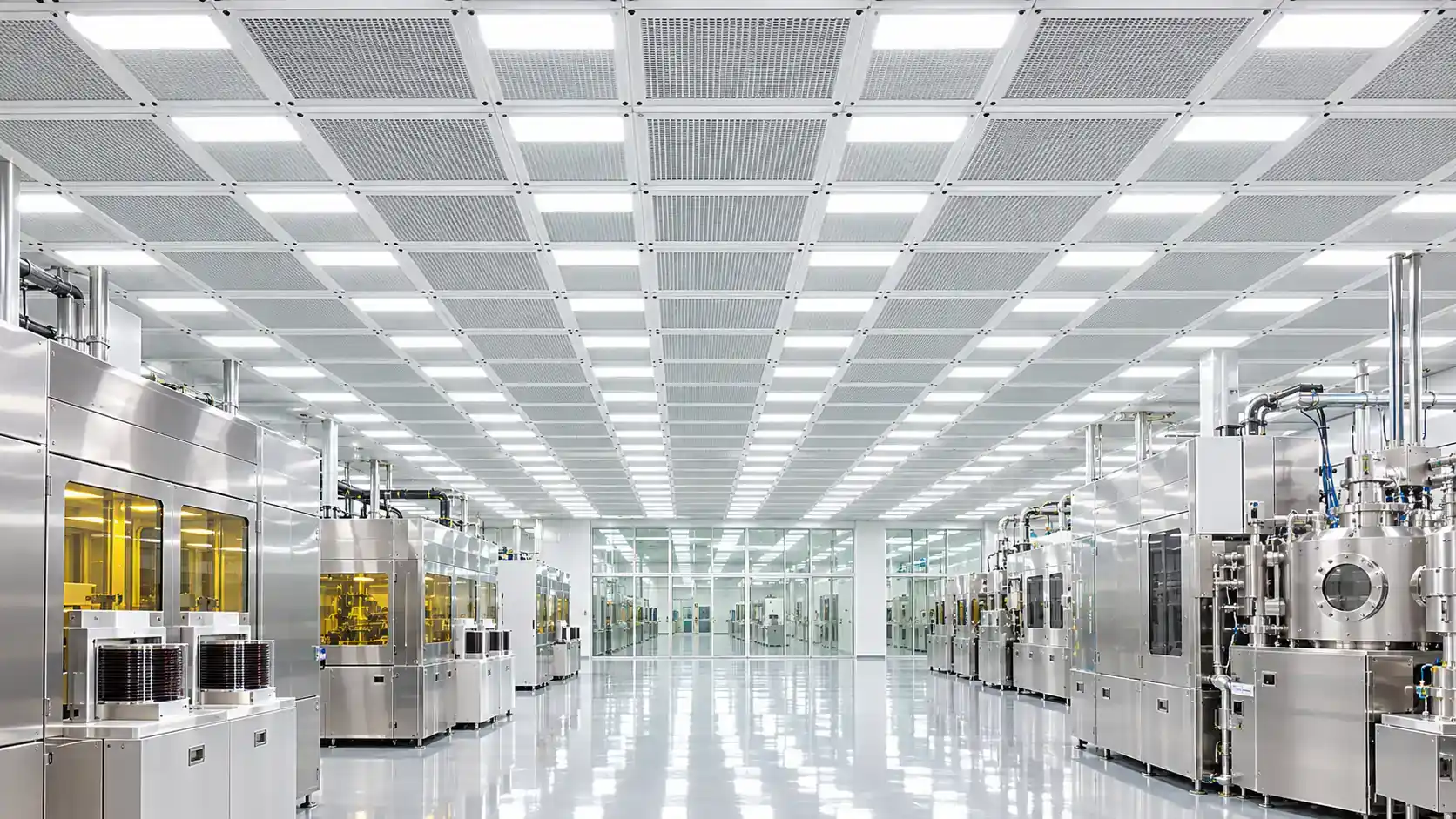
The ceiling of a modern fab is a dense grid of FFUs, each holding a final Filtro HEPA o ULPA directly above the process area. This architecture gives the fab zone level control, because each FFU can run at its own speed and be replaced without disturbing neighbors. A fab floor can hold thousands of these units, which makes filter standardization a purchasing decision of real scale.
Tool-Level Filtration
Many process tools add their own point-of-use filters inside the equipment, and minienvironments surrounding reticle stages carry dedicated HEPA or ULPA boxes. The fab filter program therefore covers three layers at once: AHU stages, the FFU ceiling, and tool-level units, each with its own grade and change-out cycle.
Key Contamination Control Requirements in Semiconductor Cleanrooms
Cleanroom performance depends on more than particle counts. Flusso d'aria, pressione, and material cleanliness also affect contamination control.
Semiconductor cleanrooms must control airborne particles, chemical contamination, and equipment vibration to protect wafer quality and production processes.
ISO 14644-1 classifies cleanrooms into nine levels based on particle concentration. The older Federal Standard 209E used a different system, where Class 100 roughly equals ISO Class 5. Critical wafer processing areas require stricter particle control than support areas, depending on the manufacturing process.
Airflow and Pressurization Discipline
Unidirectional airflow across the wafer path keeps particles sweeping downward instead of drifting, and cascaded pressure keeps cleaner zones positive against dirtier neighbors. The filter ceiling provides both, which is why face velocity uniformity is a qualification item in its own right. A filter that distributes air unevenly creates turbulence pockets where particles linger.
Chimico, Vibration, and Outgassing Limits
Filter materials must not add contamination of their own, so low-outgassing media, stainless or aluminum frames, and non-shedding sealants are specified for fab duty. Gel seal systems earn their premium here, because they avoid particle release from compressed gaskets and tolerate the constant vibration of a 24 hour fab. Instruments confirm that the filter is not a source of amines, sulfur, or volatile silicones.
Key HEPA Filter Specifications for Wafer Fabrication
Wafer fabs buy filters against MPPS data and test reports, not against brochure efficiency claims.
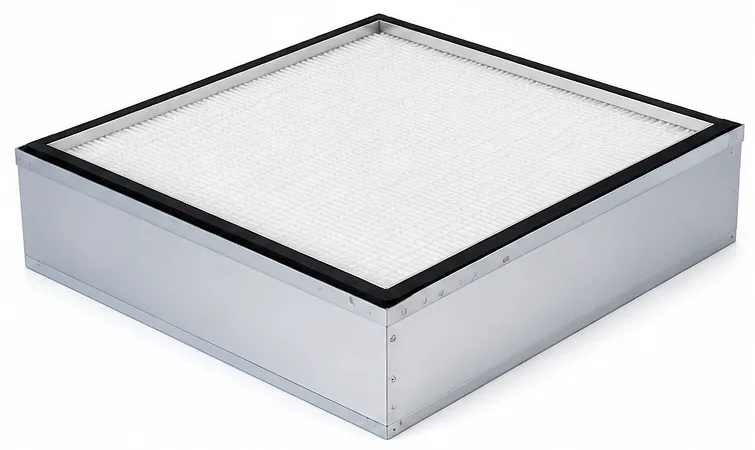
A fab qualification package for a final filter normally includes MPPS efficiency per ISO 29463 or EN 1822, initial resistance at rated flow, zona multimediale, materiale del telaio, seal type, and a scan test report for the individual filter. The table below collects the values that appear in most fab specifications for ceiling and FFU filters.
| Specifica | Fab Practice | Typical Value |
|---|---|---|
| Grado di efficienza | H14 for process zones | H14 at 99.995% MPPS |
| ULPA upgrade | Lithography and metrology points | U15 or U16 grades |
| Initial resistance | Chosen for FFU fan headroom | All'incirca 100 A 130 Papà |
| Frame and media | Low outgassing, corrosion safe | Aluminum frame, glass microfiber |
| Sigillatura | Leak-tight for years of uptime | Gel seal preferred |
Grade Selection by Zone
Fabs typically plan HEPA replacement around three to five years, driven by pressure drop and scheduled integrity testing rather than visible loading. Constant full recirculation and strict prefiltration are what make those long intervals possible. Grade selection follows the same zoning: H14 for most process ceilings, U15 and above where lithography sensitivity demands it, and H13 in less critical support space.
Reading the Test Report
Filtri ULPA, graded U15 and above, remove smaller and more particles than HEPA, capturing at least 99.9995% at the most penetrating size. Fabs use them in the tightest lithography and inspection points where even sub-0.1 micron particles would ruin a yield calculation. IL 0.3 micron figure comes from early tests that measured near the most penetrating particle size, where particles are hardest to catch.
Modern standards rate filters at that most penetrating size directly, which is why datasheets now quote MPPS efficiency instead of one number at 0.3 micron. Every filter delivered to a fab should carry its own scan result, and buyers who want the grading logic in one place can start with the ISO 14644 standards family page at IEST.
Filter Standardization Across a Fab-Scale Ceiling
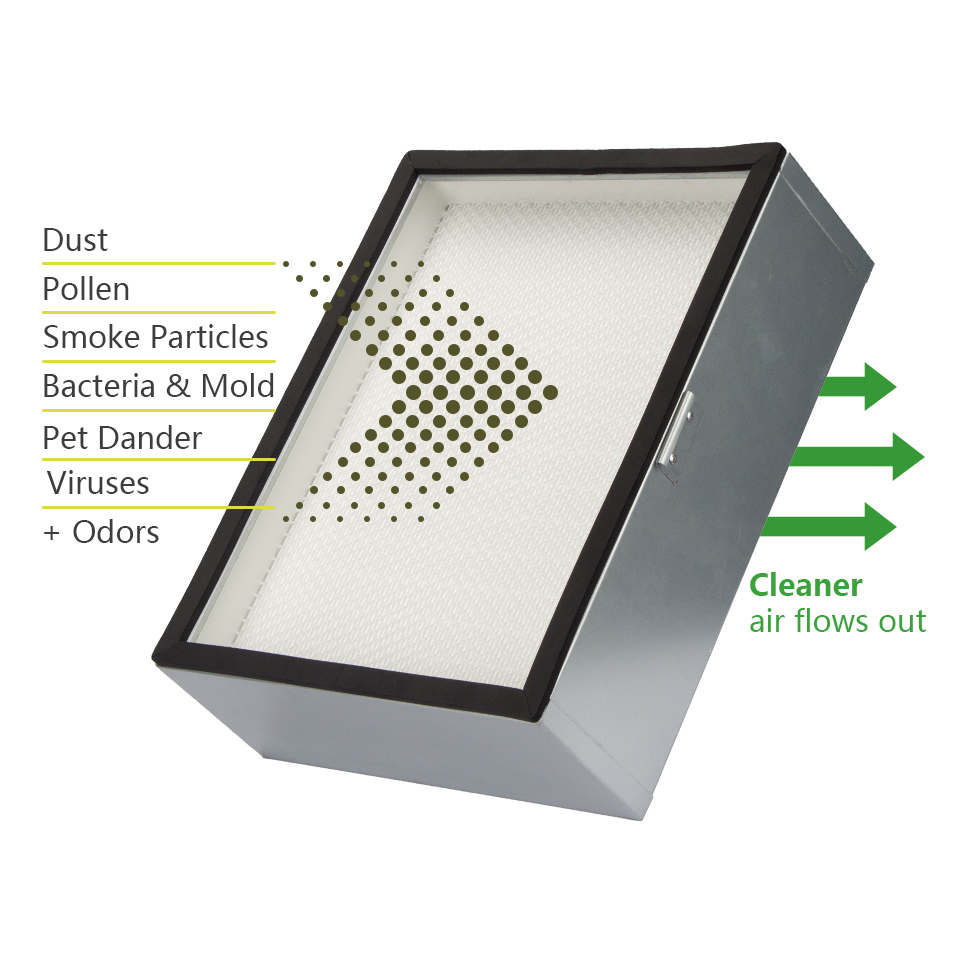
HEPA Filter Integration with FFU and HVAC Systems
In a fab, the FFU ceiling is the filter program, and the AHU exists to feed it clean air.
HEPA filters do their final work inside FFUs or filter boxes at the ceiling, so integration decisions are really decisions about those housings. Room-side pressure balance, filter depth, and the fan curve of each unit all interact with the choice of filter grade and resistance.
Matching Filters to FFU Fans
A DC FFU with an electronically commutated fan holds airflow constant as media loads, which makes initial resistance the key compatibility number. Pairing a low resistance H14 pack with a modern DC HEPA fan filter unit leaves the widest speed range for compensation, and that range is what converts into years of stable airflow between change-outs.
Change-out planning runs at fab scale as well. Replacing hundreds of ceiling filters is scheduled zone by zone so that a process area is never opened wider than necessary. Every new filter arrives with its scan report matched to the purchase line. Facilities that keep one frame standard across the ceiling turn this from a project into a repeat purchase.
Recirculation, Make-Up Air, and Chemical Filtration
The recirculation loop carries the ceiling filters, while make-up air replaces process exhaust and pressurization losses through its own staged filtration. Chemical filters for AMC ride alongside both stages where the process demands it.
For the grading rules behind these stages, our article on how to select HEPA and ULPA filter grades works through the same logic for any cleanroom type, and the EN 1822 versus ISO 29463 question is covered separately in this comparison of the two standards. Buyers weighing grade options can also start from H13 versus H14 HEPA filters before locking a fab specification.
FAQ About Semiconductor Cleanroom HEPA Filters
What type of air filters are used in semiconductor cleanrooms?
Semiconductor cleanrooms commonly use HEPA and ULPA filters to control airborne particles. HEPA filters provide high-efficiency particle removal, while ULPA filters offer even higher efficiency for applications with stricter cleanliness requirements. The selection depends on the required cleanroom class, airflow design, and manufacturing process.
What is the difference between HEPA and ULPA filters?
HEPA and ULPA filters differ mainly in their particle removal efficiency. Under the EN 1822 classificazione, H14 HEPA filters have a minimum overall efficiency of 99.995% at the most penetrating particle size (MPPS), while U15 ULPA filters reach at least 99.9995%. ULPA filters are used where higher filtration efficiency is required.
Why is 0.3 microns used to rate HEPA filters?
The 0.3-micron figure is traditionally used in HEPA filter testing because it approximates the most penetrating particle size (MPPS) for many filters. Particles at or near this size can be more difficult to capture than larger or smaller particles. Actual MPPS values vary with filter design and test conditions.
How do you select HEPA or ULPA filters for a semiconductor cleanroom?
Filter selection should consider the required ISO cleanliness class, efficienza di rimozione delle particelle, airflow volume, caduta di pressione, and installation design. Critical wafer processing areas may require higher-efficiency filtration than support areas. Filter dimensions, sealing methods, and compatibility with the air handling system should also be checked.
How often should cleanroom HEPA filters be replaced?
There is no universal replacement interval for semiconductor cleanroom HEPA filters. Maintenance teams should monitor pressure drop, airflow performance, and filter integrity through routine inspections and testing. Filters should be replaced when they are damaged, fail integrity tests, or can no longer meet the required operating specifications.
Conclusione
Semiconductor cleanrooms push filtration to its limits because the product cannot survive a single escaped particle. Filters are installed in three layers, from make-up air staging to the FFU ceiling to tool-level units. Each layer is qualified against MPPS efficiency, low outgassing, and leak-tight sealing rather than price alone.
For buyers assembling a fab filter specification, the fastest path is to standardize one frame and seal across each layer, then demand individual scan reports from a manufacturer that tests every unit. That discipline turns thousands of ceiling filters into one predictable, auditable program.