A carbon filter inside a commercial air handling unit rarely announces the day it stops working. The fan still runs, the gauge still reads a number, and air still moves through the rack at roughly the design rate. Yet the capacity that was capturing solvent odor or kitchen vapor may already be finished, because chemical exhaustion and airflow restriction are two separate events on two separate clocks.
That distinction is where most commercial HVAC activated carbon filter replacement programs go wrong. Teams inherit filters somebody else specified, apply a dust-filter habit to gas-phase media, and then either change carbon twice as often as needed or run it a season past the point of protection. This guide covers what spends carbon, the signs that media is spent, what a gauge can and cannot prove, how to monitor breakthrough, and how to build a schedule your own records support.
Why Is Carbon Filter Life Difficult to Predict?
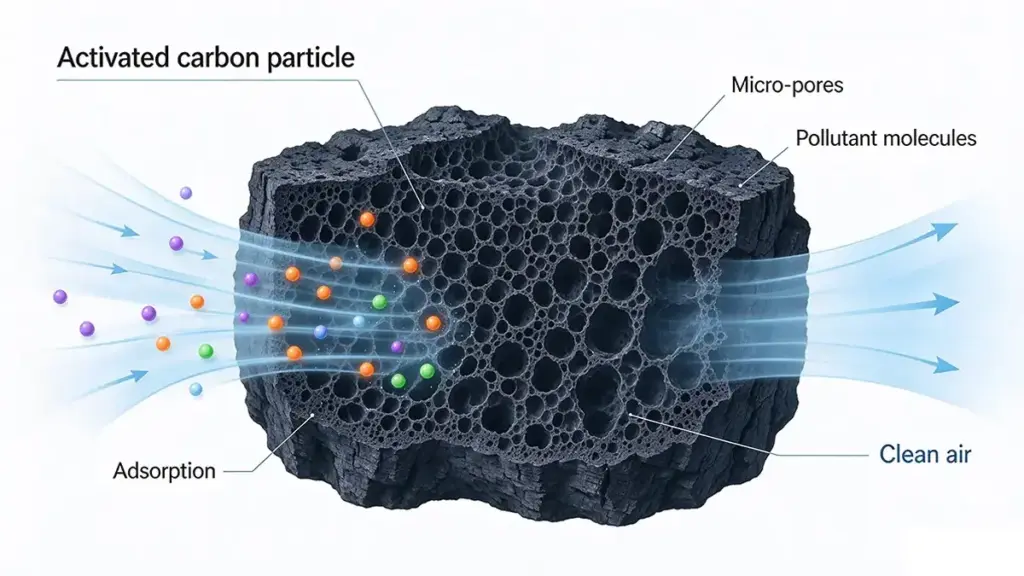
Carbon life depends on what the bed has absorbed, not on how long it has been installed.
A particulate filter fails in a way you can see. Carbon does not, because the pollutant sits inside pores you cannot inspect, in quantities too small to change the look or weight of the panel.
Capacity Is Consumed Silently
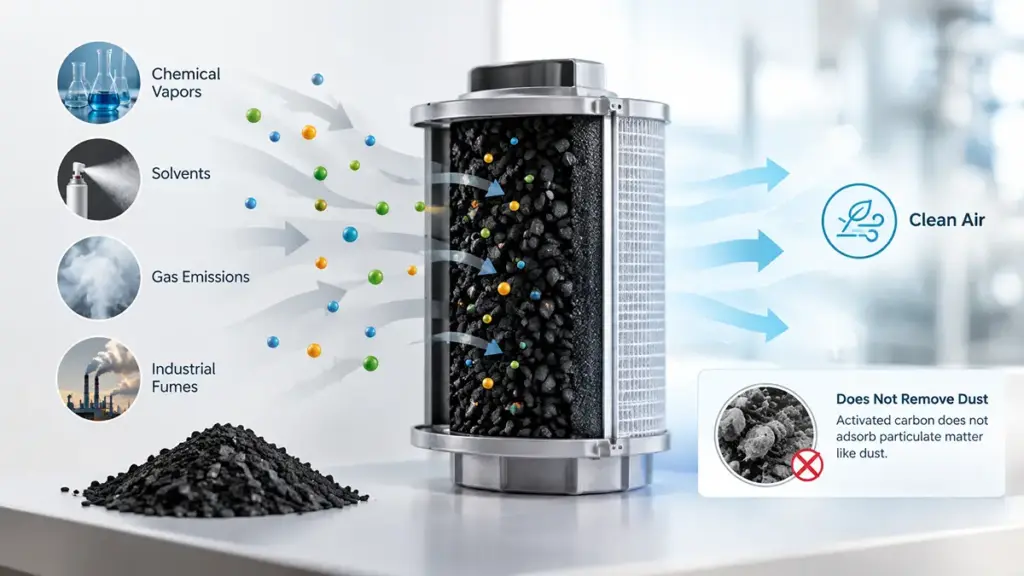
Contaminant molecules bind to the internal surface of the carbon, which runs to hundreds of square meters per gram. As that surface fills, removal efficiency holds nearly flat, then falls quickly once the adsorption zone reaches the outlet face. The panel that pulled 90% of a target compound on Monday can be at 20% by Friday with no visible change.
Load History Beats the Calendar
The honest predictor is cumulative mass captured: inlet concentration, multiplied by airflow, multiplied by operating hours. Two identical panels installed in the same month can diverge by months of service, because one protects a coating booth that runs in bursts and the other an office floor with stable background VOC. An interval copied from another site is a guess with a date attached.
Media Grade and Bed Depth Set the Ceiling
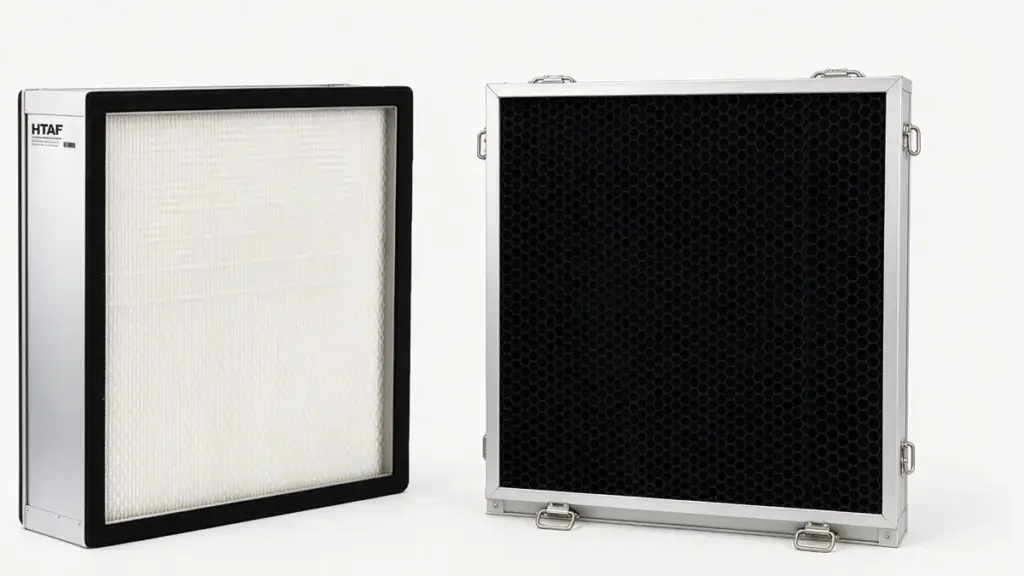
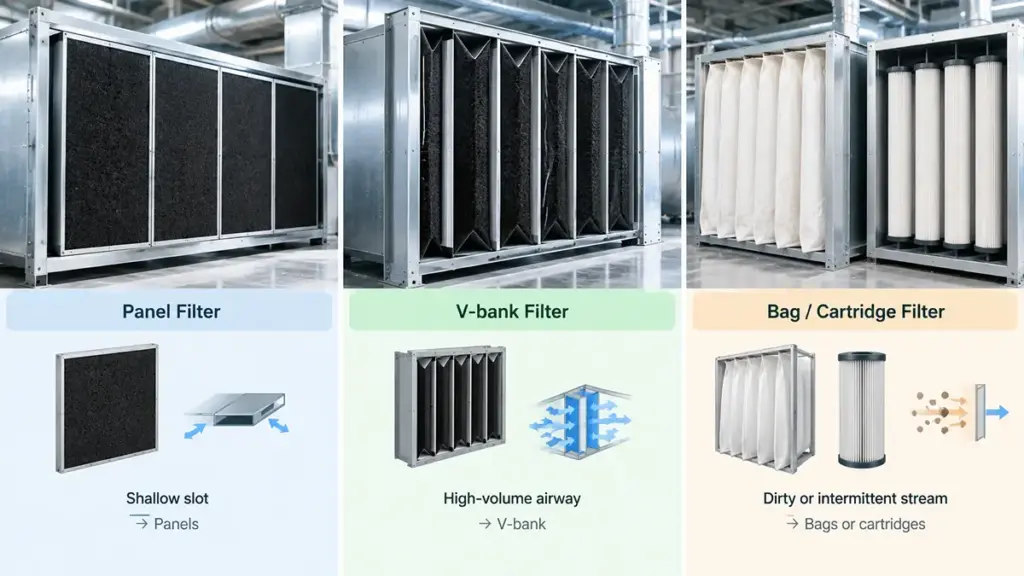
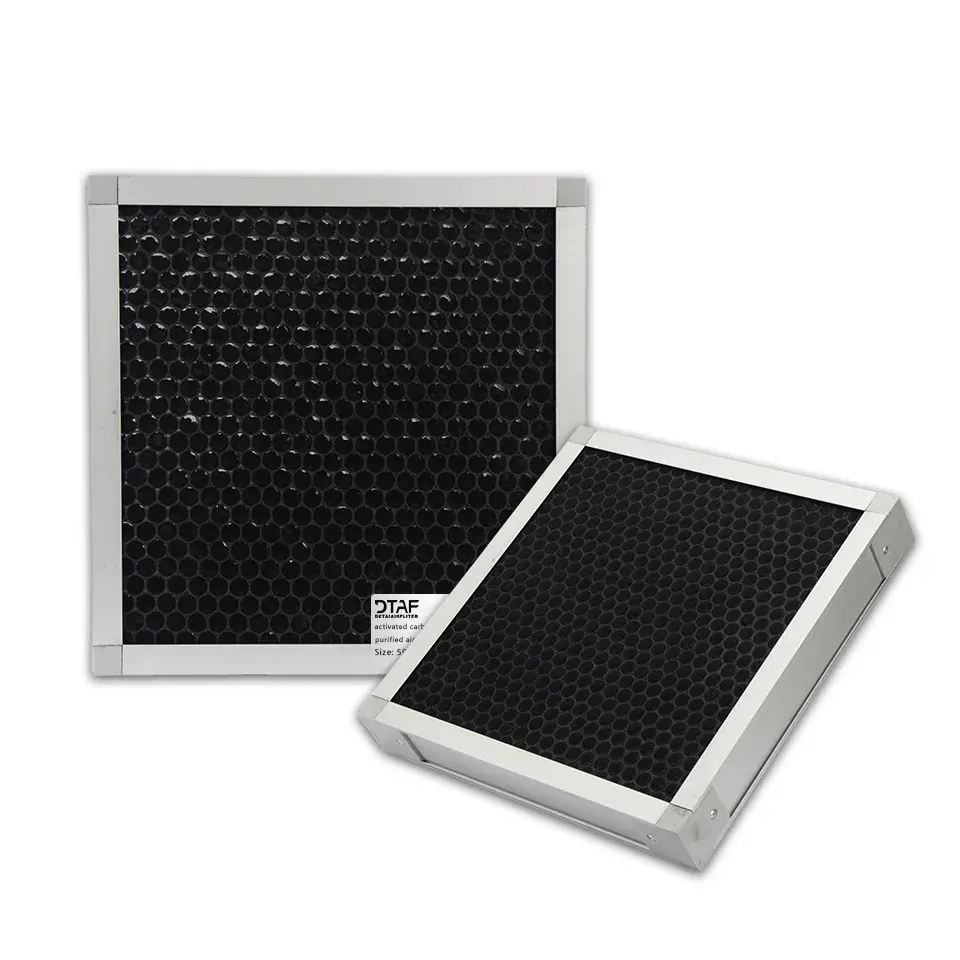
Carbon mass per unit area is the budget, and it is fixed at purchase. Our plate-type media runs from carbon cotton, at least 50% carbon by weight with benzene adsorption above 20%, to honeycomb granular beds carrying far more carbon in the same footprint, in thicknesses from 25 mm to 100 mm. Deeper beds buy hours rather than efficiency, which is why matching carbon format to housing and load is the first lifecycle decision and the one you cannot revise without a new rack.
Which Factors Shorten Service Life?
Humidity, heat, dust and load spikes spend carbon early, and most buildings run several at once.
Identify which of these is active in your system before you schedule anything. Each shortens life by a different mechanism, and each has a different fix.
Humidity Is the Quiet Capacity Thief
Water vapor competes for the same micropores as the target gases. Our carbon media is specified for 35 à 65% relative humidity, with the datasheet stating that excessive humidity reduces adsorption capacity. The U.S. EPA’s carbon adsorber guidance puts a figure on it: above roughly 75% relative humidity, efficiency can fall by about 30%, and a wet bed invites microbial growth.
Temperature Outside the Rated Band
Adsorption is exothermic and reversible, so heat pushes molecules back off the surface. Our plate-type media is rated from 5 to 55°C. Air that arrives warm holds less captured contaminant at the same carbon mass, which matters for units pulling tempering air in summer or sitting close to a process exhaust.
Dust Loading and Missing Prefiltration
Carbon panels are usually the last media stage before supply air, so anything earlier stages miss lands on the carbon face. Particulate does not consume adsorption sites, but it blinds the surface, raises resistance, and lengthens the path molecules travel to reach fresh carbon. Skipping prefilter changes means replacing carbon twice for reasons unrelated to the carbon.
Concentration Swings and Competitive Displacement
Carbon is a dilute-stream technology. It handles small amounts of pollutant well and is overwhelmed quickly by large ones, so a solvent spill, a re-coating campaign, or new flooring installed during occupied hours can consume weeks of capacity in one shift. Displacement makes it worse: strongly held compounds push weaker ones already captured back into the air stream. The mechanism is covered in our breakdown of how breakthrough differs from saturation.
What Are the Signs of Carbon Saturation?
Breakthrough is the only honest signal: the pollutant you paid to remove reappears downstream.
Saturation is not a property you can measure on the filter. It is a condition of the air leaving it, so every reliable sign compares inlet against outlet.
Odor Returns on the Protected Side
The first practical indicator in most buildings is smell, and it is missed because people check the wrong place. Sampling in the mechanical room tells you the carbon is holding something; sampling at the supply diffusers tells you whether the space is still protected. Note the timing too: odor that appears only during the second kitchen shift points at a load problem, not an exhausted bed.
Outlet Concentration Climbs Against a Stable Inlet
Where a detector is available, measure both sides of the bed on the same run at the same airflow. If the inlet is steady and the outlet is rising, the bed is through, and the trend tells you how fast. This is the reading EPA guidance treats as the primary indicator of exhaustion. A single high outlet reading is an event; three rising readings at a fixed interval is a replacement decision.
Efficiency Drifts Before It Fails
Between working and spent sits a period of partial exhaustion where the adsorption zone migrates toward the outlet face and removal falls gradually, then quickly. In sensitive spaces that drift shows up as complaints before it shows on an instrument: a lobby that used to neutralize street odor in minutes now takes half an hour.
Can Pressure Drop Indicate Carbon Exhaustion?
Pressure drop proves the bed is loaded with dust. It does not prove the carbon is spent.
This is the most common maintenance error with gas-phase media, and an understandable one, because for a particulate filter the gauge really is the answer.
What a Rising Gauge Actually Measures
Differential pressure responds to particulate captured in the media, to the face blinding over, to depth loading in a honeycomb bed, and to airflow changes when dampers or belts have been touched. Notre plate-type activated carbon filter is published with an initial resistance of 50 à 90 Pennsylvanie, lower for carbon cotton and higher for honeycomb panels, and a recommended final resistance of 180 à 220 Pennsylvanie. Those are airflow and energy limits, and they are about dust.
Why a Spent Bed Can Look Perfect
The mass of VOC captured before breakthrough is often tiny relative to the weight of the panel. A filter saturated with toluene can show almost no change in resistance while removing nothing. If your trigger is a gauge reaching its limit, the carbon stage runs on a dust schedule, and part of every cycle becomes wasted media or, more expensively, failed protection.
How to Use the Final Resistance Limit Correctly
Keep the pressure reading, but give it the right job. Our specification states the position directly: saturation is best determined by gas detection, and pressure drop is for reference only. Use the 180 à 220 Pa band to trigger the mechanical review, catch a failed prefilter, protect fan energy, and flag bypass when resistance suddenly falls. Use outlet readings to decide when the carbon itself is finished and should be replaced.
Put Your Carbon Stage on Evidence, Not on a Calendar
How Should Odor and VOC Breakthrough Be Monitored?
Choose the cheapest method that still answers one question: is the protected space still inside its limit?
Monitoring is a budget decision, not a purity test. A supermarket does not need the instrumentation of a laboratory building, and pretending otherwise is how programs get abandoned in month three.
A Monitoring Hierarchy You Can Afford
| Method | What It Tells You | Blind To | Fits |
|---|---|---|---|
| Odor check at the supply diffusers, fixed route and time | Whether the space is still protected | Odorless compounds, low concentrations | Restaurants, retail, offices |
| Handheld PID or detector tubes at bed inlet and outlet | Removal efficiency across the bed | What happens between visits | Contractors, multi-site facilities |
| Fixed analyzer or continuous VOC sensor on the outlet | Exact breakthrough time, with an alarm | Calibration drift if unmaintained | Salles blanches, labs, pharma |
| Series lead and lag stages with a sampling point between | Front-stage breakthrough while the rear holds | Costs a second rack and added resistance | Critical control, no-release duty |
Recordkeeping Is the Cheapest Sensor You Own
EPA guidance on carbon adsorption leans on two unglamorous practices: keep operating records, and check for breakthrough periodically rather than only when someone complains. A log of dates, flux d'air, humidity notes and whatever readings you can take becomes the best predictor you have by the second cycle, and it turns the supplier conversation from “how long does this last” into “here is my load history, what interval does your model give.”
Series Beds for Critical Duty
Where an excursion is unacceptable, put two carbon stages in series and sample between them. When the sampling point shows the target compound rising, the front stage has broken through while the rear stage still protects, so you change the front stage and move the partially used rear stage forward. That is a real safety margin, paid for with a second rack and added resistance.
How Can Facilities Build a Replacement Schedule?

Start conservative, log every change, and let your own data tighten or extend the interval.
A schedule is not a date. It is a rule with evidence behind it, and the first version is allowed to be wrong as long as it is written down and tested.
Set a Baseline Before You Guess
Collect six inputs before the first unit goes in: design and measured airflow, the target pollutant and a realistic inlet concentration, the temperature and humidity range, the carbon mass and media type from the datasheet, daily operating hours, and what the space is protected from. That is the same dataset a good RFQ needs, which is why our carbon filter selection guide is worth working through before the first purchase. With those six fields a supplier can model bed life; without them, anyone quoting a number is guessing.
The Replacement Log That Makes Decisions Easy
Keep one row per filter position, not per purchase order. Ten fields, filled in at the moment of the change, and the third cycle of your schedule writes itself.
| Field | Why It Earns Its Place | Example Entry |
|---|---|---|
| Rack position and AHU ID | Building averages hide the worst unit | AHU-3 / carbon stage B |
| Format, media type, carbon mass | Makes cycles comparable across purchases | 50 mm honeycomb, 6.4 kg |
| Install date and hour-meter reading | Hours drive load, not calendar days | 14 Mar / 21,480 h |
| Initial resistance at install | Your dust baseline for this rack | 62 Pa at design airflow |
| Condition notes: RH, temperature, events | Explains a short cycle without blaming media | Two weeks above 75% RH |
| Outlet or odor readings at each check | The trend that defines your trigger | 4 / 9 / 21 ppb at 30-day checks |
| Final resistance at removal | Separates dust problems from carbon ones | 148 Pennsylvanie, under the 180 Pa limit |
| Trigger that ended the cycle | Tells you which rule to revise | Odor at diffusers, second shift |
| Removal date, crew, hours in service | Turns cycles into cost per protected hour | 2 Aug / 3,140 h in service |
| Disposal route and ticket reference | Closes the record for an audit | Licensed carrier, ticket 44821 |
Adjust for Seasonal and Event Loads
Shorten the interval for the season, not for the year. A unit that runs comfortably in March may be finished in August, when humidity is high, the space is full, and the fresh-air damper is open. Run two intervals on the same positions, a normal cycle and a summer or event cycle. Add a coating line, a new kitchen, or adjacent construction, and reset the log: the old history no longer describes the air the carbon sees.
How Should Used Carbon Filters Be Handled?
A spent carbon filter is a container of concentrated pollutants, not ordinary trash.
Everything the bed captured is still inside it, waiting for heat or displacement to release it. EPA guidance on spent carbon is explicit that the material should be characterized and routed to reclamation or approved disposal rather than treated as general waste. Your obligations are set by local rules and by what your process contributes, so confirm the classification with your environmental officer before the first change-out.
Change-Out Practice That Keeps the Record Clean
Bag or seal each element as it comes out, keep removed media in a closed container away from heat and sun, and label it with position, removal date, and the pollutants the stage serves. Photograph the old filter in the rack before you pull it; that image resolves later arguments about bypass, missing gaskets, and whether the media was the specified grade. Crews should treat the carbon face as contaminated and avoid shaking panels to clear dust.
Regeneration Is a Vendor Decision, Not a Shortcut
Bulk spent carbon can be reactivated industrially, in kilns that drive off captured compounds and restore pore structure. For HVAC panels the economics rarely close: carbon mass per element is small, contamination is mixed, and frame and binder must be separated first. The field version does not work. Sun-baking a panel or washing carbon cotton releases some surface volatiles and damages the media without restoring capacity.
How to Reduce Lifecycle Cost Without Extending Use Unsafely
Cut the cost per protected hour. Do not cut it by running a spent bed another quarter.
Cost pressure is legitimate, and there are three honest places to find it, all upstream of the change-out decision.
Split the Cost Into Media, Labor, and Energy
A replacement cycle has four costs: media, labor, fan energy, and the exposure of running protection that has already failed. The last is invisible on a purchase order, which is why facilities routinely pay for it. On energy, media selection matters more than operators expect: because we make our own filter media, our panels are engineered for low initial resistance, and the figure we publish for that work is a 10% à 30% reduction in blower consumption.
Buy Life the Honest Ways
More carbon mass in the rack, a prefilter stage maintained ahead of the carbon, lower face velocity through a larger filter face, and media chemistry matched to the specific gas rather than to a general odor claim. The fourth costs the most: standard carbon covers most VOC duty, while ammonia, hydrogen sulfide, and acidic gases need impregnated media, and the wrong chemistry reads as a short-life mystery. For older AHUs, exact-size replacement matters, since our OEM retrofit tolerance is ±1 mm and a sloppy fit means air bypassing the media.
Where Over-Sizing Costs More
The opposite failure is just as common: buying the deepest bed available for a rack and airflow that cannot support it. Our carbon range spans four formats with initial resistance ceilings from about 45 Pa for pleated panels to 120 Pa for inline cylinders, and each step trades fan energy for capacity. Size the bed against the blower budget and the real load, then let the log say whether the next cycle needs more carbon or less.
Foire aux questions
How long do activated carbon filters last in commercial HVAC systems?
There is no honest fixed answer, and any number quoted without your load data is a guess. Life is set by cumulative mass captured, so it moves with inlet concentration, flux d'air, operating hours, humidity, and carbon mass. We publish media specifications rather than service-life months. Start with a conservative interval, log each change per position, and revise after the second cycle.
How can you tell when an activated carbon filter is saturated?
Measure the outlet, not the filter. The reliable signs are the target odor reappearing at the supply diffusers, outlet concentration rising while the inlet stays stable, and efficiency drifting down between checks. Color, poids, and the look of the media say nothing about adsorption capacity.
Does pressure drop indicate that activated carbon is exhausted?
Non. Rising resistance reports dust loading and airflow conditions, while the mass of VOC captured before breakthrough is usually too small to move a gauge. Our specification states that saturation is best determined by gas detection and pressure drop is for reference only, with 180 à 220 Pa as an airflow limit.
What causes early carbon breakthrough?
High humidity competing for the same pores, air temperature above the media window, a neglected prefilter, a one-off solvent or coating event, stronger compounds displacing weaker ones, face velocity above the design point, and bypass around the frame. Some are specification problems and the rest are maintenance problems, which is why a short cycle should be logged with its cause.
How do VOC concentration, humidity, and airflow affect service life?
Concentration and airflow set how many grams of contaminant reach the bed per hour, so doubling either roughly halves the time to the same captured mass. Humidity works differently: water vapor occupies micropores and reduces how much carbon is usable, which is why our media is specified for 35 à 65% RH. Higher airflow also shortens contact time.
Can activated carbon filters be regenerated or reused?
Bulk spent carbon can be reactivated in high-temperature kilns run by specialist facilities, and EPA guidance routes spent carbon toward reclamation or approved disposal. That process is not practical for HVAC filter panels: carbon mass per element is small, contamination is mixed, and the frame and binder must be separated first. Sun-baking, washing, or vacuuming do not restore adsorption capacity.
How should a facility set a replacement and monitoring plan?
Six inputs first: flux d'air, target pollutant and likely inlet concentration, humidity and temperature range, carbon mass from the datasheet, operating hours, and what the space is protected from. Then set a conservative interval, pick a monitoring method matched to the consequence of failure, and revise from your own trend rather than a general guideline.