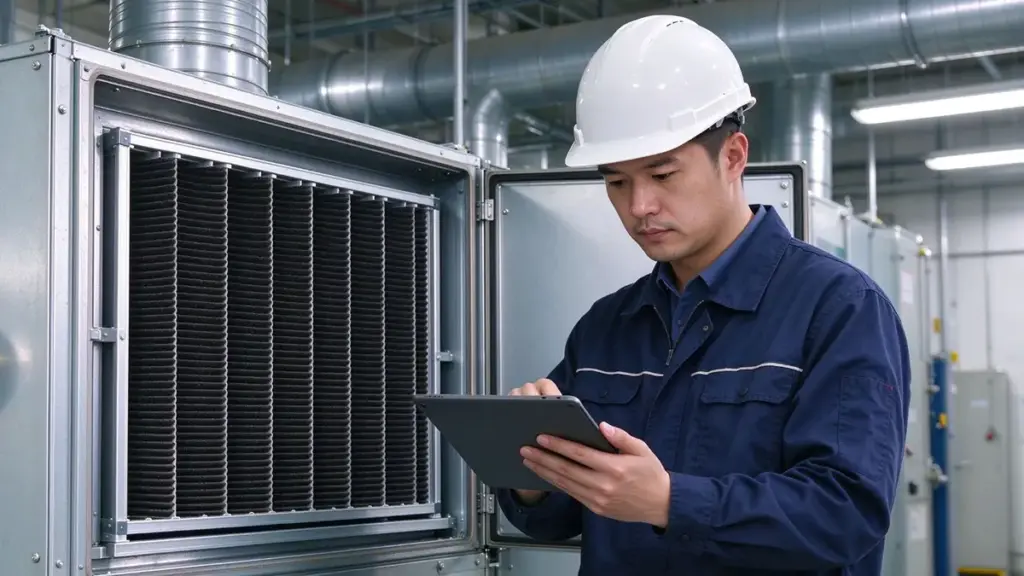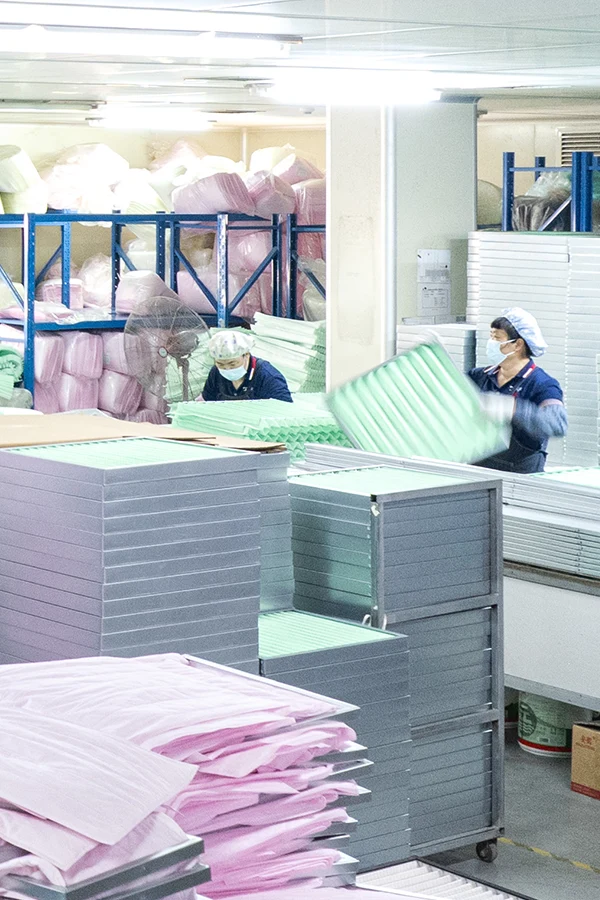
A facility that changes its HEPA cartridge on schedule and still smells solvent has not bought the wrong filter. It has asked one stage to do two jobs. The HEPA vs activated carbon filter question is not about grade, price or brand. It is about what the media is physically built to stop.
One stage is a mat of fine fibers that strains solid particles out of the airstream. The other is a bed of porous carbon that holds gas molecules on its internal surface. Neither does the other’s work reliably. This guide separates the two families, shows how each is specified, where each fails early, and how to sequence them so the cheap media protects the expensive one.
HEPA and Carbon Capture Different Pollutants
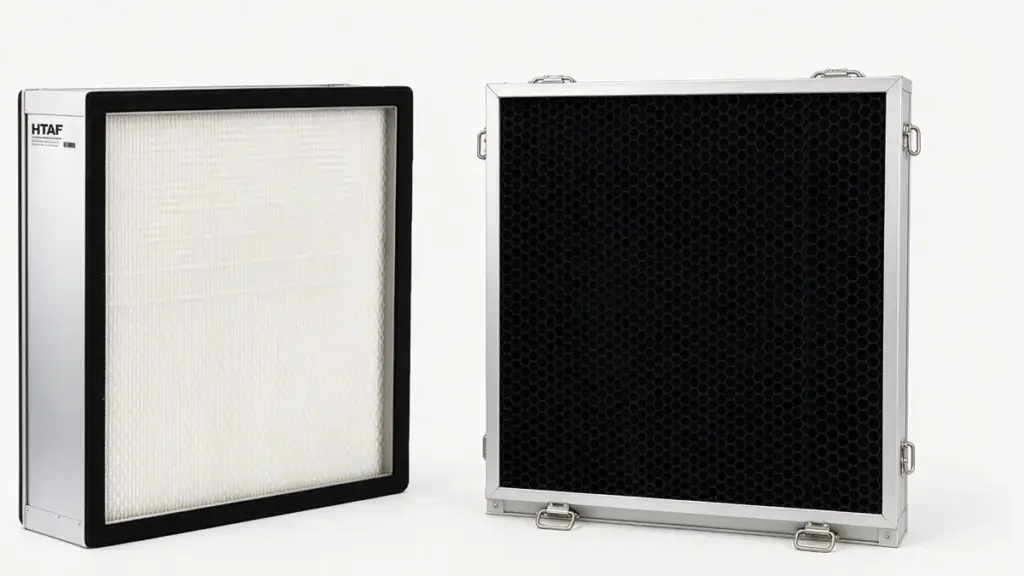
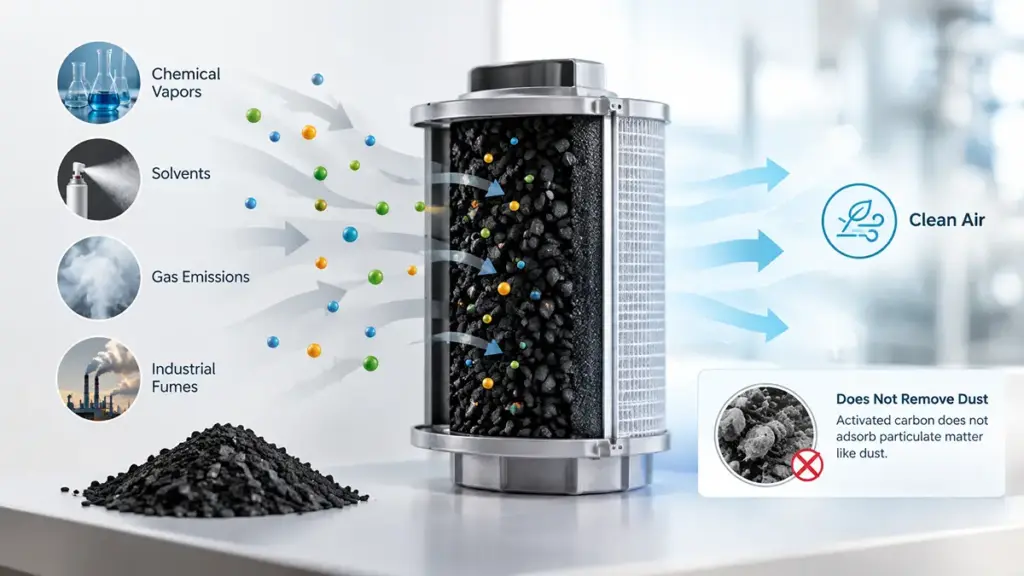
A HEPA stage is rated for particles and a carbon stage for gases, so neither substitutes for the other at any grade.
Contamination arrives in two forms that behave nothing alike. A dust particle is a solid object carried by the air. A solvent vapor is a molecule in the gas phase, dispersed the way salt dissolves in water. Filtration must match the state of matter, not the size of the complaint.
Particles Stop Inside a Fiber Web
A HEPA medium is a random matrix of ultra-fine fibers, dry-laid so the passages twist millions of times per centimeter. Air follows the turns, but a particle cannot always follow them. It impacts on a fiber, intercepts one along its path, or drifts into one by Brownian movement at the smallest sizes. Nothing is neutralized, and the particle stays until the media is discarded, which is why the class is an efficiency figure measured on particles.
Gas Molecules Bind to Carbon Pores
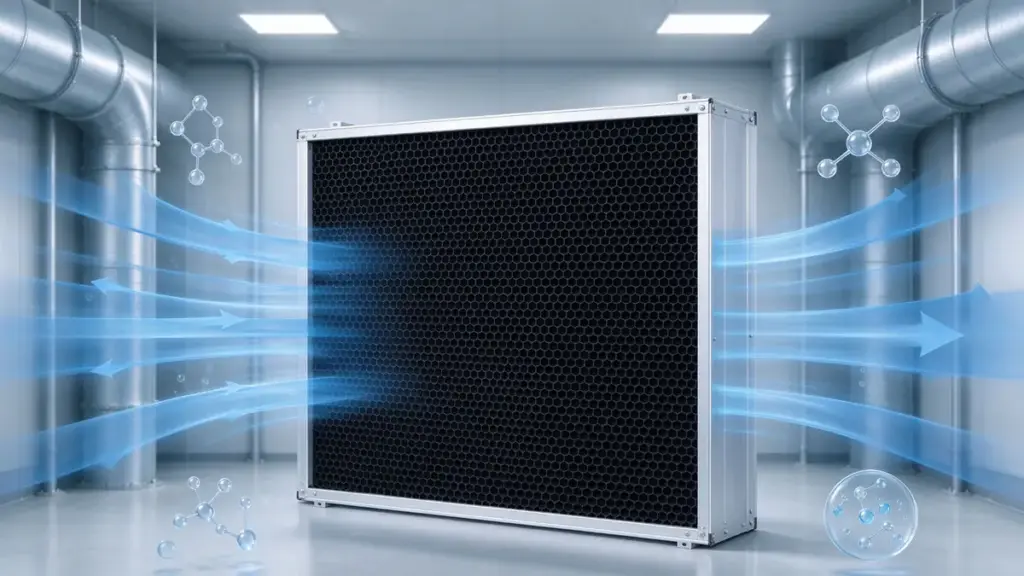
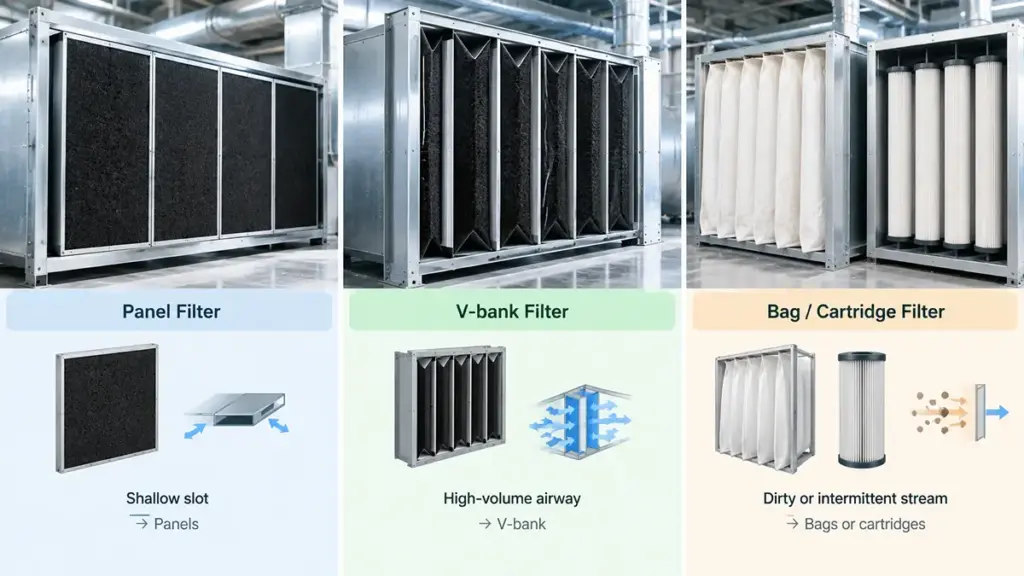
Activated carbon works by adsorption. Its pore network offers enormous internal surface, and gas molecules that wander in are held by surface attraction. Our carbon stages target volatile organic compounds, airborne chemicals and noxious odors, from pleated panels to honeycomb blocks of granular carbon. Capture is a holding operation rather than a destruction one, so capacity follows the number of sites and the contact time.
Why a Denser HEPA Will Not Clear Odor
A buyer reports an odor, and the response is to move from H13 to H14. The class improves particle capture and does nothing to molecules passing through void space far larger than the molecule itself. In the HEPA vs activated carbon filter decision, grade is not the variable that fixes a gas problem. Our comparison of HEPA vs ULPA filters states the rule plainly: gases, odors and VOCs need activated carbon or another gas-phase medium. EPA guidance agrees, advising a filter designed to remove gases and two stages where both particle and gas control are required (EPA guide to air cleaners).
| Attribute | HEPA Stage | Activated Carbon Stage |
|---|---|---|
| Target | Solid and liquid particles suspended in air | Gaseous molecules: COV, odor, acid and alkaline gases |
| Rated by | Efficiency class tested at most penetrating particle size | Carbon mass, bed depth, contact time, impregnation chemistry |
| How it fails | Dust loading raises resistance and cuts airflow | Pore sites fill; pollutant reaches the outlet |
How a HEPA Stage Is Specified
HEPA is a tested class, and the class means nothing without rated airflow and resistance attached.
Efficiency classes are the part everyone quotes and the easiest to verify. In the EN 1822 system our filters are built and tested to, media is challenged at its most penetrating particle size rather than at one convenient diameter. The class is a floor on removal at that worst case. Our HEPA and ULPA range is made in a 100,000-class cleanroom.
| Classe | Efficiency at MPPS | Résistance initiale | Médias | Frame Options |
|---|---|---|---|---|
| H13 | 99.95% or higher | 220 Pa or lower | Ultra-fine fiberglass or PTFE | Aluminium, acier galvanisé, stainless |
| H14 | 99.995% or higher | 250 Pa or lower | Ultra-fine fiberglass or PTFE | Aluminium, acier galvanisé, stainless |
| U15 | 99.9995% or higher | 280 Pa or lower | Ultra-fine fiberglass | Anodized aluminum profile |
| U16 / U17 | 99.99995% or higher | Custom design | Ultra-fine fiberglass | Anodized aluminum profile |
Class Selection Follows the Process
An H14 panel at 99.995% is the common terminal choice for controlled environments. Semiconductor-grade air needs U15 or higher. That decision belongs to the process contamination limit, not to a taste for larger numbers. The trade-off is resistance paid in fan energy.
Four Values Travel Together
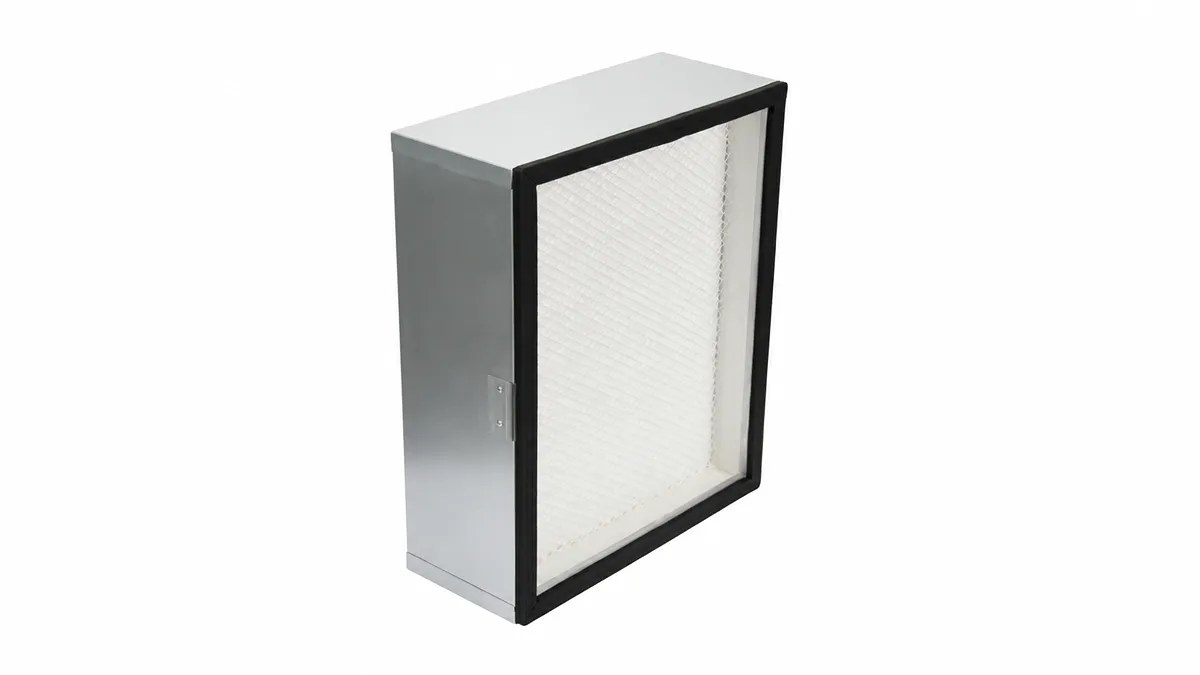
A class label without rated airflow is a brochure. Notre H14 mini-pleat HEPA air filter in the 305 by 305 by 290 mm size is rated at 6 cubic meters per minute at H14. The same frame is rated at 7 cubic meters per minute at H13, with 249 Pa initial drop and a 500 Pa final limit. That row is a complete specification: class, volume, clean resistance, dirty limit.
How a Carbon Stage Is Specified
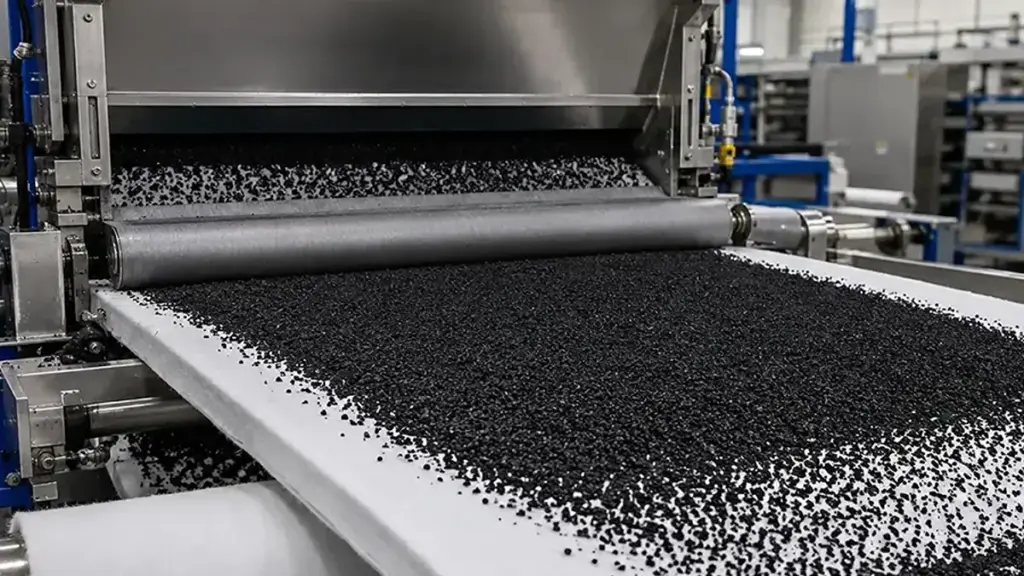
Carbon has no equivalent efficiency class, so a serious specification is written in mass, depth, dwell and chemistry.
That absence is the largest practical difference between the two sides of the HEPA vs activated carbon filter comparison. EPA notes there is no widely used performance rating system for filters designed to remove gases, while particle filtration has established ratings. The buyer must assemble the evidence; no single number does it.
Carbon Mass Sets the Ceiling
Capacity follows the number of pore sites, and sites come with mass. A panel coated at 650 grams per square meter holds more than a lightly dusted one at the same size. A 100 mm panel holds more than a 25 mm one at the same footprint. Our plate-type carbon media runs 25, 46, 50, 60, 70 et 100 mm thick in standard 592 by 592 et 610 by 610 frames.
Contact Time Decides Whether the Mass Is Used
A given mass only works if molecules reach its pores. A molecule has to meet a pore before the air carries it past. Mini-pleat construction raises carbon loading per installed volume and lengthens each molecule’s path, using 20 by 50 mesh granular stock in non-woven matrix. EPA’s control manual frames carbon life the same way: theoretical capacity versus the working capacity actually achieved. More air through the same bed shortens dwell.
Chemistry Decides Which Gas You Catch
Plain carbon is strong on many organic vapors and weak on others. EPA lists methanol, vinyl chloride and formaldehyde among compounds activated carbon does not hold well. That is why our carbon stages ship in acid-impregnated, alkali-impregnated and potassium-permanganate-modified versions. Ammonia and amines are alkaline, so they need acidic media; sulfur dioxide and hydrogen sulfide need alkali or permanganate chemistry.
What to Ask for in Writing
A workable enquiry names the pollutant, flux d'air, carbon weight per unit, mesh size, coating weight, bed depth and initial resistance. Notre plate-type activated carbon air filter is published at 50 à 90 Pa initial with a recommended 180 à 220 Pa final limit. That page also states our change-out signal: saturation is best determined by gas detection, and pressure drop is for reference only. The mechanism sits in our activated carbon air filter guide.
Where Each Stage Fails Before Its Term
Dust blinds a HEPA early and humidity disarms carbon, and both causes sit upstream of the filter itself.
Filters rarely reach their rated limit. They are defeated by the air in front of them, so fixing the condition saves more than upgrading the media.
Dust Closes the Voids
A HEPA panel loses capacity by gaining resistance. Dust accumulates in the matrix, airflow falls, and the filter becomes the restriction it was meant to prevent. Our separate treatment of HEPA filter pressure drop covers the loading curve and a clean baseline. An unprotected H13 in a dusty corridor is a short-life consumable.
Humidity Occupies the Pores
Water vapor competes for the same sites as the target pollutant. Our carbon media is specified for 5 à 55 °C service with an optimal band of 35 à 65% relative humidity, and excessive humidity reduces adsorption capacity. EPA is blunter: some studies show roughly a 30% drop in removal efficiency once the stream exceeds 75% relative humidity, and moisture in the bed encourages biological growth. Uncontrolled make-up air makes a healthy carbon stage look broken.
Weakly Held Gases Reach the Outlet First
Breakthrough is not uniform across a pollutant mix. Compounds with low affinity travel further into the bed and exit before the strongly held ones. An installation can still be removing odor while a target compound already passes. Channeling adds to it: unevenly filled beds let air take the path of least resistance, and part of the carbon never works. Our panels pot the media into the frame under controlled filling.
Heat Can Reverse the Process
Adsorption is reversible, so regeneration and uncontrolled release are both possible. EPA’s carbon adsorbers manual describes spent carbon returning to a reclamation facility, where it is analyzed for hazardous compounds. Our plate carbon media carries a 140 °F maximum against its 5 à 55 °C service band. The same manual notes carbon bed fires with certain adsorbed compounds, so disclose your process chemistry to whoever sizes the bed.
When a Building Needs Both Stages
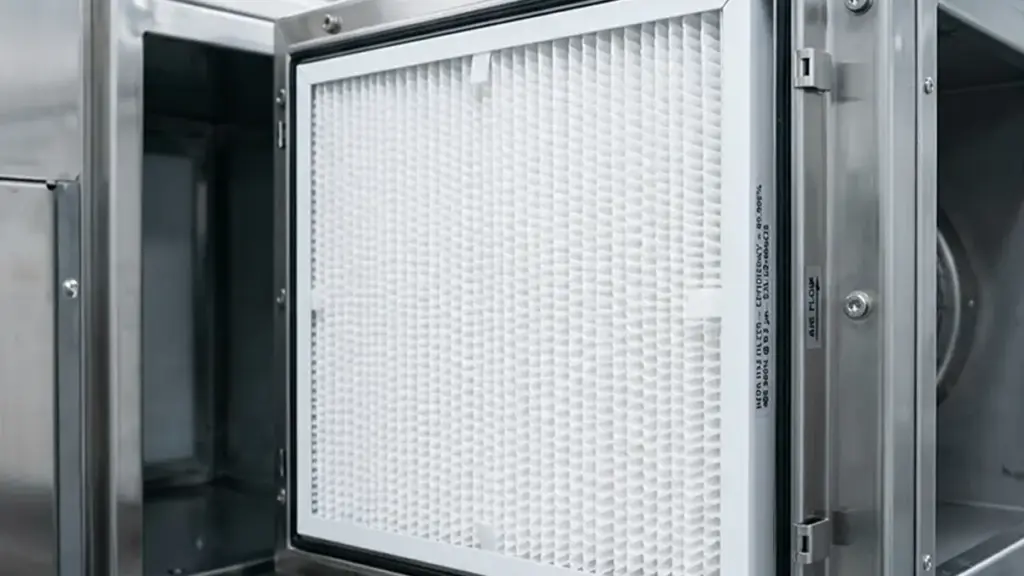
Specify both whenever the site carries a particle limit and a gas complaint, because each stage answers a different symptom.
Arguments for the HEPA vs activated carbon filter pair usually start from symptoms rather than a specification review. Four situations justify the added pressure drop and line item.
An Odor Complaint With a Healthy Gauge
The cleanest diagnostic in the field. Resistance sits near baseline, airflow at the diffusers is normal, and people still smell solvent, cooking fat or sulfur. That says the gas-phase load is unaddressed, not that the filter is dirty. Adding carbon capacity is the answer; replacing a HEPA on the strength of a smell is not.
Salles blanches, Labs and GMP Supply Air
Controlled environments carry two limits at once. Particle counts are validated against a cleanliness class, and airborne molecular contamination (AMC) is controlled separately, because process chemistry is sensitive to film-forming vapors. Our low-dust-emission carbon version serves that role as auxiliary AMC purification in semiconductor, lithium battery and GMP workshops. There the bed must not add its own fines to the air it treats.
Process Exhaust and Solvent or Kitchen Loads
Where the airstream carries benzene, formaldehyde or ammonia from a laboratory, electronics line, food plant or pharmaceutical process, a particulate-only train meets neither the discharge limit nor the neighborhood. Our chemical air filter uses activated carbon felt in 4V and 5V constructions, handling 1,600 à 3,400 cubic meters per hour at 60 à 80 Pa behind the particulate stages. There the felt does adsorption work rather than dust work.
Tight Retrofits Where a Composite Element Fits
Some equipment has one slot. We build combined elements for that case: a washable primary layer, a honeycomb granular carbon layer, then an H13 particulate layer. Understand the boundary. A compact cartridge carries a modest quantity of carbon, and in an air handling unit with a real gas load two separately sized stages beat one compromise.
Which Stage Order Protects Both Media
Buy the cheapest media first, because every stage in front of an expensive one is paid for by the life it adds.
Sequence turns the HEPA vs activated carbon filter decision from a comparison into a design. Protect the particulate stage from dust, protect the carbon from dust and moisture, and put the final filter where it also catches what the carbon gives up.
Pre-Filtration Without Exception
Nylon mesh panels run at 25 Pa or lower, wash through fully and are reusable, the cheapest protection available. Aluminum and stainless mesh panels sit near 30 Pennsylvanie. A pleated panel sits near 45 Pennsylvanie. Behind them, pocket stages carry the graded work. M5 at ePM10 50% starts at 45 Pennsylvanie, and F7 at ePM1 50% at 75 Pennsylvanie. F8 to F9 at ePM1 80% runs at 95 Pennsylvanie, retiring at 250 à 300 Pennsylvanie. Skipping this group puts the whole dust load on a stage that costs several times more per change.
Carbon Before the Final Filter
Two placements are defensible, and the difference is what you protect. Putting carbon ahead of the terminal HEPA lets the final filter capture carbon fines and any dust that reached the bed, the arrangement built into our three-stage cartridges. Putting carbon last protects the bed but leaves supply air carrying whatever the bed releases, so carbon first is the safer default for occupied and controlled spaces. Where an excursion is unacceptable, EPA describes running adsorbers in series so the second unit controls breakthrough from the first.
Add the Resistance Honestly
Each stage spends static pressure, and the sum must sit inside what the fan can deliver at design volume. A representative train built from published figures starts near 45 Pa at the pleated panel. It adds 75 à 95 Pa across a pocket stage, 50 à 90 Pa through a carbon panel, et 220 à 280 Pa at the final class. The carbon stage is not the restriction. Low-resistance media can cut fan and FFU energy by 10 à 30%, so a tight fan budget calls for better media and more face area.
| Stage | Format | Initial | Retire At | Protects |
|---|---|---|---|---|
| Grossier | Nylon, aluminum or stainless mesh panel | 25 à 30 Pennsylvanie | Wash nylon; replace when damaged | Every downstream stage |
| Fine | Pocket M5 through F9 | 45 à 95 Pennsylvanie | 250 à 300 Pennsylvanie | Carbon bed and final filter |
| Gas phase | Plate carbon 25 à 100 mm | 50 à 90 Pennsylvanie | 180 à 220 Pennsylvanie, or outlet reading | Odor, VOC and gas limits |
| Final | H13, H14 or U15 panel | 220 à 280 Pennsylvanie | About 500 Pa at 290 mm depth | Room or process particle limit |
Size Both Stages Against Your Real Airflow
How to Specify Both in One Order
A request that names the pollutant and the airflow gets an engineered answer; one that names a size gets a catalog item.
For the HEPA vs activated carbon filter pair, buying both families from one supplier pays off only if the enquiry carries enough to size them. Dimensions alone are not a specification, and a supplier who answers a dimension-only request without questions is quoting from a stock list.
Data to Collect Before You Ask
Record airflow per unit and available face area, the static pressure the fan can spare, target pollutants by name, humidity and temperature range, and rack dimensions with tolerance. Add the cleanliness or exposure limit the space is validated against. That fixes the particulate class independently of the gas question.
Questions That Separate a Factory From a Reseller
Ask whether each unit gets an individual leak scan, and for the test report at the stated class. Ask carbon mass per unit, granular mesh size, coating weight, bed depth and what the impregnation chemistry is matched to. Ask whether the media pack is potted against bypass. We hold OEM frames to plus or minus one millimeter. Standard panel and pocket formats support low-MOQ trials; custom frames and fan filter units typically start at 50 à 100 unités.
Acceptance Checks on Delivery
Weigh a sample from each carbon shipment against the stated fill. A shortfall is invisible in the box and shows up as a shortened cycle. Measure initial resistance at rated airflow, compare it with the datasheet, and log it as the clean baseline for that position. Verify the seal type against the drawing and the class marking against the report. Consumable media sits outside equipment warranty because it requires regular replacement.
Where Water Service Genuinely Differs
All of the above assumes an airstream. Liquid carbon treatment is sized in empty-bed contact time, with hydraulic loading, backwashing and NSF/ANSI vessel ratings that do not apply to air-side panels.
Foire aux questions
What is the actual difference between a HEPA filter and an activated carbon filter?
HEPA is a fiber matrix that strains particles mechanically, rated by an efficiency class tested at the most penetrating particle size. Activated carbon is a porous adsorbent that holds gas molecules on pore surfaces, sized by mass, depth, contact time and chemistry. One handles dust, smoke and microbes; the other handles vapors and odors.
Can a HEPA filter remove odors or volatile organic compounds?
Non. Gas-phase molecules pass through the void space between fibers, so a higher class does not change the result. Some elements combine HEPA media with a carbon layer, but that is a second mechanism in the same frame. Where odor or VOC control is required, add a gas-phase stage.
Does an activated carbon filter capture dust as well?
Some capture happens, because granular beds and coated media obstruct airflow. But carbon stages are not tested or rated as particulate filters. Dust blocks the pore openings and consumes pressure drop with no efficiency claim behind it. Protect the carbon with a mesh pre-filter and a graded pocket stage.
Which should come first, the carbon stage or the HEPA stage?
Pre-filtration first in every case. After that, placing carbon ahead of the terminal HEPA lets the final filter capture carbon fines and anything that reached the bed, which is how our combined cartridges are built. Placing carbon last protects the bed but leaves supply air carrying whatever it releases.
Can either filter type be cleaned and put back into service?
Nylon pre-filter panels are washable and reusable until physically damaged. HEPA media is not, because washing collapses the fiber matrix and voids any leak-scan record. Carbon cannot be restored in a building utility room, since regeneration is a thermal process run at a facility that also tests the spent material.