Premature breakthrough is the most common activated carbon filter failure, and it rarely starts with the media. It starts with a selection made from a generic rating instead of four measured inputs. Those inputs are the pollutant you are actually removing, the operating conditions around it, the airflow the filter must serve, and the resistance the fan can tolerate.
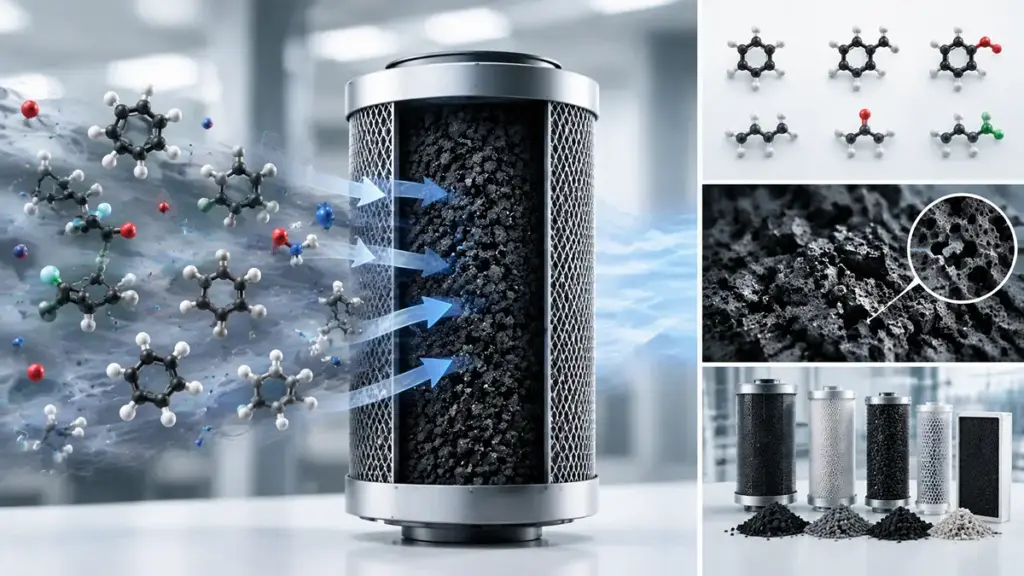
This guide walks through activated carbon filter selection for gas-phase duty, step by step, using the specification fields a factory needs from you. We cover contaminant matching, concentration, temperature and humidity limits, airflow and face area, pressure drop margins, media chemistry and format, and the verification checks that decide service life. Carbon filters address gaseous pollutants; how activated carbon filters work covers the adsorption mechanism behind those choices.
Identify the Target Pollutant and Source
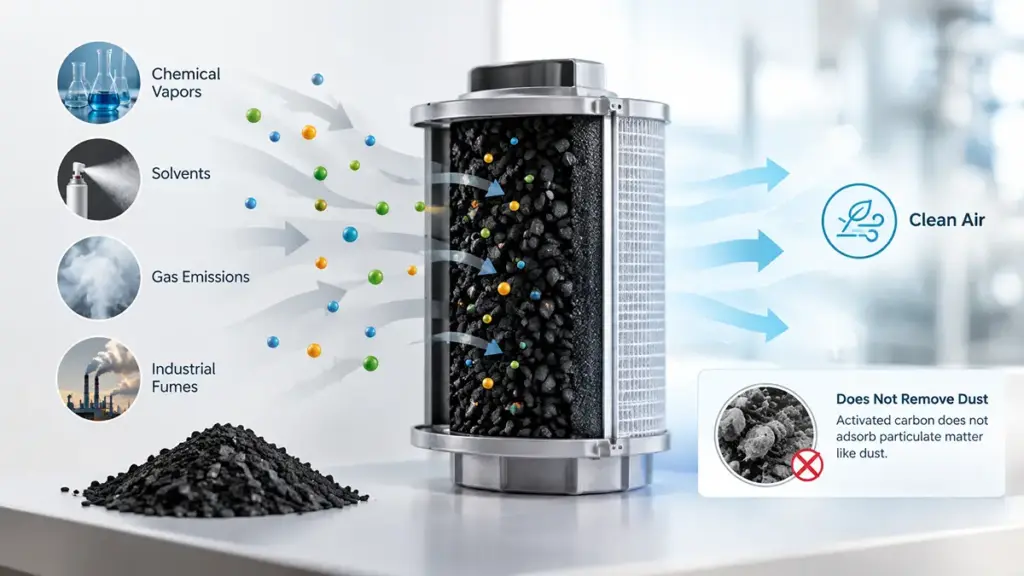
Activated carbon filter selection starts with the pollutant. Carbon adsorbs gases and vapors, not dust, so the contaminant and its source decide everything downstream.
Before you compare filters, write down what you are trying to remove. Activated carbon is highly effective, but only across a defined range of contaminants. Mismatching the filter to the problem is the common and expensive mistake, because the media looks identical either way and only fails in service.
Gases That Carbon Captures Well
Carbon targets organic compounds and certain reactive gases in ventilation and exhaust air. In the work our own panels are specified for, that means VOC and TVOC, formaldehyde, benzene-series compounds, odors, acid gases, ammonia, hydrogen sulfide, and ozone.
- Volatile organic compounds (COV): Solvents, paints, adhesives, inks, and off-gassing from new furnishings. The EPA documents the impact of VOCs on indoor air quality — carbon adsorption suits the low-concentration range.
- Odor gases: Hydrogen sulfide and mercaptans from wastewater handling, lavorazione degli alimenti, and animal facilities; ammonia from stables and cleaning chemicals.
- Acid and alkaline vapors: Hydrochloric and sulfurous vapors, plus ammonia, respond better to impregnated media than to plain carbon.
- Ozone: Requires a dedicated catalytic or impregnated formulation rather than ordinary coal-based carbon.
What Carbon Does Not Remove
Carbon is not a universal filter. Two burdens land on the upstream stage, and a third requires a different technology entirely.
- Particulate matter: Dust, pollen, and PM2.5 pass straight through a carbon bed. They are caught by mechanical media such as MERV-rated panel or pocket filters, and they blind carbon fast if you let them arrive unprotected.
- Microorganisms: Standard carbon does not reliably remove bacteria or viruses; disinfection is a separate stage.
- Carbon dioxide and most inorganic gases: CO, CO2, and nitrogen oxides are poorly adsorbed on untreated carbon.
Why the Source Changes the Answer
Naming the source tells you the likely mixture, concentration band, and whether the load is constant or intermittent. A paint booth delivers solvent vapor in bursts tied to shifts. A printing line delivers a steadier, warmer stream. A wastewater plant delivers low-concentration odor continuously, plus moisture that shortens carbon life.
That classification decides your carbon type, your format, and your change-out interval. Two rooms with identical airflow can need completely different carbon, and this is why VOC carbon filter specification data belongs in the same document as your airflow numbers.
Define Concentration, Temperature, and Humidity
Three operating conditions set the safety margin and the service life of a carbon filter: inlet concentration, gas temperature, and relative humidity.
Inlet Concentration
Concentration is the amount of pollutant in the stream, reported in ppm or mg/m³. A higher inlet load saturates the bed faster, so it shortens service life directly rather than reducing efficiency. For solvent vapors, a standard safety guideline is to keep the stream below 25% of its lower explosive limit before it reaches the carbon. That ceiling also sets how much air you dilute with, so concentration and airflow get solved together.
Gas Temperature
Adsorption is exothermic, so it works better at lower temperatures. As the stream warms, captured molecules release more easily and removal efficiency falls. Our standard carbon media is rated for a 5–55 °C operating range, per the plate-type activated carbon air filter specification. Hotter air needs cooling upstream or a media grade chosen for that duty.
Relative Humidity
Water vapor competes with the target pollutant for adsorption sites. The practical window is 35–65% relative humidity; above that, capacity for organic vapors drops and condensation inside the bed can ruin the media outright. Saturated streams from drying, sterilization, or wastewater handling usually need a dehumidification or pre-heating step in front of the carbon stage.
Calculate Airflow and Filter Face Area
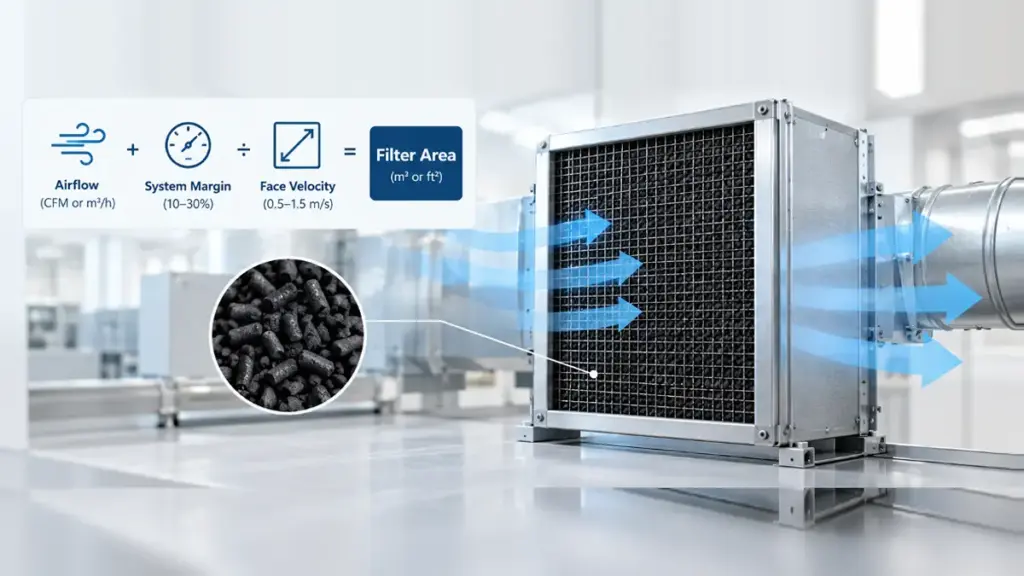
Size the airflow first, add margin for system resistance, then divide by a sane face velocity to get the filter area you actually need.
Base Airflow
Required airflow follows from room volume and air changes per hour (ACH). In imperial units, CFM = (room volume in ft³ × target ACH) ÷ 60; in metric, m³/h = room volume in m³ × target ACH. Four ACH is a common baseline for general ventilation, and six or more for spaces with continuous emission. Exhaust hoods are sized by capture velocity at the hood face — a fan calculation, not a filter one.
Margin for System Losses
The base figure ignores duct resistance, plenum losses, and the filter itself. A loaded carbon stage can cut delivered airflow by 20–30%, so add 10–25% headroom to the calculated number before you select the fan. Confirm the fan curve at your real design flow, not the nominal catalog rating.
Face Area and Face Velocity
Filter face area = adjusted airflow ÷ target face velocity. Face velocity is the variable that decides whether the air spends enough time in the bed. Push too much air through a small face and the stream rushes past the media, efficiency falls, and breakthrough arrives weeks earlier than the datasheet implies. Keep velocity inside the range the manufacturer publishes for that format.
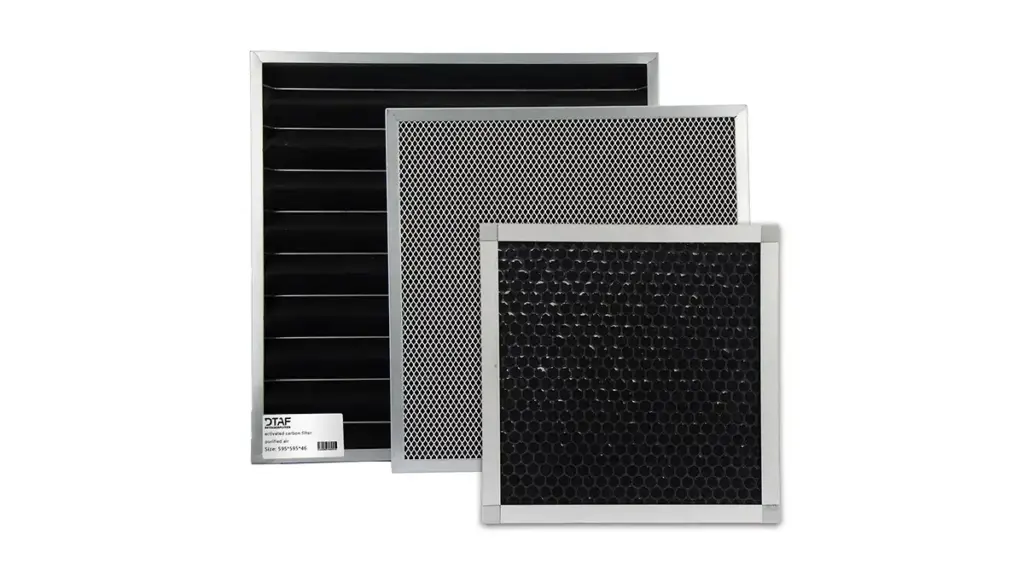
Standard panel frames come in fixed sizes, such as 592×592 mm or 610×610 mm. So the last step is arithmetic: divide required face area by the frame’s free area, round up, and check the housing fits. Custom sizes exist precisely because that rounding often leaves an awkward gap.
Set the Allowable Pressure Drop
Pressure drop is the operational ceiling that balances flow against fan capacity, and it is the number that sets your change-out discipline.
Every carbon filter carries two values. Initial resistance is the baseline of new media. Final resistance is the upper limit at which you stop the stage or swap the media. For our standard carbon panels, initial resistance runs 50–90 Pa (lower for carbon cotton, higher for honeycomb panels) and recommended final resistance sits at 180–220 Pa.
What Drives Resistance Up
- Bed depth and media grade: Thicker media, in the 25–100 mm range we build, and finer granular carbon both add resistance from day one.
- Dust loading: Without a pre-filter, particulates plug the surface and resistance climbs long before the carbon is spent.
- Compaction and fines: Vibration and airflow settle the bed unevenly, creating both resistance and bypass paths.
- Velocity: Resistance rises faster than linearly as you push more air through the same face.
How to Set Your Limit
Start from the maximum the fan can deliver at your design flow, then size the clean filter well below it so a fouling margin survives. Choose a lower allowable pressure drop where the system is critical, where change-out requires a shutdown, or where the fan has no spare capacity. A higher limit can be acceptable when the fan has headroom and swaps are scheduled routine work.
Set two thresholds rather than one: an alarm value that schedules the purchase order, and a hard limit that triggers the physical swap. The EPA’s air cleaner guide makes the same point domestically: rated airflow falls as the filter loads up.
Choose Carbon Chemistry and Media Form
Match the pore structure to the molecule and the physical format to the housing. Get either one wrong and performance suffers regardless of carbon quality.
Chemistry Follows Molecular Size
- Microporous carbon, usually coconut-based, handles small molecules such as formaldehyde, many solvents, and odor compounds.
- Mesoporous carbon, typically wood-based, suits larger organics and heavy odor bodies.
- Coal-based carbon offers a broader pore spread and is often specified for mixed solvent streams.
- Impregnated media carries the reactive load that plain carbon cannot hold: acid gases, ammonia, hydrogen sulfide, and ozone. Our own media uses acid-impregnated and alkali-impregnated grades for exactly those duties, E activated carbon filter media compares the four formats side by side.
Format Follows the Housing
The format controls pressure drop, carbon loading, and how the filter fits. Specify it against the equipment you already have.
| Format | Where It Belongs | Trade-off |
|---|---|---|
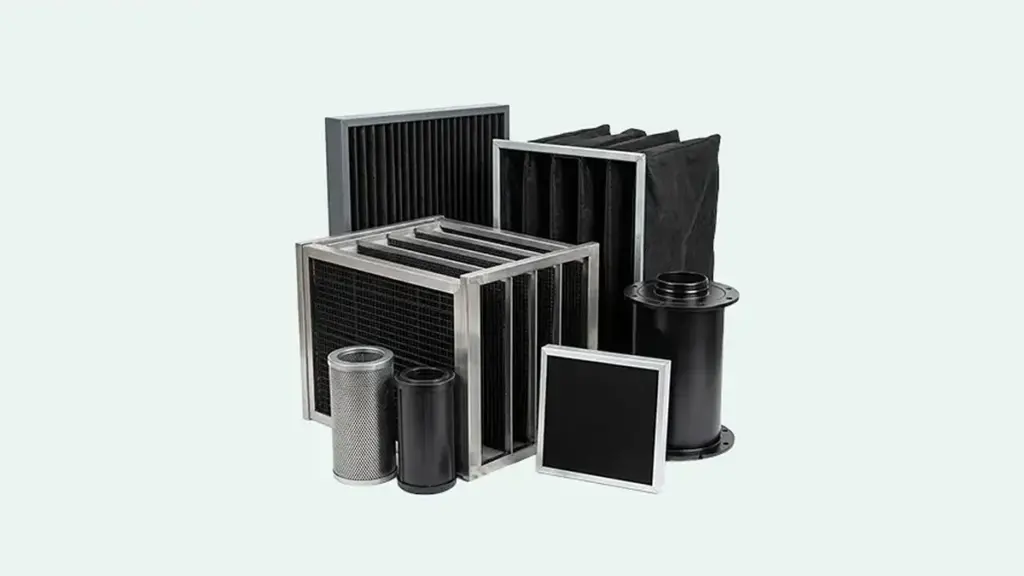
| Carbon cotton / impregnated felt | Thin panel frames, FFUs, duct inline holders | Lowest resistance; carries less carbon per frame |
| Honeycomb granular block | High-load VOC and odor duty, deep-bed stages | Highest capacity per frame; higher resistance |
| Pelletized or extruded carbon | Cartridge and cylinder housings, gas-phase plants | Dust-free and stable; needs the right housing |
| V-bank and compact cells | Air handling units with height limits | Large face area in shallow depth; higher cost |
Fields to Verify on the Datasheet
- Carbon content of the finished media, which our carbon cotton grade states as at least 50%.
- A benzene adsorption figure, at 20% or better on that grade, as a capacity proxy you can compare between suppliers.
- Moisture content and ash, which reduce the active carbon you are paying weight for.
- Frame and seal construction, because cardboard frames cannot take wet or high-dust air.
- Independent test reports, typically EN1822 for the particulate stage alongside CE and RoHS declarations.
Verify Contact Time, Carbon Mass, and Bypass
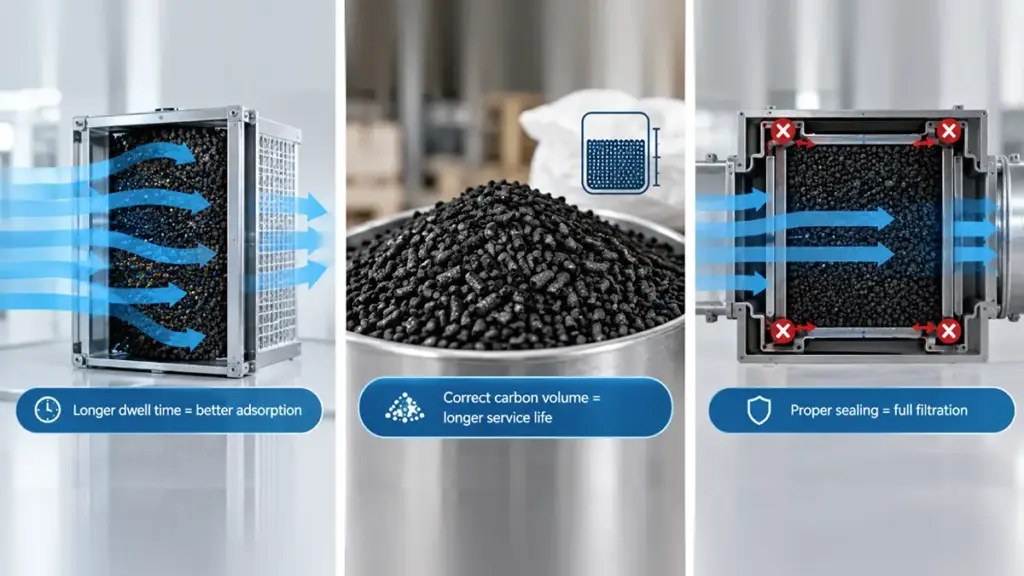
Three checks decide whether the sized filter performs: enough contact time, enough carbon for the load, and no path around the bed.
Contact Time in Gas-Phase Duty
Contact time is bed depth divided by face velocity. In air service that number is measured in fractions of a second, not minutes, which is why gas-phase filters are sized by velocity and depth together. A 50 mm bed at 0.5 m/s gives 0.1 seconds of theoretical contact; a deeper honeycomb at lower velocity buys more. Efficiency curves come from the manufacturer’s tested data for that format, and pilot testing on your own stream is the only way to confirm them.
Carbon Mass Sets Service Life
Carbon mass equals bed volume times packing density. More carbon means more sites to fill, so the same contaminant load buys a longer run before exhaustion. This is the arithmetic behind a change-out interval. Inlet concentration times hours run times airflow gives the mass of pollutant captured, and the media’s working capacity says how much carbon that needs.
Bypass Is the Silent Failure
Bypass happens when air finds a route around the media rather than through it. The usual causes are gaps between frame and housing, a missing gasket, an unevenly filled bed, or a wrongly sized filter. Untreated air escapes through the first path it finds, while the manometer still looks healthy. Sealed frames, correct holders, and even airflow distribution are the prevention.
For continuous duty where an outage is unacceptable, staged housings let you isolate one stage while the other carries load, which also gives you a clean measurement point between stages.
Plan Monitoring and Replacement
Replace carbon on evidence, not on the calendar. Pressure drop is a reference figure; outlet detection is the real trigger.
Indicators Worth Tracking
- Rising outlet concentration of the target pollutant, which is the definitive breakthrough signal.
- Odor returning downstream of the filter, an early and cheap indicator for odor duty.
- Pressure differential climbing toward the recommended final resistance for the format.
- Visible damage: clumping, channeling, moisture, or media that has shifted in the frame.
- Sensor alarms where the system carries inline gas detection.
Our specification states it plainly: saturation is best determined by gas detection, and pressure drop is for reference only. A dust-loaded pre-filter can push differential pressure to the limit while the carbon underneath is barely used, and a bypassed bed can show a stable reading while discharging untreated air.
A Practical Schedule
- Record a baseline at installation: resistenza iniziale, outlet reading, flusso d'aria, and date.
- Set inspection frequency by severity, with high-load industrial service checked far more often than light ventilation.
- Use a hybrid rule: fixed-interval inspections, condition-triggered replacement.
- Protect the carbon with a pre-filter upstream, and control the source where you can.
- Log every change-out with media type, batch, hours run, and the reason, so your own service-life curve replaces generic guidance.
Build a Complete Activated Carbon Filter RFQ
Vendors cannot price carbon by the frame. An RFQ with measured operating data is what turns incomparable bids into a decision.
Apples-to-oranges proposals are almost always a symptom of a thin RFQ. Fill these five blocks and the quotes you receive become comparable on capacity, resistance, and life rather than on price alone.
| RFQ Section | Information to Include |
|---|---|
| Scope and Performance | Applicazione, target pollutant, required outlet level, housing or AUH model, and operating schedule. |
| Air Data | Measured inlet concentration in ppm or mg/m³, flusso d'aria, temperature, relative humidity, and dust load. |
| Media and Format | Carbon base and impregnation, format, frame and seal type, dimensioni, depth, and target face velocity. |
| Resistance and Change-Out | Allowed initial and final pressure drop, expected service life, disposal or regeneration preference, site access limits. |
| Commercial and Documents | Line-item pricing, sample lead time, test reports and declarations, warranty terms, and trial-order quantity. |
Three Lines That Decide Bid Quality
Inlet concentration, flusso d'aria, and relative humidity are what a factory needs before it can quote media depth and quantity. Omit them and every vendor guesses differently.
Ask for the numbers you will check in service: carbon content per unit, packing density, initial resistance at your flow, and a proposed change-out interval with the assumption behind it. A vendor who supplies those is quoting engineering; one who supplies only a price is quoting a catalogue item.
If your duty is liquid-phase instead, the framework carries over but the specification set does not. Water service adds empty bed contact time in minutes, vessel hydraulics, backwash behaviour, and NSF/ANSI certification. We build gas-phase air filtration, so a liquid vessel belongs with a water-treatment supplier.
Source Carbon Air Filters on Low-MOQ Trial Orders
Domande frequenti
How do you choose an activated carbon filter for air?
Match the pollutant to the carbon chemistry, then the format to your housing. Name the target gas and its source, then confirm concentration, temperature, and humidity sit inside the media’s rated window. Finally size airflow and face area, and set a pressure drop limit your fan can meet. Certification claims matter only where your regulator or customer requires them.
Is pressure drop a reliable sign that carbon is spent?
NO, it is a reference figure. Dust loading can drive differential pressure to the limit while the carbon still has capacity, and an exhausted or bypassed bed can hold a steady reading while passing untreated air. Outlet gas detection is the reliable trigger; pressure drop tells you when to inspect rather than when to replace.
How do airflow and face velocity affect adsorption?
They set contact time. Higher face velocity shortens the time a molecule spends against the media, so removal efficiency falls and breakthrough arrives earlier. Lower velocity extends contact but demands more face area and a fan that can still push the design flow through a larger, deeper bed.
Does humidity shorten the life of a carbon filter?
SÌ. Water vapor occupies adsorption sites that would otherwise hold your target pollutant, so capacity drops as humidity rises. Standard media is rated for roughly 35–65% relative humidity, and condensation inside the bed can end media life outright. Dehumidify or pre-heat saturated streams before the carbon stage.
What data must an RFQ include to get comparable quotes?
Inlet concentration, flusso d'aria, temperature, and relative humidity, plus the target pollutant, allowed pressure drop, frame dimensions, and expected change-out interval. With those numbers a factory can quote media depth and quantity; without them each vendor guesses differently and the bids cannot be compared.
Considerazioni finali
A cheap generic carbon filter costs more the moment it breaks through early, releases odor into a neighbouring space, or stalls a line during an unplanned change-out. Activated carbon filter selection is four measured inputs, a matched media chemistry, and a verification plan you can run on site.
Take the pollutant, concentration, flusso d'aria, umidità, and pressure drop limits you have now, put them into the RFQ blocks above, and send them to your supplier. If you would like a second reading on those numbers, il nostro team di ingegneri will review them against our tested media data and return a proposal.