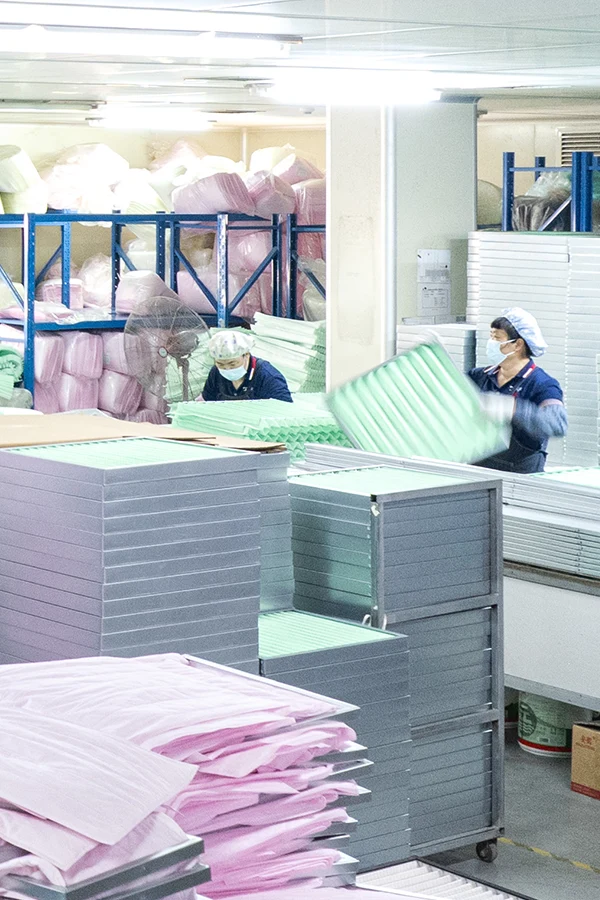
Specifying the wrong activated carbon air filter for an industrial or commercial application creates immediate operational risk. Choosing media on vague marketing claims instead of empirical data leads to premature saturation, breakthrough of the target contaminant, and costly unplanned downtime.
This guide provides the technical framework for proper selection. We evaluate carbon media types and filter structures against the metrics suppliers actually test to, including CTC activity, iodine number, carbon content, bed depth, and pressure drop.
How Activated Carbon Adsorption Works
An activated carbon air filter traps gases, odors and VOCs by adsorption onto a porous carbon surface. It carries no efficiency rating for dust or particles.
Adsorption Happens at the Surface
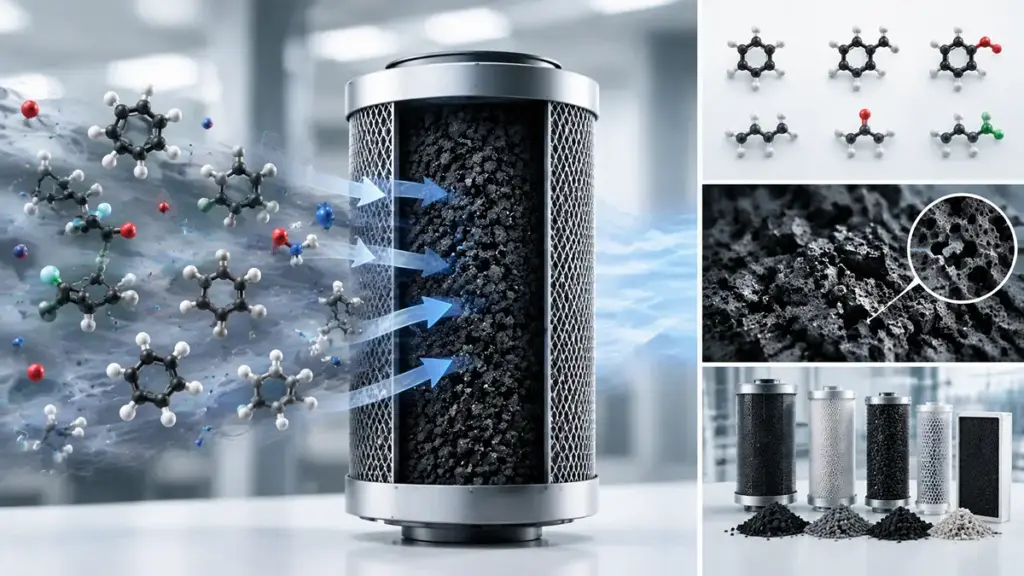
Activated carbon is treated with heat or steam until its structure opens into a network of microscopic pores. That processing gives a single gram more than 500 square meters of surface area on a BET basis. As air is drawn through the bed, gas molecules diffuse into those pores and hold there on weak intermolecular forces called van der Waals attraction. Nothing dissolves and the carbon is not consumed. The pollutant leaves the air stream and stays on the internal surface.
Physical Adsorption Does Most of the Work
Standard filters rely on physical adsorption. It changes nothing chemically and is reversible, since heat or a drop in ambient concentration can drive captured molecules back off the media. Chemical adsorption, or chemisorption, is the exception. There the carbon carries a reagent that reacts with the contaminant and binds it permanently. Chemisorption is what you specify for reactive inorganic gases that a plain bed would release again within hours.
Four Variables Set Real-World Performance
Capacity on a datasheet means little until you set it against your conditions. Four variables decide what a filter delivers:
- Total carbon mass, which sets how much the bed can hold before it is full.
- Contact time between air and media, which falls as airflow rises.
- Inlet concentration of the target contaminant, which consumes capacity faster the higher it runs.
- Temperature and humidity, since adsorption works better cold and water vapor competes for pore space.
Our companion article on how an activated carbon filter works covers the mechanism in more depth, including the adsorption versus absorption distinction and how carbon differs from HEPA media.
What Activated Carbon Removes and What It Misses
Carbon handles gas-phase pollutants well and needs chemical impregnation for acid and alkaline gases. Solid particles belong to the mechanical stage.
COV, Solvent Vapors and Odors
The core job is adsorbing volatile organic compounds: hydrocarbons, aromatic solvents, and the off-gassing from paints, adhesives and cleaning chemicals. EPA guidance on VOCs and indoor air quality notes that many VOC concentrations run consistently higher indoors than outdoors. That is why a carbon stage earns its place in tight, recirculating spaces. The same mechanism handles odors from industrial processes, wastewater, landfills and food processing.
Acid and Alkaline Gases Need Impregnated Media
Plain carbon captures sulfur dioxide (SO2), nitrogen dioxide (NO2), chlorine (Cl2), hydrogen sulfide (H2S) and ammonia (NH3) poorly. Those molecules are polar and react weakly with an untreated surface. Control comes from chemically treated media: acid-impregnated carbon for alkaline gases such as ammonia and amines, and alkali- or potassium-permanganate-modified carbon for acidic and sulfur compounds. Our plate-type filters are built with carbon cotton, honeycomb granular carbon, and acid-, alkali- and potassium-permanganate-modified media. The impregnation is chosen against a named gas list, not sold as a generic upgrade.
Formaldehyde Is a Separate Question
Formaldehyde is small, polar, and usually present at low concentrations, so it binds weakly to unmodified carbon. Treat an activated carbon air filter quoted for formaldehyde removal on plain coconut or coal-based granules as unproven until you see the test conditions. Effective control comes from treated or catalytic media, sized against a stated inlet concentration and confirmed by breakthrough data. Ask which method and loading produced the figure, not merely what percentage is printed.
What Carbon Does Not Remove
Carbon is not a particulate filter. Dust, pollen, mold spores and the tar fraction of smoke require a mechanical stage such as a pre-filter or HEPA media. Combustion smoke is where specifications often go wrong. The carbon stage strips the gaseous and odorous fraction, while visible particles stay behind in fiber media. A loose bed intercepts some dust by accident, but it carries no MERV or HEPA rating, so never present it as the particle stage.
Four Activated Carbon Media Types for Air
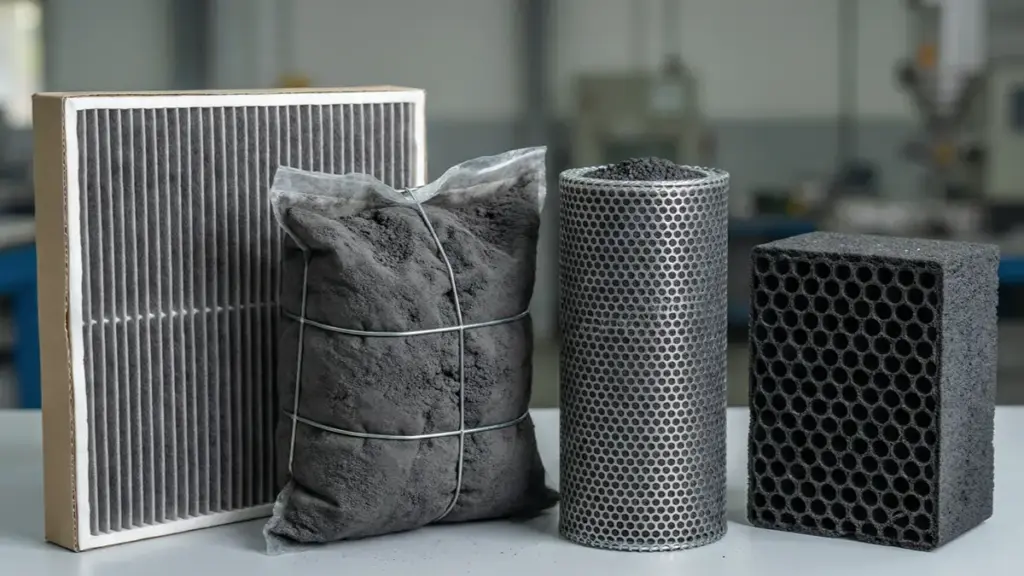
The physical form of the carbon decides pressure drop, capacity and which gases the media will hold in your housing.
Granular Activated Carbon (GAC)
GAC is the workhorse: loose granules packed into a bed, canister or cartridge. Feedstock drives the pore structure. Coconut-shell carbon is highly microporous and favors smaller molecules such as solvent vapors and odor compounds. Coal-based carbon offers a broader pore distribution that suits mixed industrial gas streams. For air duty, specify a coarse mesh. Fine granules raise resistance and generate dust.
Pelletized (Extruded) Carbono
Extruded carbon re-forms powdered carbon into uniform cylinders with a binder. It resists crushing, sheds little dust, and typically produces the lowest pressure drop among the bulk media. That combination is why pellets are common in high-airflow industrial cartridges and inline duct units, where the fan has limited static pressure to spare.
Carbon-Impregnated Felt, Foam and Cotton
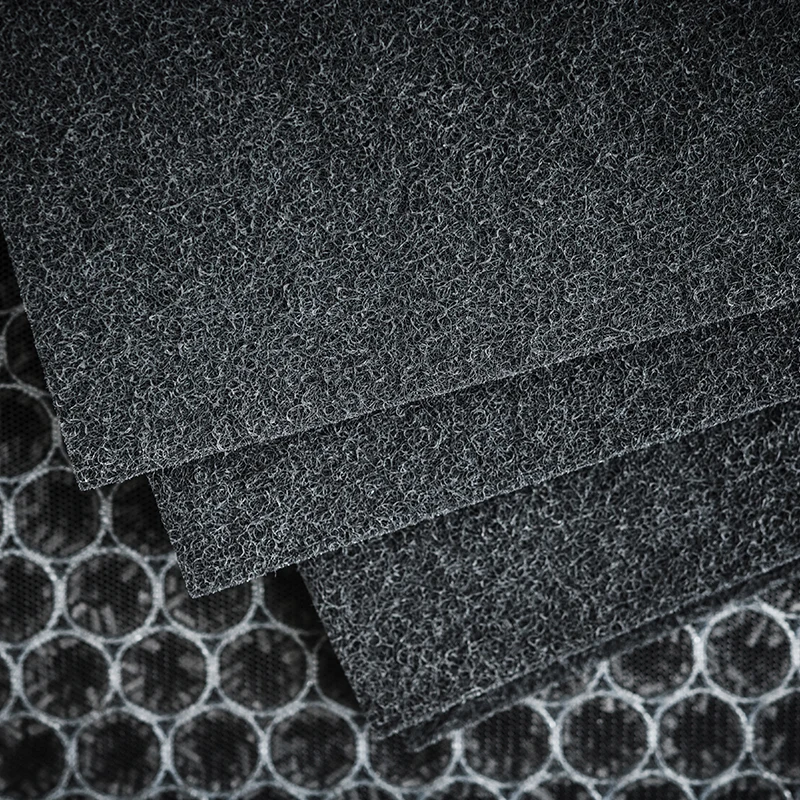
Where the media must stay flexible, carbon particles are bonded into a substrate. Nosso activated carbon media rolls include carbon cotton on a polyester fiber base, carrying wood-, coal- or coconut-shell powder. Carbon content runs at 50% or more with benzene adsorption of 20% or more, in thicknesses from 1 para 25 mm. The polyurethane foam equivalent is specified at 45% carbon and 22% benzene adsorption. In roll form, impregnation loads reach up to six times the base-web weight. This format lets a pleated panel treat odor without a loose-fill canister.
Impregnated Carbon for Targeted Gases
Potassium permanganate, potassium hydroxide, phosphoric acid and amine treatments turn the same granule into a reactive medium. Specify this class by the gas and the reagent loading, because a 1% and a 5% treatment are different products. The datasheet should name the target contaminant and state the impregnation percentage. If it lists only “treated carbon”, the media is not yet specified.
Filter Formats From Panels to Honeycomb Blocks
Format decides how the media meets your airflow. The same carbon grade performs worse in the wrong housing than a cheaper grade in the right one. Housing sets contact time, dust protection and the pressure drop your fan must overcome.
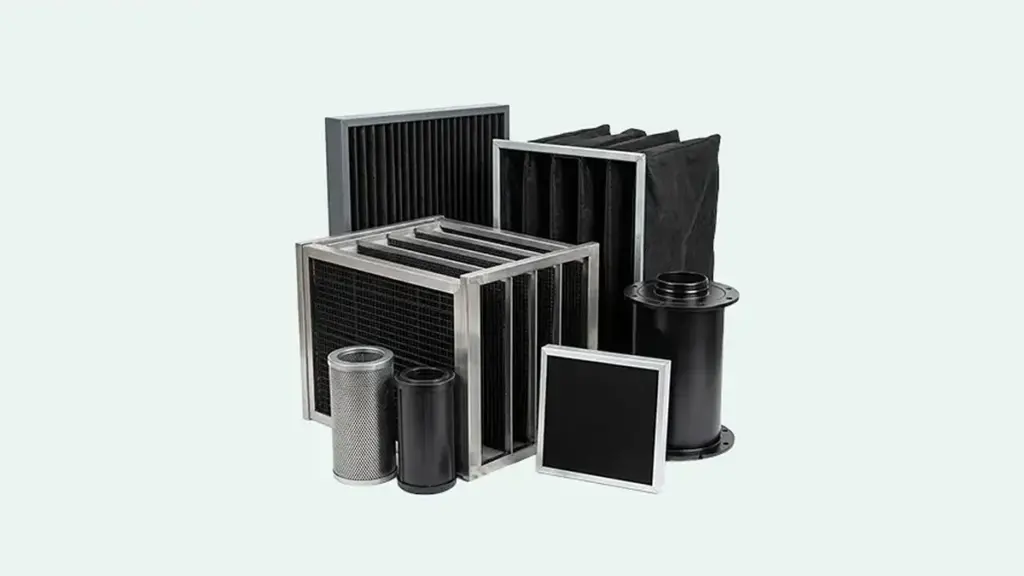
Loose-Fill Beds and Cylindrical Cartridges
Loose granules in a canister give the highest carbon mass per unit cost and the longest service intervals, which suits ventilation units with space for media. The known weakness is channeling. Air finds the path of least resistance and bypasses part of the bed, cutting effective contact time. Proper filling, an even support screen and a pre-filter limit the problem without removing it.
Painel, Pleated and Bag Formats
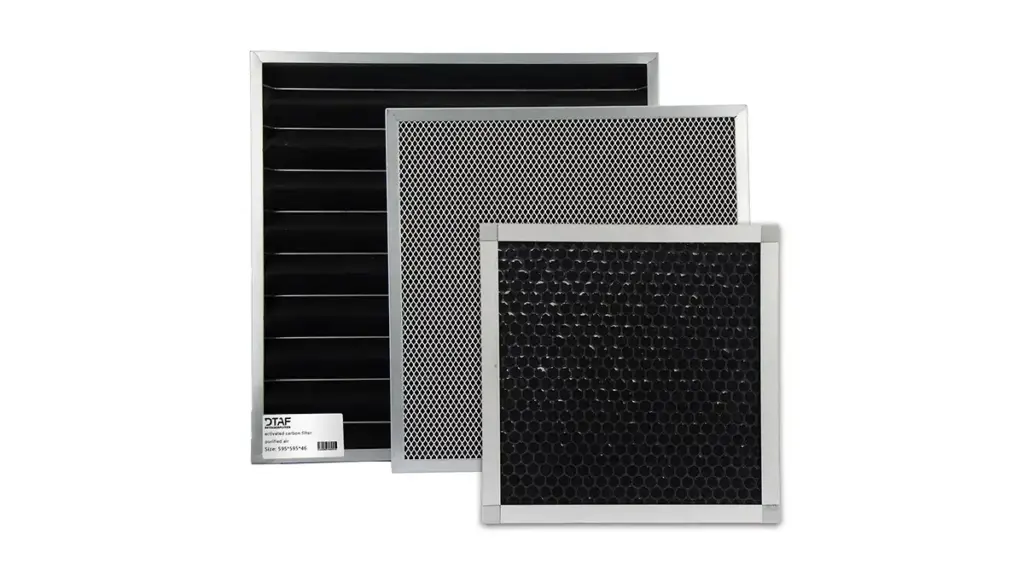
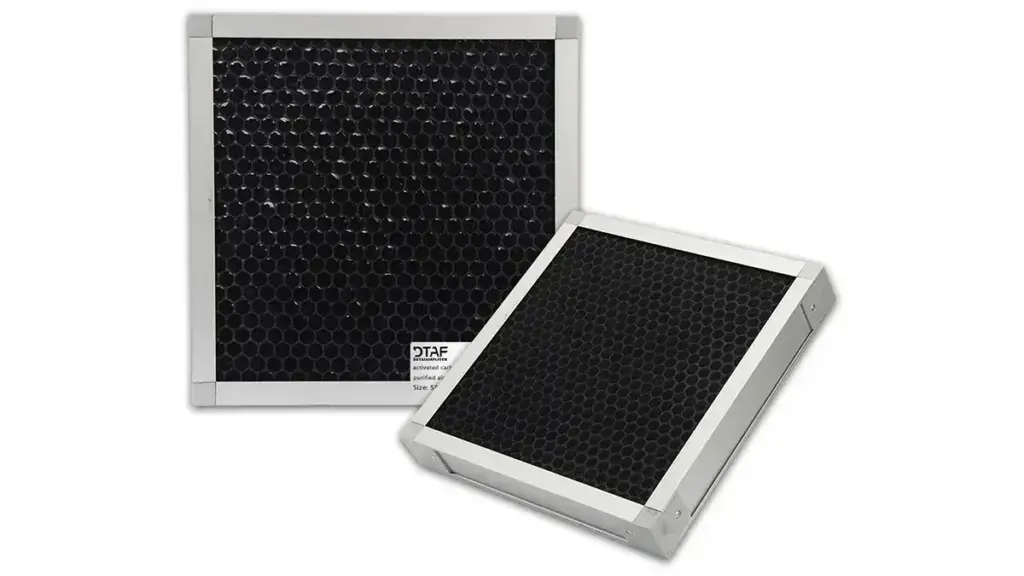
Our plate-type carbon filters are built in 25, 46, 50, 60, 70 and 100 mm thicknesses. Standard frames are 592×592, 575×575, 1175×575 and 610×610 mm, with custom sizes available, and initial resistance runs 50 para 90 Pai. Carbon cotton sits at the lower end and honeycomb granular plates at the higher end. Bag formats add surface area without depth, which helps where airflow is high and the odor load is moderate.
Honeycomb Blocks and Structured Media
Honeycomb extrusions place a substantial carbon mass in front of an open channel matrix, so a deep bed stays practical inside a duct section. Our honeycomb blocks are supplied with 1.5, 3, 4, 5 and 8 mm holes, a bulk density of 0.35 para 0.6 g/cm3, and moisture at or below 5%. Standard units measure 100x100x100 mm and 100x100x50 mm. The rigid structure cannot settle or channel, which keeps performance predictable.
Compressed Carbon Blocks Stay a Water Format
Solid compressed blocks dominate water cartridges, where pressure drop is affordable and channeling must be eliminated. In air treatment that same density starves airflow, so blocks appear only in low-velocity devices and always behind a pre-filter. If a supplier offers a water-grade block as a duct filter, treat it as a specification error rather than an upgrade.
Where Industrial Buyers Deploy Carbon Filters
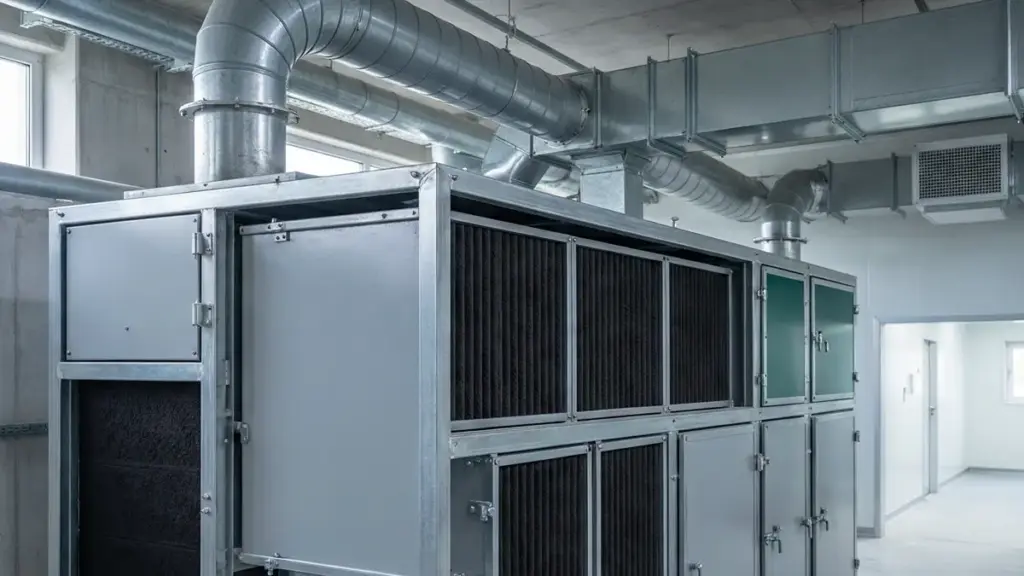
Carbon stages go wherever gases, odors or VOCs are the complaint, from building air handling to process exhaust and cleanroom supply air.
Commercial HVAC and Building Air Handling
Fresh-air handling units, office towers, hotels and data centers use carbon panels and cells to strip traffic fumes, ozone and industrial odor before air reaches the occupied zone. Commercial kitchens add a carbon stage after grease extraction. Residential purifiers and range hoods apply the same principle in a smaller carbon charge.
Process Exhaust and Odor Control
Factories, paint booths, printing lines and chemical plants capture solvent vapors and VOCs at the exhaust header. Wastewater stations and composting sites dose impregnated media for hydrogen sulfide and ammonia. These are the duty cases where inlet concentration, humidity and gas mix decide whether standard carbon survives a week or a quarter.
Salas limpas, Laboratories and Sensitive Spaces
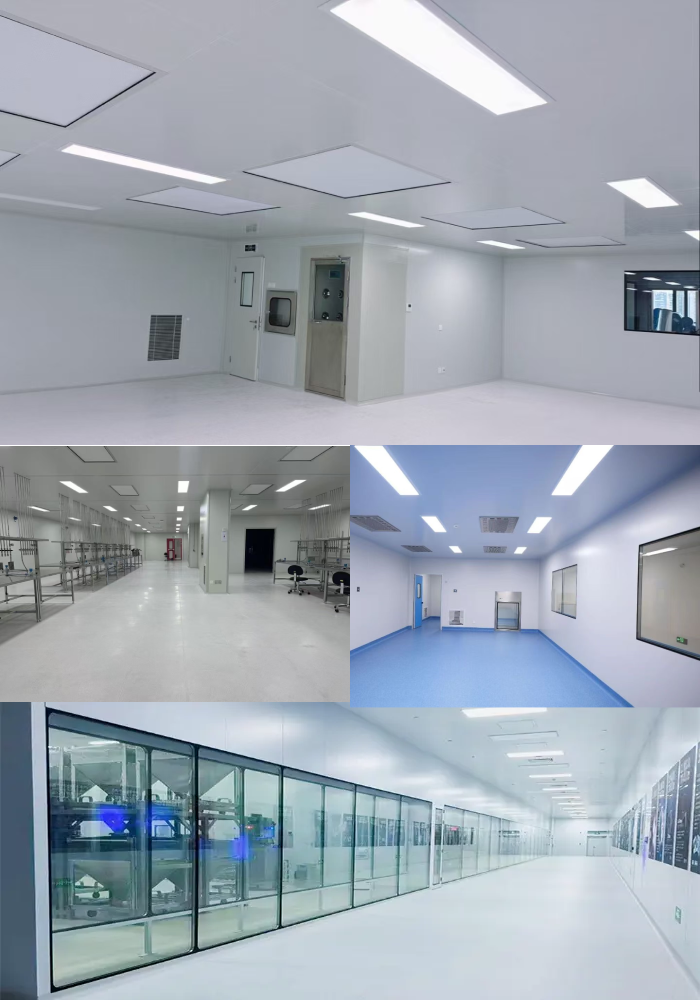
Pharmaceutical and electronics cleanrooms place a carbon cell upstream of the HEPA stage to control acid-gas contamination and protect personnel from fume-hood exhaust. Museums and archives use the same approach to slow degradation of documents. Fan filter units with an integrated carbon cell cover both stages where ceiling space is limited.
Source Certified Air Filters at MOQ 1
How to Specify an Activated Carbon Filter
Match the media to the gas, verify capacity with measured data, and confirm the filter will not starve the fan. A marketing claim is not a specification.
Selection drives operating cost, not just the purchase order. Work the five steps in order. Skipping the first two is how buyers end up with a filter that looks correct on an invoice and fails in service.
| Selection Step | Key Action |
|---|---|
| 1. Identify Contaminant | Name the gas and its inlet concentration. Standard carbon for VOCs, impregnated media for H2S, ammonia or chlorine. |
| 2. Choose the Air-Grade Form | Coarse GAC, extruded pellets, impregnated felt or honeycomb, matched to the housing and allowable pressure drop. |
| 3. Verify the Data Sheet | Iodine number, CTC activity, carbon content, moisture, bulk density and mesh size, each with its test method. |
| 4. Confirm System Fit | Check pressure drop at design airflow, contact time, and frame dimensions against the existing unit. |
| 5. Set the Change-Out Rule | Agree a saturation trigger in writing. Outlet gas detection beats a calendar interval for carbon. |
Ask for Numbers, Not Surface Area
BET surface area is one averaged figure and says little about your contaminant. Before comparing two activated carbon air filters, ask for iodine number, carbon content by weight, moisture, ash, bulk density, and mesh or pellet diameter. Iodine number reports micropore capacity in mg/g, while CTC activity is a carbon-tetrachloride adsorption index still common on gas-phase datasheets. Then ask which method produced each figure. A capacity measured on toluene at 25 C and 50% humidity says little about ammonia at 80% humidity.
Size the Bed Before the Cartridge
Two parameters decide whether the unit works: face velocity and contact time. Air-side contact time in a carbon bed is short, commonly well under a second, and it shrinks further as airflow rises. An undersized bed breaks through early regardless of media grade. An oversized one charges the fan static pressure it does not need to spend.
Four Recurring Specification Mistakes
- Buying water-grade fine mesh carbon for an air duct, where it chokes airflow and releases dust.
- Ranking products on surface area alone, without pore distribution or gas-specific capacity data.
- Ignoring the pressure-drop budget of the fan, so the system simply moves less air.
- Applying untreated carbon to reactive gases that only impregnated media can hold.
Service Life, Pressure Drop and Replacement Triggers
Lifespan follows contaminant load, carbon mass and operating conditions, not a printed interval. Pressure drop shows a dirty filter, not a spent one.
What Actually Consumes the Carbon
- Inlet concentration of VOCs and gases, the primary driver of how fast capacity is used.
- Airflow rate and total runtime, which set how much air the bed must treat.
- Carbon mass and bed depth, which correlate directly with durability.
- Operating conditions. Our plate-type filters are rated for 5 para 55 C and work best between 35 and 65% relative humidity.
- Pre-filtration quality, because dust that seals the media ends service life early.
Why Pressure Drop Is the Wrong Signal
This is the most expensive misunderstanding in carbon specification. A saturated bed can still pass air almost as freely as a new one, because adsorbed molecules occupy pores without blocking the flow path. Our plate-type panels start at 50 para 90 Pa and reach a recommended terminal resistance of 180 para 220 Pai. That limit tracks dust loading on the fiber media. Carbon saturation is best confirmed by outlet gas detection, with pressure drop as a secondary indicator only.
Replacement Triggers You Can Act On
- Outlet gas readings from a photoionization detector or target-gas tube, trending toward breakthrough.
- Return of the target odor at the diffuser, which means breakthrough has already begun.
- Scheduled replacement of the pre-filter stage, so the carbon never faces raw dust loading.
- A spent-media lab check when a service interval is disputed with a supplier.
For the mechanical side of the same calculation, our guide to HEPA filter pressure drop explains how initial and terminal resistance set realistic change-out intervals.
Ordering Custom Carbon Filters From a Factory
A vague RFQ produces a vague filter. Buyers who get consistent media send one complete specification sheet. These are the fields a manufacturer needs to quote against, and our carbon filter range is built to them as standard OEM work.
- Outer dimensions, thickness and housing type: panel, cartridge, cylindrical, bag or loose media.
- Media class: granular, pelletized, carbon cotton, foam or honeycomb, plus impregnation type and loading.
- Required carbon mass or bed depth, which sets capacity more reliably than any efficiency claim.
- Design airflow and the maximum allowable pressure drop at your fan.
- Named contaminant list with expected inlet concentrations and operating humidity.
- Target service interval and the breakthrough definition you will judge it by.
Perguntas frequentes
What does an activated carbon air filter remove?
It removes gaseous pollutants: volatile organic compounds, solvent vapors, fumes from paints and cleaners, and odor molecules. It does not remove dust, pollen or mold spores, and it carries no particulate efficiency rating. Pair it with a mechanical pre-filter or HEPA stage whenever particles are also present.
Does activated carbon remove formaldehyde?
Only partially, and not reliably in untreated form. Formaldehyde is small and polar, so it bonds weakly to standard carbon and desorbs as temperature rises. Effective control requires treated or catalytic media, correct bed depth, and breakthrough testing at your actual inlet concentration rather than a datasheet percentage.
How long does a carbon filter last in commercial HVAC?
Quoted intervals of three to six months for light duty, or six to twelve months for larger charges, are starting points rather than predictions. Real life equals carbon capacity divided by the contaminant mass arriving per hour. High humidity, heavy VOC load and missing pre-filtration shorten it. Outlet gas detection is the dependable end-of-life signal.
Can activated carbon filters be washed or reused?
No, not in service. Water closes the pores and leaves the media loaded with whatever it held. Industrial regeneration is a separate thermal process for bulk carbon, carried out in a kiln and never inside a filter housing. Sunlight or a freezer restores negligible capacity, so replace spent media and dispose of it as contaminated waste.
Which is better, carbon pellets or carbon-impregnated fabric?
Neither, because they answer different questions. Pellets carry far more carbon per volume and suit sustained VOC loads where the fan can afford the resistance. Impregnated felt and foam add little pressure drop and are the right choice for odor polish, thin pleated panels and high-airflow systems where depth is limited.
Final Thoughts on Carbon Filter Selection
Generic media can look cheap on a purchase order and expensive in operation. Specifying your activated carbon air filter against validated data protects a project from premature saturation and unplanned change-outs. Work from iodine number and carbon content through to breakthrough behavior at your own humidity, rather than a quoted percentage.
Verify before you commit. Request a media sample and a full technical data sheet, and test them against your requirements. Send our engineering team your airflow, contaminant list and pressure-drop limit, and we will build a custom OEM specification around them.