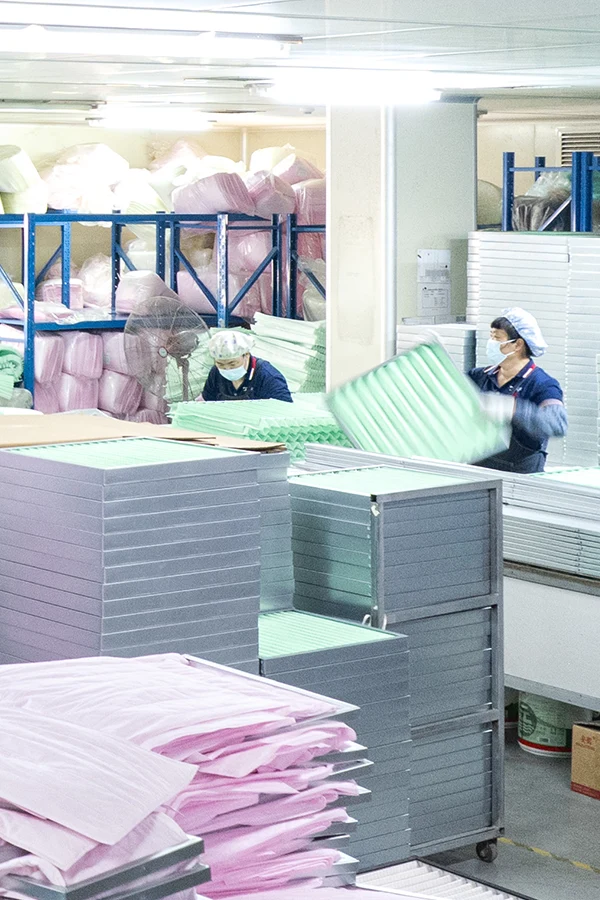
Selecting a custom HEPA filter manufacturer on unit price alone introduces real project risk, from mismatched dimensions to performance failures in the field. A poorly made filter doesn’t just underperform; bypass leakage can compromise system integrity, invalidate an entire controlled environment, and cause costly delays.
This guide lays out a technical vetting framework for industrial buyers. It covers the data points that separate qualified manufacturers from order takers, from EN 1822 test reports and pressure drop curves to the physical integrity of frames and seals, so the supplier you select can deliver consistent, batch-to-batch performance for your project.
When Does a Project Need a Custom HEPA Filter?
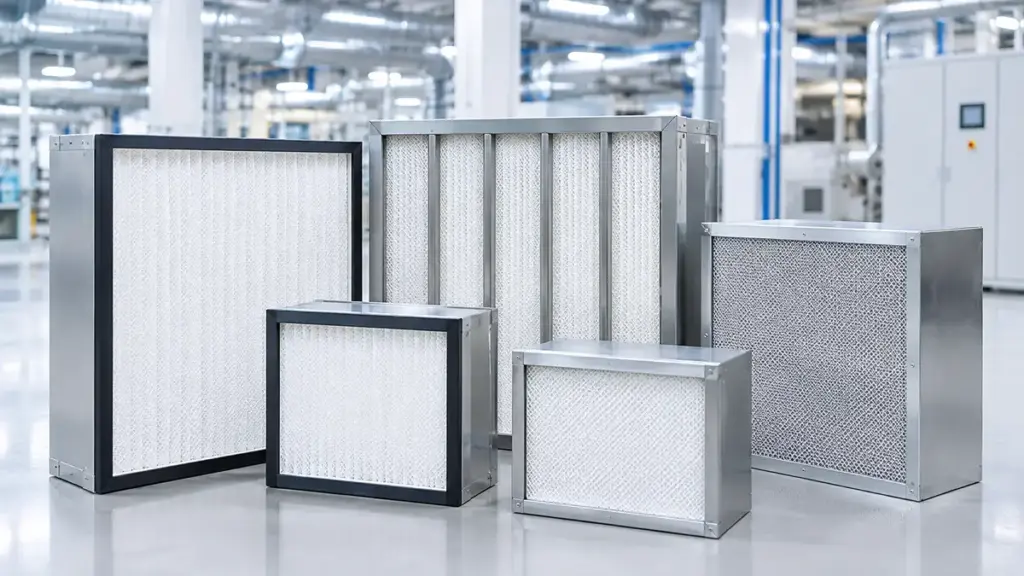
A project needs a custom HEPA filter when standard sizes don’t fit, specific performance targets must be met, or validated documentation is required for the application.
The choice between standard and custom comes down to hard project requirements. If an off-the-shelf product creates installation or performance issues, customization is a necessity, not a luxury. The decision is driven by fit, performance targets, and compliance demands that a generic filter cannot satisfy.
When Standard Filters Fall Short
Going custom becomes essential when catalog items cannot resolve these constraints:
- The equipment housing has non-standard dimensions or a mounting geometry that a stock filter won’t fit without modifications.
- A specific airflow and pressure drop target must match the equipment’s fan curve and performance goals.
- The installation demands a specialized seal, such as a fluid gel or a custom-molded gasket, to prevent bypass leakage.
- The project requires audited documentation or batch-specific test certifications for that exact application.
Scenarios Where a Standard Filter Is Sufficient
When speed and low-volume cost matter more than tailored specifications, a standard filter is often the right call:
- An off-the-shelf size fits the housing or ceiling grid without adapters or modifications.
- A standard HEPA grade, such as H13 or H14, already meets the cleanliness target for the space.
- A tight timeline makes the quick delivery of stock items a priority.
- The order quantity is too low to justify custom engineering and tooling costs.
Project Types That Often Require Customization
Certain applications are far more likely to need custom filters because the filtration component is integral to the system’s function, safety, or compliance:
- OEM equipment where the filter’s size, shape, and performance are engineered into the machine’s core design.
- Cleanroom ceiling grid modules for electronics, pharma, or medical device manufacturing.
- Custom terminal filter housings or boxes with dimensions or seals that don’t match standard frames.
- Final filtration in air handling units (AHU) for hospital isolation rooms or laboratories.
Which Manufacturing Capabilities Should You Verify?
When vetting a supplier, verify their technical standards, production environment, engineering support, and realistic output figures, not just factory claims or a low price tag.
Technical Standards and Quality Systems
- Demand EN 1822 test reports for the exact HEPA grade you need, such as H13 or H14. Don’t accept a generic certificate for a different product.
- Confirm a valid ISO 9001 certification as basic proof of structured process control.
- Require documentation proving compliance for your target export markets to avoid problems at customs.
- Ask whether every unit is inspected before shipping. 100% inspection is a strong quality signal; batch sampling is a gamble.
Production Process and Environment
- Assess their pleating technology and media spacing control. Poorly managed pleats directly affect airflow resistance and filter performance.
- Confirm assembly takes place in a controlled environment, such as an ISO 7 청정실, to prevent media contamination during manufacturing.
- Check capabilities in potting, gasketing, and die cutting. Weakness in these processes is a common source of leaks.
- Ask about supply chain consistency for media and frames. An unannounced material substitution causes performance to drift between batches.
Engineering and Customization Support
- Look for real R&D support for co-designing a filter to meet your airflow or pressure drop targets. You want an engineering partner, not just an order taker.
- Confirm they can produce the exact format you need, whether panel, cartridge, or V-bank configuration.
- Evaluate their OEM/ODM track record with private labeling or complex custom builds.
- Check their ability to supply samples or small pilot batches, so you can validate the design in your application before committing to volume.
Production Capacity and Logistical Reliability
- Request realistic daily or monthly output figures for your filter design, not an inflated factory total.
- Obtain lead times in writing and clarify the process when delays occur.
- Ask for performance data beyond initial efficiency, such as dust-holding capacity and final pressure drop, to predict service life and total cost of ownership.
- Confirm the minimum order quantity (MOQ) for your specific design early, before investing more time in qualification.
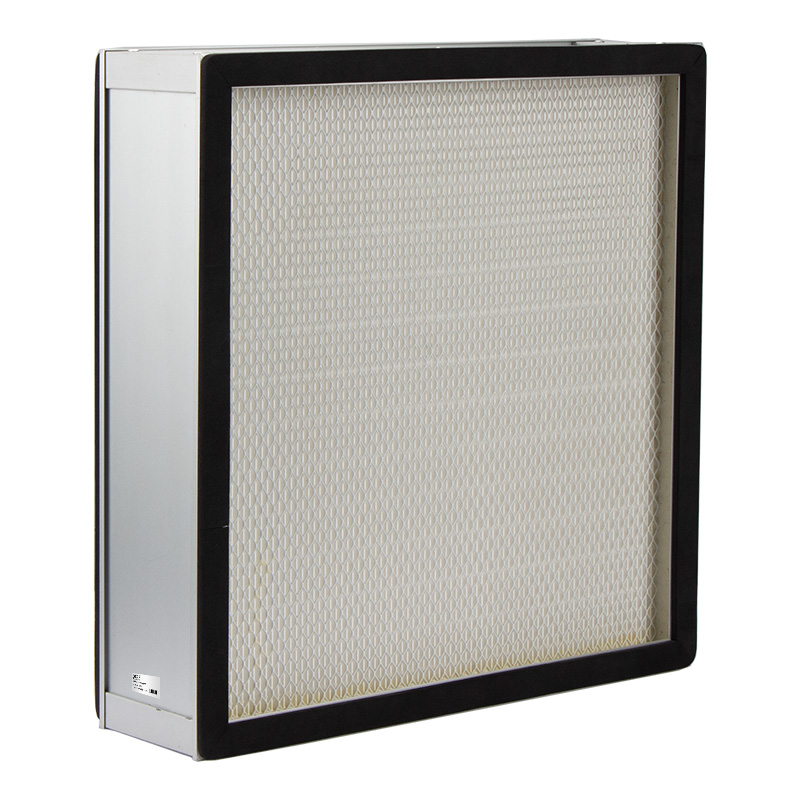
What Test Reports and Certificates Should You Require?
A filter’s factory test report proves its rating, but the installed integrity test proves it doesn’t leak. They are not the same document, and regulated industries add stricter rules.
Factory Classification Standards
Manufacturers prove a filter meets its stated grade before it ships through classification standards. The primary European and international references are EN 1822 ISO 29463, which define classes such as H13 and H14 based on capture efficiency at the Most Penetrating Particle Size (MPPS), the particle size hardest for the media to stop. In North America, IEST-RP-CC001 serves the same purpose. For a side-by-side comparison of the two classification systems, see our guide 안에 1822 대 ISO 29463: HEPA 및 ULPA 필터 분류 설명.
Installed Filter Integrity Testing
Once a filter is installed, performance depends on the entire system. A flawless filter with a bad seal is a failed system. In-situ integrity testing, governed by methods in ISO 14644-3, verifies there are no leaks in the filter media, the gasket seal, or the housing frame. The common practice introduces a challenge aerosol, such as PAO, upstream and scans the downstream face with a photometer. This report matters for cleanroom commissioning, periodic certification, and GMP compliance in pharmaceutical and other regulated environments.
Requirements for Nuclear and Regulated Facilities
For nuclear and similarly regulated industries, standard commercial reports are not enough. Filters intended for U.S. Department of Energy (DOE) nuclear facilities must meet the requirements of DOE-STD-3020 and DOE-STD-3025, which impose strict quality assurance, testing, packaging, and documentation rules that go far beyond commercial norms. ASME AG-1 is also frequently referenced for nuclear-grade fabrication and quality control. Any supplier serving this sector should be able to demonstrate compliance with these standards.
Key Information on a Filter Test Report
Claims of performance are meaningless without verifiable proof. Every HEPA and ULPA filter should ship with its own factory scan test report, because batch testing is not an acceptable substitute for these products. When you review that report, insist on:
- Filter class and standard: the exact class (예를 들어, H14) and the standard used, including the year (예를 들어, 안에 1822:2019).
- Efficiency values: overall efficiency, and local efficiency measured at MPPS for higher grades.
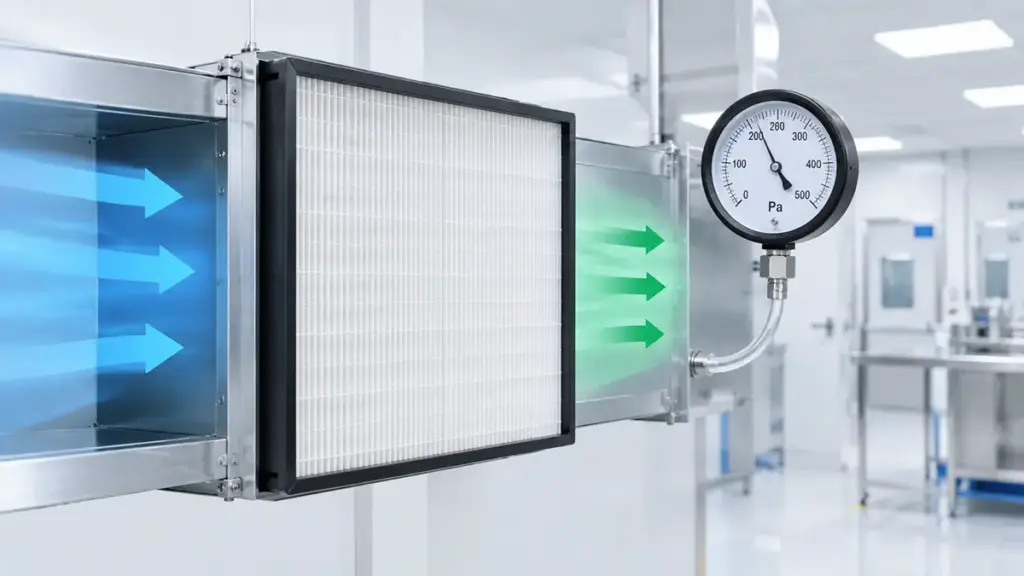
- Pressure drop: initial resistance measured at the stated test airflow. A pressure drop figure without an airflow rate is useless.
- Traceability: a unique serial number on both the report and the filter itself, which is fundamental for audits.
- Pass/fail criteria: clearly stated acceptance limits, not just a list of raw measurements.
How Should You Assess Frames, Seals, and Dimensions?
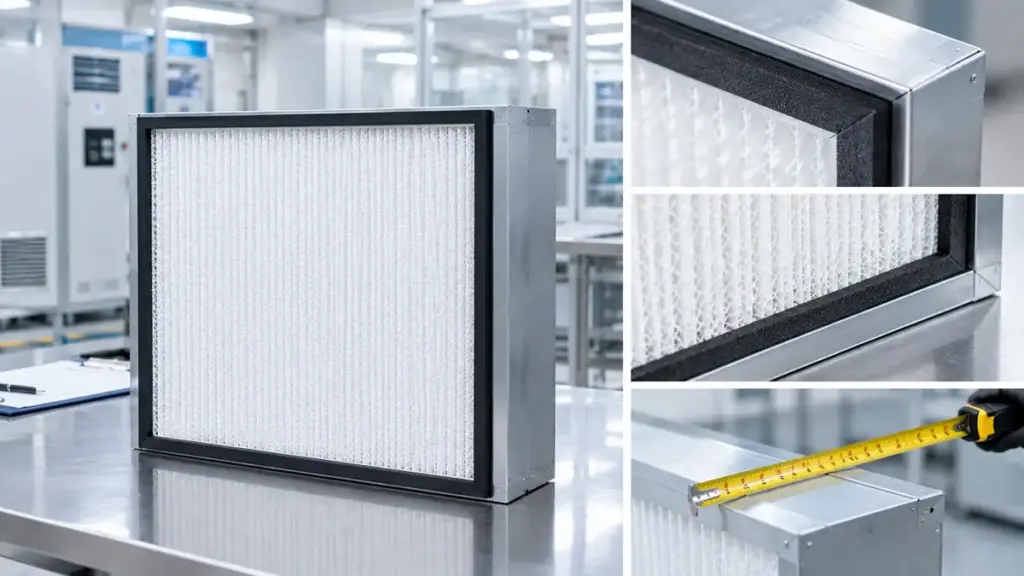
The frame, seal, and dimensions work as a single system. A poor fit or leaking seal negates the HEPA media’s efficiency, making physical assessment as important as the filtration rating.
Frame Integrity and Material Compatibility
A filter’s frame is a structural component, not just a box. A weak frame bows or twists under airflow pressure, creating bypass leaks that render high-efficiency media useless.
- Confirm the frame material (예를 들어, aluminum, 아연 도금 강철) is non-shedding, corrosion-resistant, and mechanically stable for your environment.
- Check structural rigidity so the frame won’t deform during installation or under operational airflow.
- Inspect corner joints and seams for gaps, the most common leak points.
- Make sure the surface finish or coating suits your conditions, especially high humidity or chemical exposure.
Seal Performance and Bypass Prevention
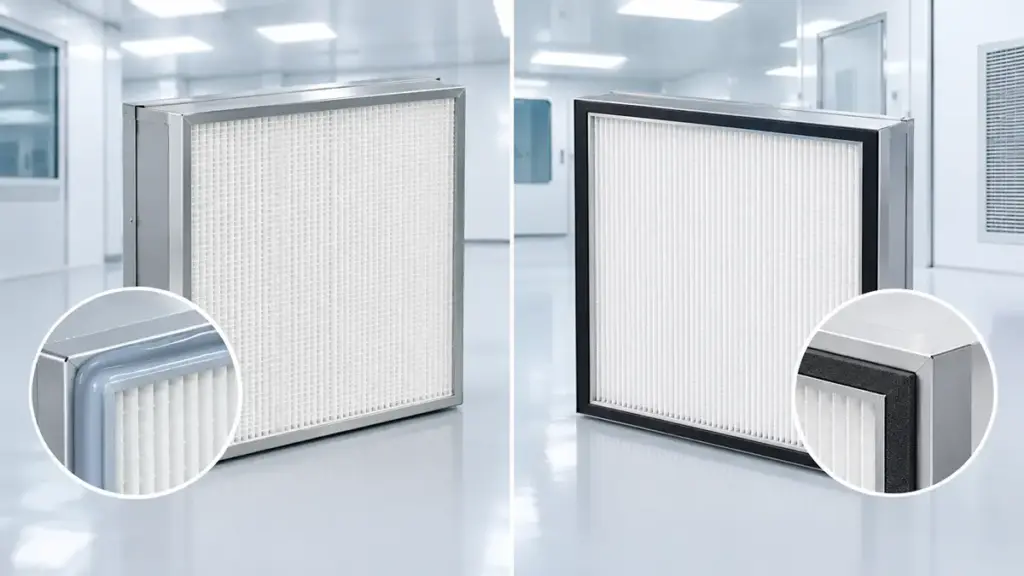
The seal is your primary defense against air bypassing the filter media. Even a filter that meets its rated efficiency is compromised by a poorly designed or installed seal. For a detailed comparison of the two main sealing approaches, see our article 클린룸 시스템용 젤 씰과 개스킷 씰 HEPA 필터.
- Match the seal type, gasket or gel, to the housing design, such as a knife-edge for gel seals or a flat surface for gaskets.
- Confirm the seal compresses uniformly across the entire perimeter to prevent localized leaks.
- Assess durability against temperature changes, pressure cycling, and vibration over the service life.
Dimensional Accuracy and Housing Fit
“Close enough” doesn’t work for HEPA installations. Mismatched dimensions lead to gaps, binding that prevents a proper seal, or installation failure. Always work with actual dimensions, not nominal catalog sizes.
- Confirm the filter’s actual outer dimensions, not just the media size, against the installation opening.
- Check frame depth for enough clearance for mounting hardware and other components.
- Review the manufacturer’s dimensional tolerances on technical drawings before approving any custom order.
- Measure the receiving housing or ceiling grid yourself to prevent problems on installation day.
What Does a Good Sample and Approval Process Look Like?
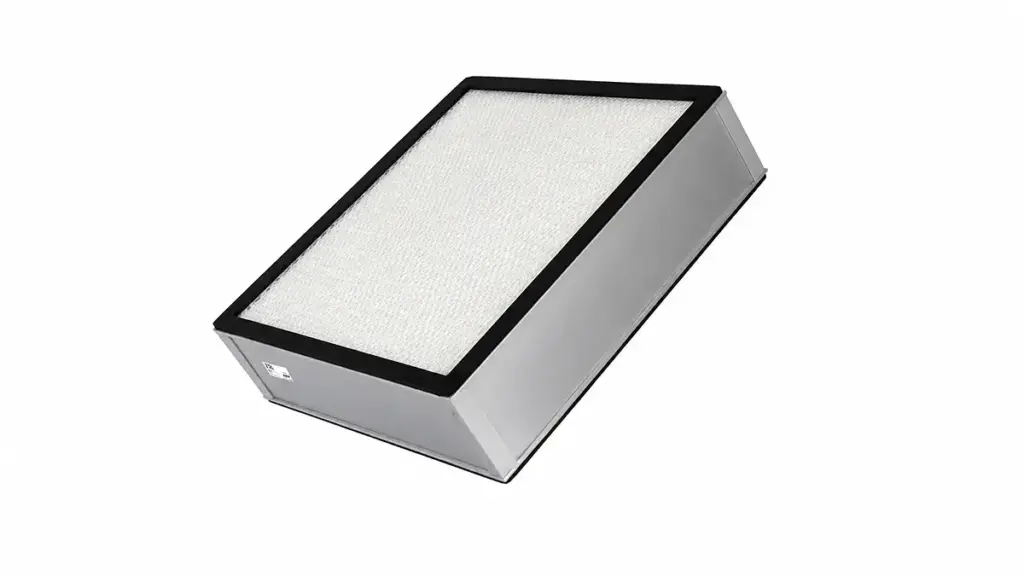
A strong sample process is a documented, multi-stage qualification that proves a filter meets spec with objective testing before bulk production begins.
The Step-by-Step Approval Workflow
A reliable process moves from broad requirements to a locked-down product in stages, with each step generating a deliverable that builds confidence for the next:
- Requirements capture: both parties align on filter class, 치수, target airflow, pressure drop limits, and materials.
- Design and review: the manufacturer produces drawings and a bill of materials (BOM), which you review and approve.
- Sample production and inspection: representative samples are built with the same materials and methods intended for production, then inspected for dimensional accuracy and workmanship.
- Performance testing: samples are tested for efficiency, 압력 강하, and leak integrity.
- Customer review and release: a formal written sign-off locks the design before mass production starts.
Critical Acceptance Criteria for Approval
Approval should rest on predefined, objective criteria tied to how the filter performs in its intended application:
- Integrity: during an aerosol scan test, no single point leak should exceed 0.01% of the upstream challenge concentration.
- 능률: the filter meets or exceeds the specified collection efficiency, such as 99.95% at MPPS for an H13 grade.
- Pressure drop: initial resistance at the rated airflow falls within the specified tolerance.
- Workmanship: free from physical defects, including media pack damage, incomplete sealant, or flaws in the frame.
Red Flags in a Weak Sample Process
- Samples are approved on visual inspection alone, without supporting performance data.
- Prototype materials differ from what will be used in the production run.
- No documented test results for efficiency, 압력 강하, or leak integrity accompany the sample.
- There is no formal sign-off, leaving confusion about which version of the sample was approved.
How to Compare Quotes Beyond Unit Price
A cheap unit price often hides higher lifetime costs. Compare quotes on total ownership cost, not just the initial purchase.
Standardize Technical Inputs Before Comparing
You can’t compare quotes if suppliers are bidding on different things. Before sending out an RFQ, create a single specification sheet that requires every supplier to quote the same airflow, filter class, and physical dimensions, under identical operating conditions such as temperature, 습기, and pressure drop limits. Define the full scope of supply as well, so prices explicitly include frames, gaskets, freight, and any testing services.
Separate One-Time Costs from Recurring Expenses
Isolate the one-time capital expense for housings or main units from recurring costs such as replacement filters and service labor. Scrutinize each bid for omitted items like commissioning, testing, or freight, and add an estimated cost back in to create an adjusted, apples-to-apples comparison. List all consumables, including pre-filters and sealants, to see the true recurring material cost.
Model Total Lifecycle Cost Over a Fixed Period
Judge a quote on total cost of ownership over a fixed period, such as five years, covering the initial purchase price, projected energy consumption, and all replacement costs. Pay close attention to pressure drop: higher resistance forces fans to work harder, and a cheaper filter with poor airflow characteristics can end up costing more to operate. A durable filter with a longer service life often provides a better return even at a higher upfront price.
Assess Serviceability, Compliance, and Risk
Some of the biggest costs aren’t on the quote. Review how easily the filter can be accessed and changed out; difficult service increases labor cost and can delay maintenance. Read the warranty terms and exclusions carefully. Finally, confirm the filter meets the compliance standards your facility or process requires. A cheap filter that fails an audit is not a bargain; it’s a liability.
Custom HEPA Filter RFQ Checklist
Use this checklist to collect complete, comparable quotes from candidate manufacturers:
| RFQ Category | Information to Provide |
|---|---|
| Application and Equipment Context |
|
| Performance and Compliance |
|
| Physical Design and Operating Conditions |
|
| Testing, 선적 서류 비치, and Commercial Details |
|
자주 묻는 질문
Can HEPA and ULPA filters be manufactured in custom sizes?
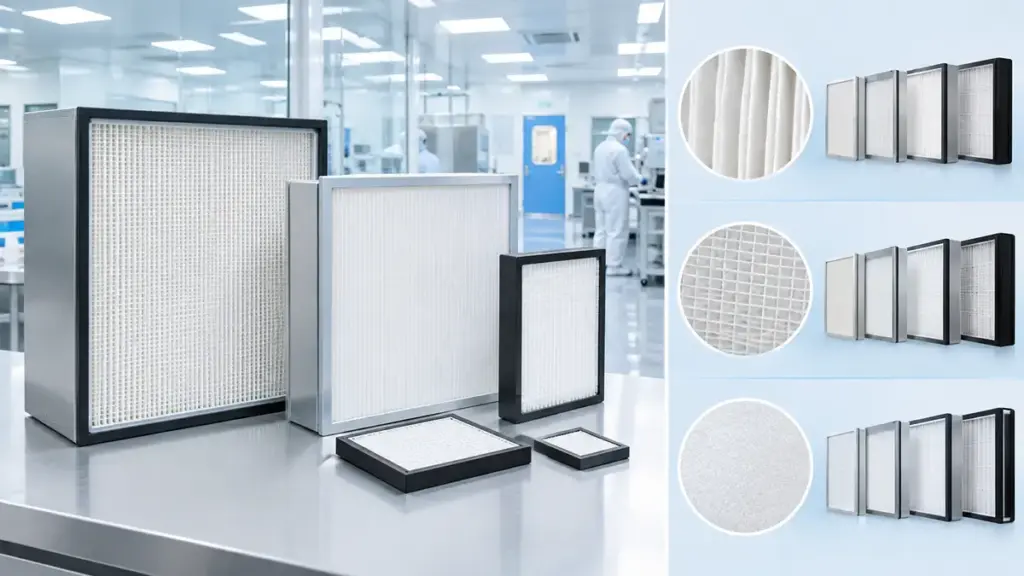
예, custom sizing for HEPA and ULPA filters is a standard offering for industrial, medical, and OEM applications. Manufacturers can adjust dimensions, efficiency grades (H13, H14), frame materials such as aluminum or stainless steel, and seal types such as gaskets or gel seals. The process typically starts with the customer providing drawings or housing dimensions.
What should buyers ask a custom HEPA filter manufacturer?
Key questions include which efficiency standard the filter meets (such as EN 1822), requests for actual test reports, and certifications like ISO 9001. Also ask about production capacity for your specific filter, sample availability, lead times, and experience with similar custom projects. On your side, provide clear technical requirements for dimensions, 기류, and sealing.
Which certificates and test reports should a supplier provide?
A credible supplier provides an ISO 9001 certificate and, more importantly, an individual factory test report for each filter. This report documents the test standard used (such as EN 1822), measured efficiency, pressure drop at the specified airflow, and a unique serial number. For critical applications, a scan leak test report for each unit is standard practice.
How should samples, prototypes, and batch consistency be approved?
Use a structured process: first approve the engineering drawings, then test a physical prototype to confirm fit, performance, and construction. Once a sample is signed off, it becomes the master reference for all future production, with consistency managed through lot traceability and continuous quality control.
Final Thoughts
Choosing a custom HEPA filter manufacturer on unit price alone invites unacceptable risk from leaks, contamination, and failed audits. The documented manufacturing and testing requirements in this guide form a qualification standard that protects your system from performance failures that can compromise an entire controlled environment.
The next step is execution. Use the RFQ checklist to formalize your requirements, then run the sample and approval process to validate a supplier’s ability to meet your specifications before you commit to a production order.