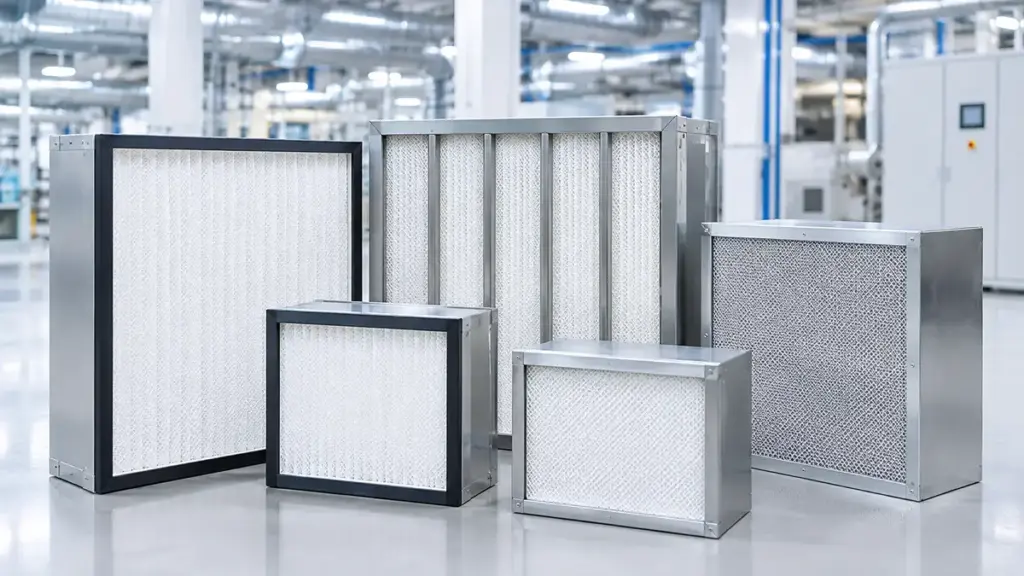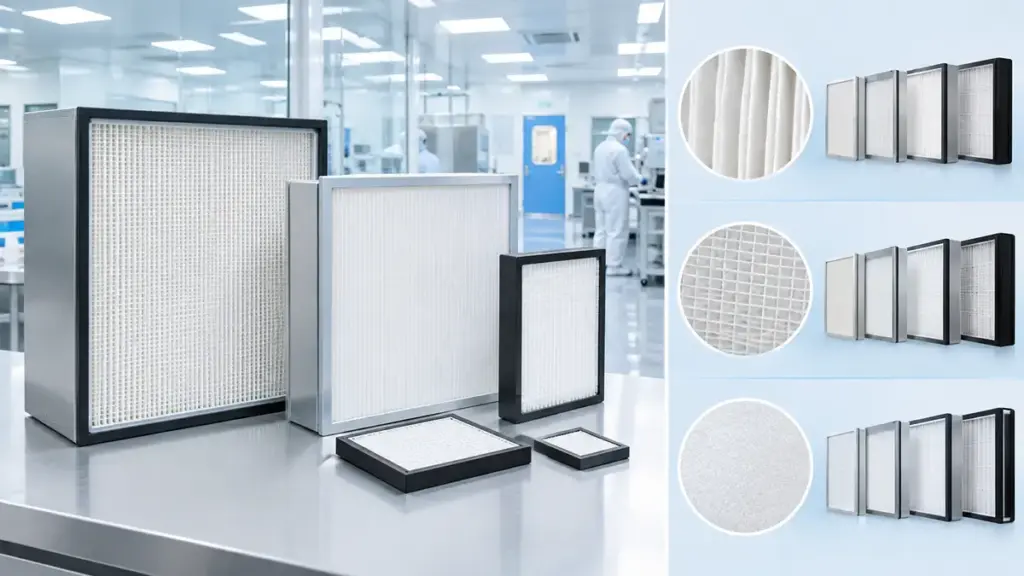
The gel seal vs gasket seal HEPA filter decision is critical for preventing air bypass, where a single leak can cause an entire cleanroom system to fail certification. This choice directly controls the risk of product contamination and personnel exposure, with immediate implications for operational uptime and compliance costs. A seal failure is a system failure, making this selection a primary engineering control, not a procurement afterthought.
This analysis benchmarks both seal types against industry standards for performance verification, as defined in ISO 14644-3. We evaluate key factors like housing compatibility (knife-edge vs. flat surface), installation tolerance, and long-term failure modes such as gasket compression set. The goal is to provide empirical data to help you specify the correct filter and avoid a costly failed in-situ leak test.
Why Does HEPA Filter Sealing Matter?
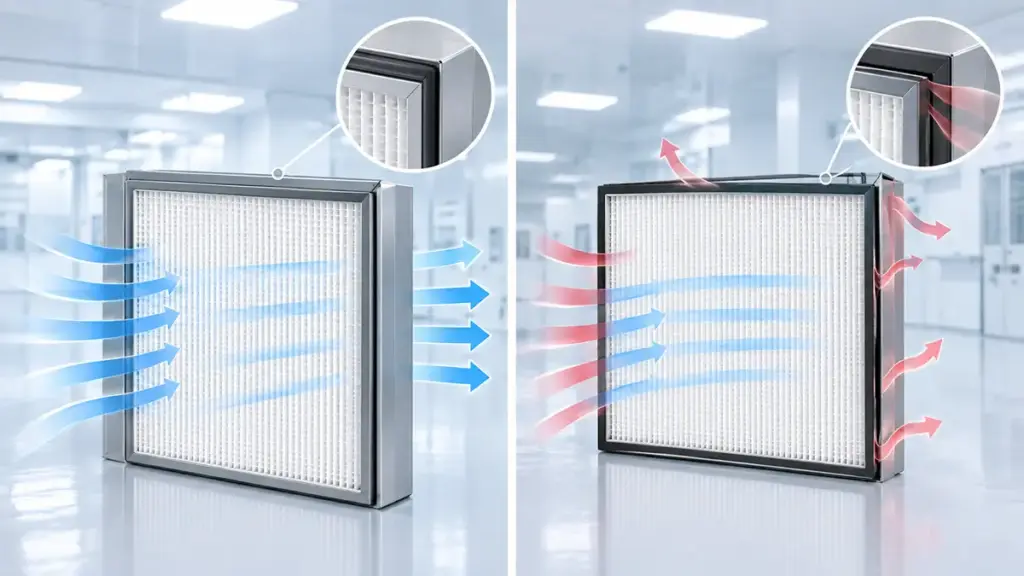
A HEPA filter’s efficiency rating is not the determining factor if air leaks around it. The seal’s integrity dictates the system’s actual performance, not just the filter media’s spec sheet.
How Air Bypass Undermines HEPA Filtration
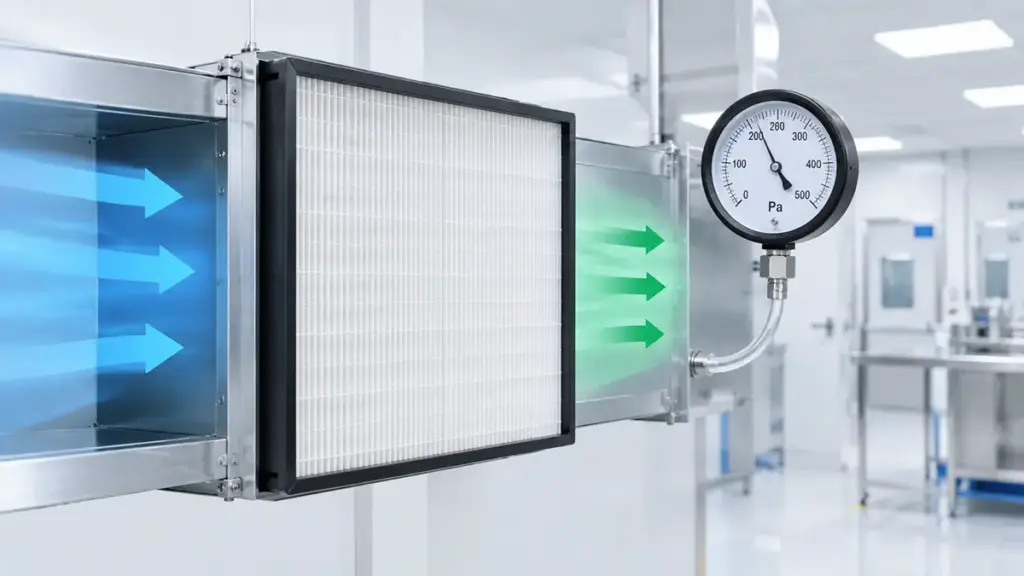
Air typically follows the path of least resistance. Any gap between the filter and its housing creates a shortcut, allowing contaminated air to bypass the filter media instead of passing through it. A HEPA filter’s efficiency rating applies only to the air forced through the media, not the entire airflow when leaks are present. A filter system with a properly rated HEPA media can perform like a much lower-grade filter if even a small seal leak exists.
Practical Causes of Seal Failure
Improper installation is a primary cause of immediate leakage, often from uneven tightening or incorrect filter seating. Over time, gaskets can degrade from constant compression, vibration, or temperature changes, losing their ability to maintain a tight seal—a problem known as “compression set.” The condition of the housing’s mating surface is also critical; any scratches, dirt, or warping can prevent both gaskets and gels from sealing properly.
Seal Integrity in Critical and Regulated Environments
In cleanrooms, biosafety cabinets, and hazardous containment systems, a seal failure can lead directly to product contamination or personnel exposure. Performance verification in these settings includes in-place integrity testing, which challenges the seal, not just the filter media. A single leak detected around the filter seal is enough to cause an entire system to fail certification, proving that the seal is just as critical as the filter itself for compliance and safety.
How Does a Gel Seal Work?
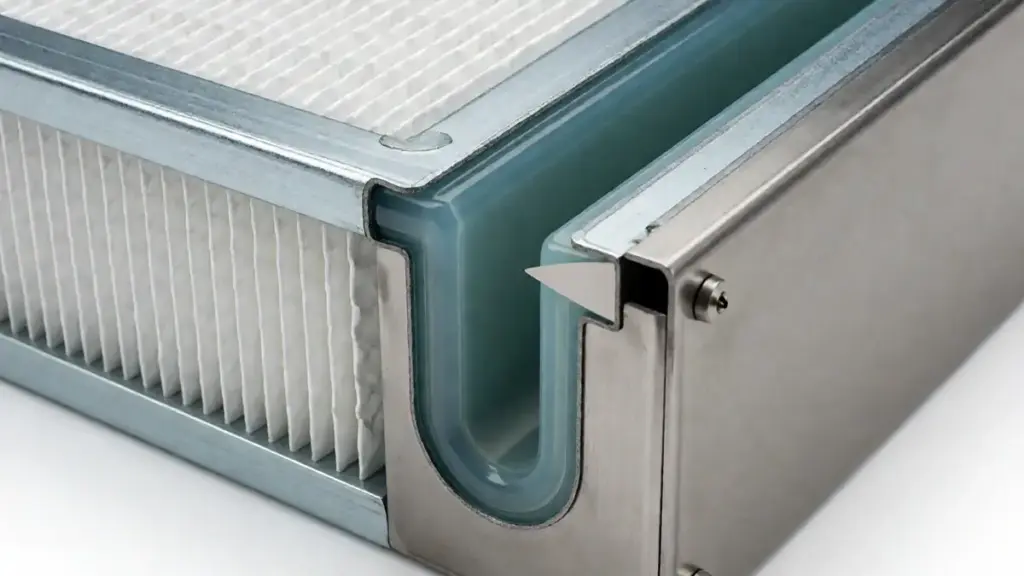
A gel seal uses a compliant, sticky gel in a filter frame. A housing knife-edge sinks into it, creating an airtight barrier that stops air from bypassing the filter.
Fundamental Sealing Mechanism
A gel seal operates on a simple but effective principle. The filter frame is designed with a perimeter groove filled with a compliant, silicone-based gel. When the filter is installed, a sharp “knife-edge” on the housing presses directly into this gel. This action displaces the gel and forms a continuous, airtight barrier around the entire perimeter. The seal’s effectiveness stems from the gel’s natural adhesion and flexibility, which allows it to conform tightly to the knife-edge and fill in any minor surface irregularities. This design helps maintain a reliable seal even when subjected to changes in temperature and pressure.
Practical Performance and Materials
In practice, gel seals provide very high resistance to leaks and maintain a stable seal, even in environments with persistent vibration. A key advantage is that the gel can often re-form or “heal” itself around the knife-edge. This allows a filter to be carefully removed and reinstalled without necessarily compromising the seal, unlike a gasket that can take a permanent compression set. The most common materials used for the gel are silicone and polyurethane, chosen for their long-term stability, temperature range, and adherence properties based on the specific operational demands of the application.
How Does a Gasket Seal Work?
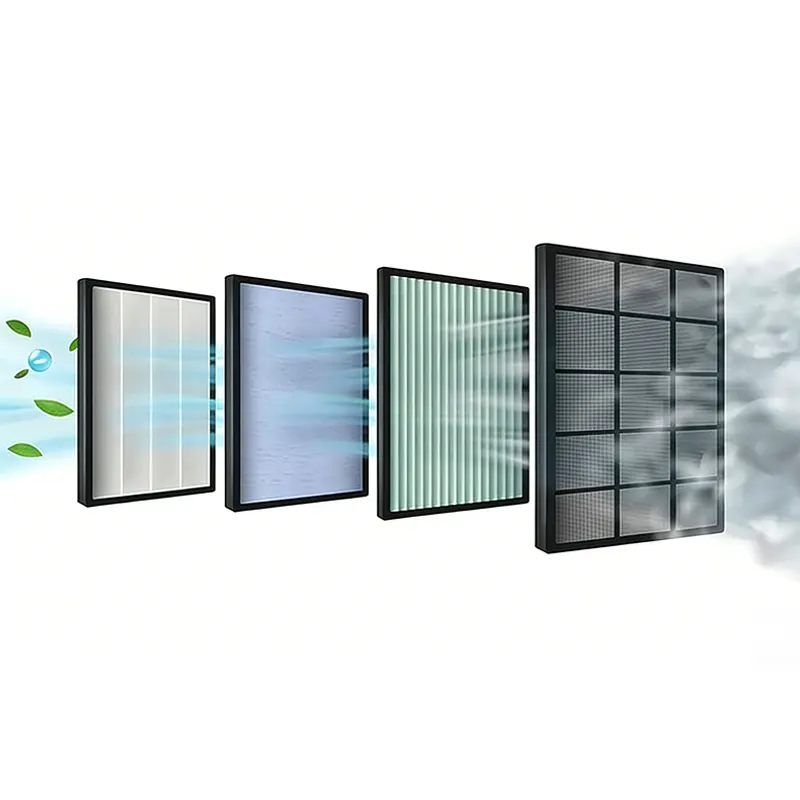
A gasket creates a seal by being compressed between two surfaces. This mechanical force makes the material deform and fill microscopic surface gaps, blocking potential air leaks.
The Principle of Compression Sealing
A gasket seal works by being compressed between two mating surfaces, like a HEPA filter frame and its housing. This compressive force causes the gasket material to deform and flow into the microscopic peaks and valleys that exist on even the smoothest-looking surfaces. By filling these irregularities, the gasket effectively blocks any potential leak paths. It functions as a static barrier, ensuring that unfiltered air cannot bypass the filter media. The entire process relies on mechanical force and the material’s ability to conform, not on any kind of chemical bond or adhesive.
How the Seal is Formed During Installation
During installation, the gasket is first positioned on the filter frame or the housing’s mounting flange. The filter is then inserted into the housing, and clamping hardware, such as bolts, clips, or cam locks, is tightened to apply a load. This pressure needs to be applied as evenly as possible across the entire perimeter. The force squeezes the gasket, ensuring it makes continuous and intimate contact with both sealing faces. A successful installation results in a complete, unbroken barrier around the filter, forcing all air through the media.
Critical Factors for Seal Integrity
Several factors determine whether a gasket seal will be effective and reliable. Getting them right is critical to specify.
- Proper Compression: There is a sweet spot. Insufficient force allows air to leak through gaps. Excessive force can crush the gasket, permanently damaging it and reducing its ability to maintain a seal over time.
- Material Resilience: The gasket material must be soft enough to deform under pressure but also resilient enough to push back and maintain that pressure, especially with small movements or temperature changes.
- Uniform Pressure: The clamping force must be distributed evenly around the entire perimeter. Uneven pressure creates weak points or gaps where leaks will occur.
- Surface Condition: The two mating surfaces must be clean, dry, and relatively smooth. Debris, rust, or significant scratches can prevent the gasket from conforming properly and creating a complete seal.
Practical Differences: Leak Risk, Tolerance, and Housing Compatibility
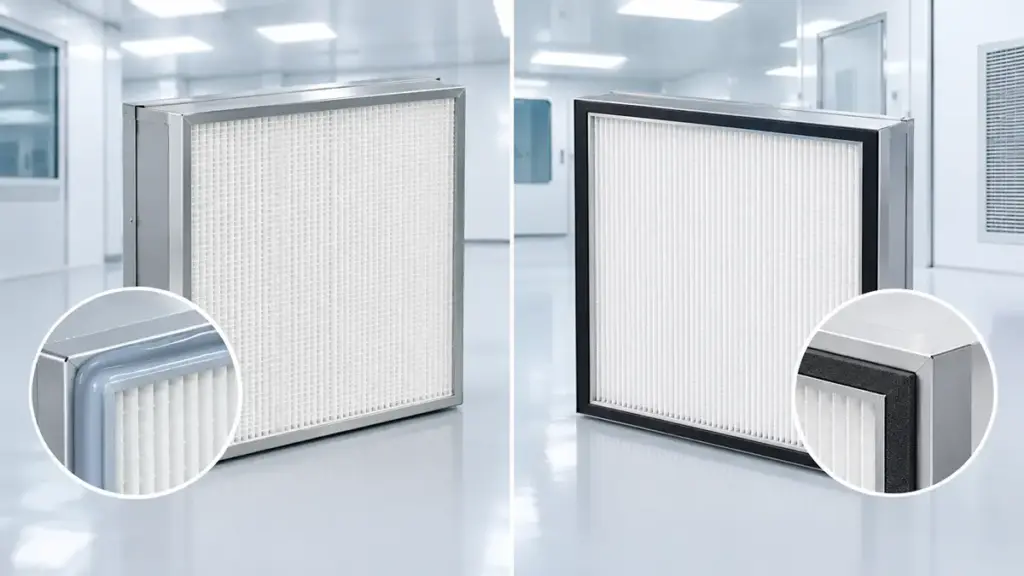
Gel seals offer a lower leak risk and wider installation tolerance. Gasket seals are simpler but more sensitive to installation quality, surface condition, and housing design.
Leak Risk and Installation Tolerance
Gel seals create a continuous, robust barrier as the housing’s knife-edge frame embeds itself into the gel channel. This design inherently minimizes the potential for bypass leakage. In contrast, gasket seals depend entirely on precise and even compression to work. The risk of a leak increases significantly with any uneven torque, frame distortion, or imperfections on the sealing surface.
While a gasket seal can perform well with a proper installation, it is fundamentally more sensitive to these variables. This is why post-installation leak testing is critical for both types; leaks can occur right at the sealing interface, even if the filter media itself is in good condition. Gel seals also provide a much higher tolerance for installation variances. The viscous, pliable gel easily conforms to minor irregularities on the housing’s sealing surface, essentially filling in the gaps. Gasket seals are far less forgiving and demand a flat, smooth housing surface and exact alignment to prevent leaks from day one.
A common mistake with gaskets is over-tightening, which can paradoxically create a leak by damaging the gasket material or warping the filter frame. Although the gel interface itself is highly tolerant, the overall system is not universal. It still requires a compatible knife-edge housing design to function as intended.
Housing Requirements for Each Seal Type
The two seal types require fundamentally different housing designs, making them non-interchangeable in almost all scenarios.
- Gasket-seal housings use a simple, flat plane to seat the filter. They require mechanical compression hardware—latches, crank locks, or side-access doors—to apply even, predictable pressure. Common designs include side-access housings, clamp-style units, and standard bag-in/bag-out (파괴) systems.
- Gel-seal housings feature a continuous, built-in knife-edge around the perimeter. This knife-edge inserts directly into the HEPA filter’s gel channel, forming a fluid-seal barrier. Typical examples include knife-edge terminal units, gel-seal ceiling grids, and fluid-seal (FS) side-access housings. Some manufacturers offer distinct GS (gasket-seal) and FS (fluid-seal) versions of the same housing model.
How to Verify Compatibility
Before ordering a replacement filter, do a quick physical check or review the documentation. Getting this wrong means the filter won’t seal, no matter how good the media is. Inspect the housing’s filter frame—is it a flat surface (for a gasket) or a prominent knife-edge (for a gel seal)? Check the filter itself for a perimeter gasket or a gel-filled channel. Review equipment drawings or model numbers, which often specify compatibility with codes like GS (gasket seal) or FS (fluid seal).
What Maintenance and Replacement Issues Matter?
Gel seal maintenance focuses on physical integrity, while gasket seals demand attention to material aging and compression. The right choice depends on your long-term operational and service strategy.
Core Maintenance Differences and Replacement Triggers
Maintenance for gel and gasket seals follows two different philosophies. With gel seals, inspections focus on physical integrity—checking the gel channel for contamination, dust, or physical breaches, and inspecting the housing’s knife-edge for damage. Gasket seal maintenance centers on managing material degradation: checking for hardening, cracks, or permanent flattening known as compression set, while ensuring consistent clamping torque around the entire frame.
A failed leak test or a sudden spike in downstream particle counts demands immediate investigation. For gasket seals, common replacement triggers include visible cracks, hardening, or compression set. For gel seals, replacement is necessary if the gel is contaminated, physically breached, or if the mating knife-edge is damaged. Any warping or distortion of the filter frame or ceiling grid also forces replacement, regardless of the seal’s condition.
Leak Testing and Long-Term Reliability
Leak testing at installation is a primary requirement; it confirms a proper seal before the cleanroom goes into service. After that, periodic testing ensures ongoing compliance and performance, with some standards recommending checks twice a year for aseptic processing rooms. A PAO aerosol test method around the filter’s perimeter is an effective field diagnostic. It can quickly distinguish between a leak at the seal and a failure in the filter media itself.
If a leak is detected with a gasketed filter, the standard procedure is not to immediately discard it. Technicians should first reseat the filter, clean the housing flange, and then re-test. Replacement is the last resort after these corrective steps fail. Over time, gaskets are susceptible to compression set, where the material permanently deforms under pressure, steadily increasing leak risk. Gel seals are less affected by mechanical wear and vibration, giving them more stable long-term sealing integrity in demanding environments. The gel itself is not completely failure-proof—it can degrade under certain chemical or environmental conditions—but it does not suffer from the same mechanical compression set as a gasket.
Gel Seal or Gasket Seal: Selection Checklist
Choosing between a gel or gasket seal comes down to balancing leak risk, hardware compatibility, maintenance burden, and total cost of ownership for your specific application.
| Selection Factor | Gel Seal | Gasket Seal |
|---|---|---|
|
Cleanliness Class & Leak-Tightness |
Use for critical areas like ISO 클래스 5 and tighter, where the primary goal is to eliminate bypass risk at the filter-to-frame interface. |
Suitable for standard cleanroom applications that can tolerate a conventional mechanical seal and its associated risk profile. |
|
Holding Frame & System Compatibility |
Must be paired with housings that feature a ‘knife-edge’ designed to sit in the filter’s gel channel. Using the wrong frame guarantees failure. |
Designed for frames that create a seal by compressing a flat or formed gasket against a mounting surface. Confirming the frame type is critical. |
|
유지, Vibration & Stress |
Provides more reliable long-term sealing in high-vibration environments, reducing the need for repeated torque adjustments and maintenance. |
May require periodic inspection, re-torquing, or replacement as part of a routine maintenance program to ensure seal integrity. |
|
Environmental & Regulatory Factors |
Verify temperature compatibility (예를 들어, up to 50°C). In GMP facilities, the seal must support the validation strategy and in-situ leak testing per ISO 14644-3. |
May tolerate higher temperatures (예를 들어, up to 120°C). The entire assembly must be testable according to standards like ISO 14644-3 for requalification. |
|
Initial Cost vs. Long-Term Performance |
Higher upfront cost, but may offer a lower total cost of ownership by minimizing leak risks and the need for corrective actions. |
Generally has a lower initial purchase cost, making it a common choice for budget-driven projects where standard performance is acceptable. |
자주 묻는 질문
What is a gel seal HEPA filter?
A gel seal HEPA filter is a high-efficiency filter that uses a channel filled with a non-hardening gel to create an airtight seal with its housing. This design is engineered to prevent air bypass around the filter media, making it ideal for critical environments like cleanrooms and hospitals where seal integrity is paramount.
What is the difference between gel seal and gasket seal HEPA filters?
The primary difference is the sealing method. Gel seal filters use a liquid gel in a channel that mates with a ‘knife-edge’ on the housing for a highly reliable seal. Gasket seal filters use a compressible, solid gasket that is compressed between the filter frame and the housing. Gel seals generally offer lower leakage risk, while gasket seals are simpler and more common in less critical applications.
Is a gel seal better than a gasket seal for cleanrooms?
For most cleanrooms, yes, a gel seal is considered better because it provides superior long-term sealing integrity and is more resistant to leaks caused by vibration. While gasket seals can be effective, they are more dependent on proper installation and can degrade over time, making gel seals the preferred choice for high-stakes contamination control.
Can a gel seal HEPA filter fit any housing?
아니요, a gel seal HEPA filter cannot fit just any housing. It requires a compatible housing specifically designed with a ‘knife-edge’ flange that seats into the filter’s gel channel. Attempting to install a gel seal filter in a standard gasket-style housing will result in a poor seal and significant bypass leakage.
How is bypass or seal leakage tested after installation?
Seal leakage is tested using an in-place aerosol challenge test, often called a PAO test. An aerosol is injected into the air upstream of the filter, and a technician uses a photometer probe to test the downstream face and the entire perimeter seal. Any detected aerosol penetration above a strict limit (typically 0.01% of the upstream concentration) indicates a leak that must be corrected.
Final Thoughts
Choosing a seal based on upfront cost is a false economy. A single bypass leak can invalidate an entire cleanroom certification, costing far more than the initial filter price. Adhering to a quality factory standard for your seal selection is the only way to protect your operations and product integrity.
Your system’s integrity cannot be left to chance. Before your next procurement cycle, verify compatibility with our engineering team to ensure you have the correct seal for your specific housing. We can supply the correct filters to match your needs, from standard replacements to custom OEM specifications.