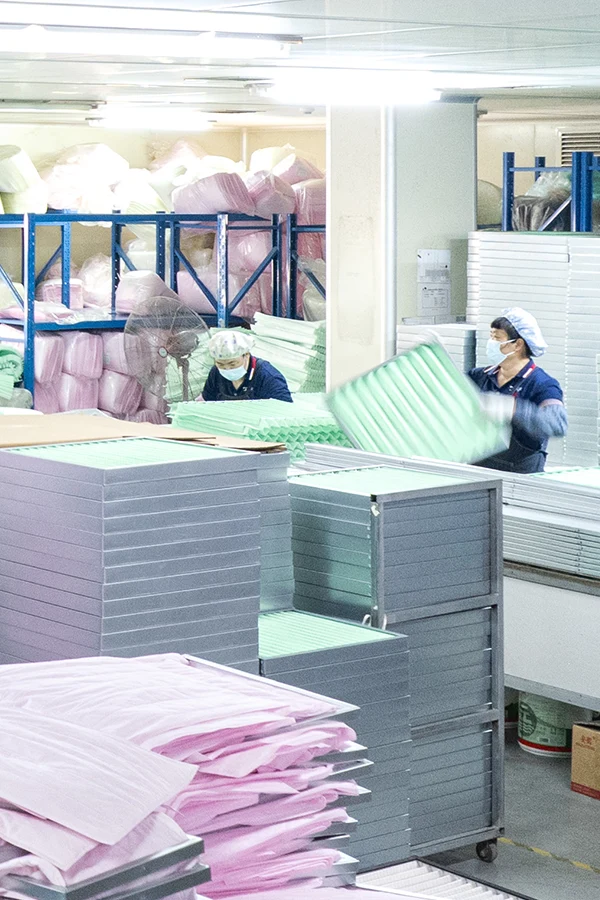
Choosing the wrong activated carbon filter media format is a common engineering oversight. It is paid for in fan energy, premature breakthrough, and filter housings that do not fit the airflow. A mismatch between the media’s physical structure and its duty shows up as excess pressure drop. Service life then falls far short of the datasheet.
This guide benchmarks impregnated fabric, felt, foam, and granular carbon against their intended air-phase applications. We weigh pressure drop against adsorption capacity, and finish with the specification sheet a supplier needs before quoting.
What Is Activated Carbon Filter Media?
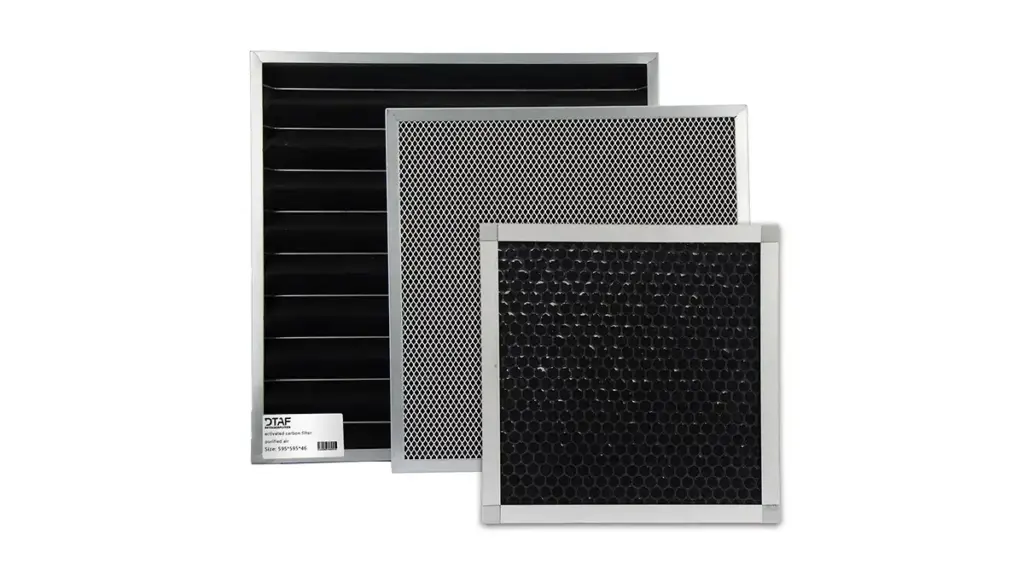
Activated carbon filter media is a porous carbon material that traps gas-phase contaminants by adsorption. Its internal surface provides the binding sites. It is supplied as granules, pellets, blocks, or carbon bonded to a fabric, felt, or foam substrate.
How Adsorption Captures Contaminants
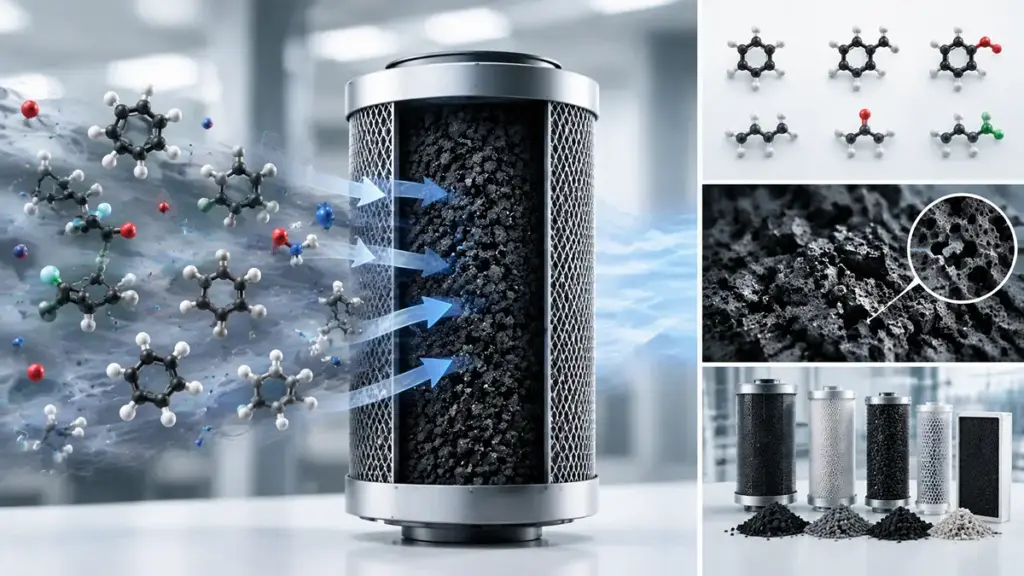
Activated carbon filter media captures molecules on a vast internal surface. The process is adsorption: molecules of gas, vapor, or odor physically adhere to the pore walls. It is not absorption, where a substance is drawn into the volume of a material the way a sponge takes up water. Coconut shell, wood, and coal are the usual bases, and high-temperature processing opens up their pore network. Our activated carbon air filter guide covers the mechanism in more detail.
Performance Factors That Decide Results
Value comes from internal surface area, which commonly exceeds 500 square meters in a single gram. That pore structure provides the sites contaminants adhere to. Results then depend on contact time, because air must dwell inside the bed long enough for molecules to reach a pore and bind. Finally the media saturates. Once the pores are full it must be replaced rather than cleaned.
What This Media Removes
Activated carbon is not a one-size-fits-all solution, but it is highly effective against a defined range of gaseous contaminants.
- Volatile organic compounds (VOCs) such as benzene, toluene, and xylene, plus solvent fumes and smoke. See the US EPA overview of VOCs in indoor air.
- Nuisance odors and industrial fumes in air handling, from a carbon panel in a supply unit to a bag filter on an extraction line.
- Acidic and reactive inorganic gases, but only when the carbon carries an impregnant. Plain carbon performs poorly on these.
Where Each Form Is Used
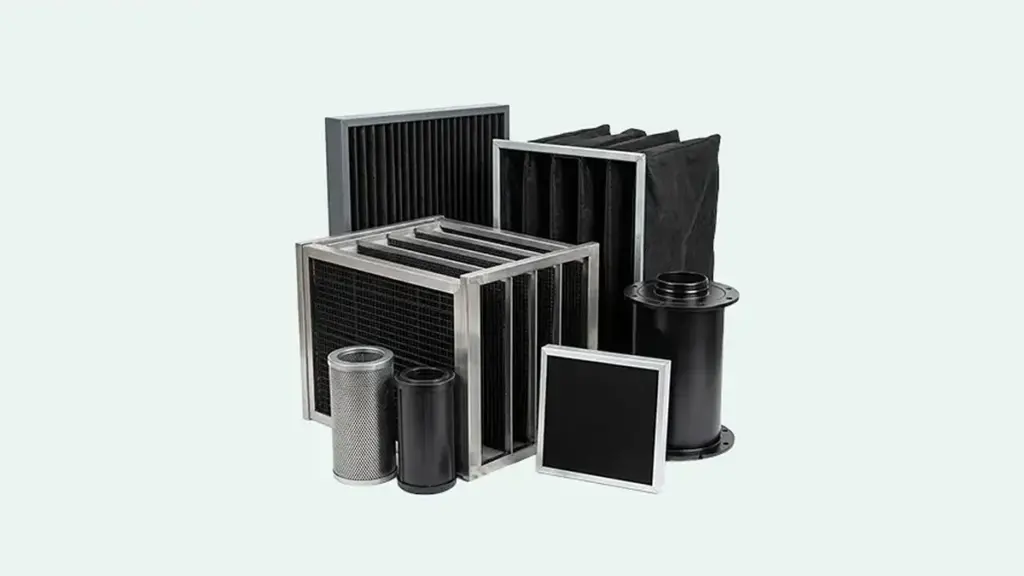
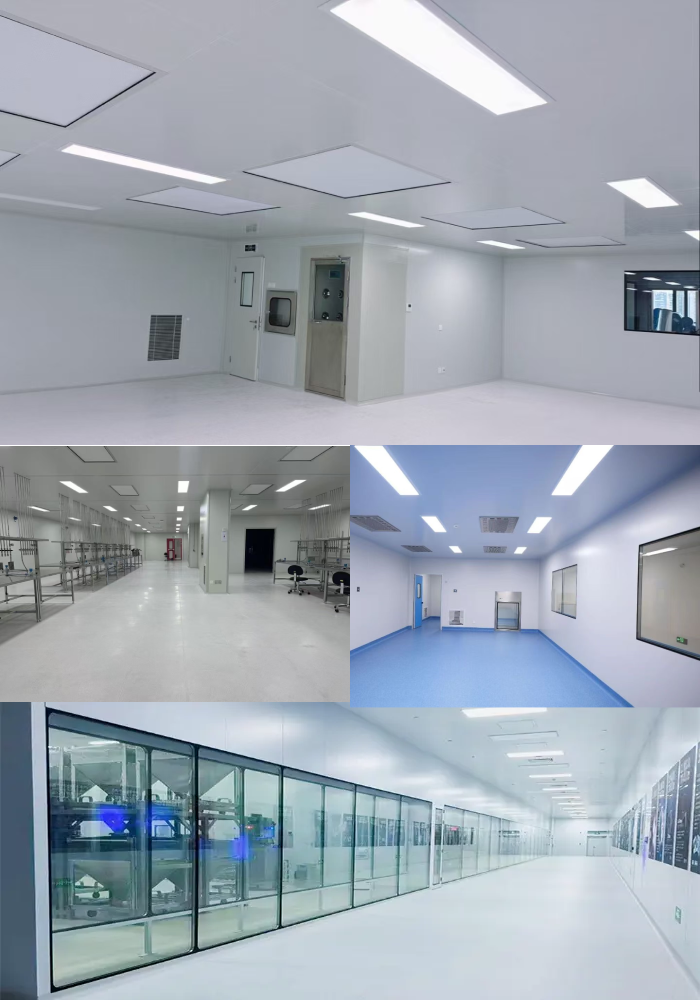
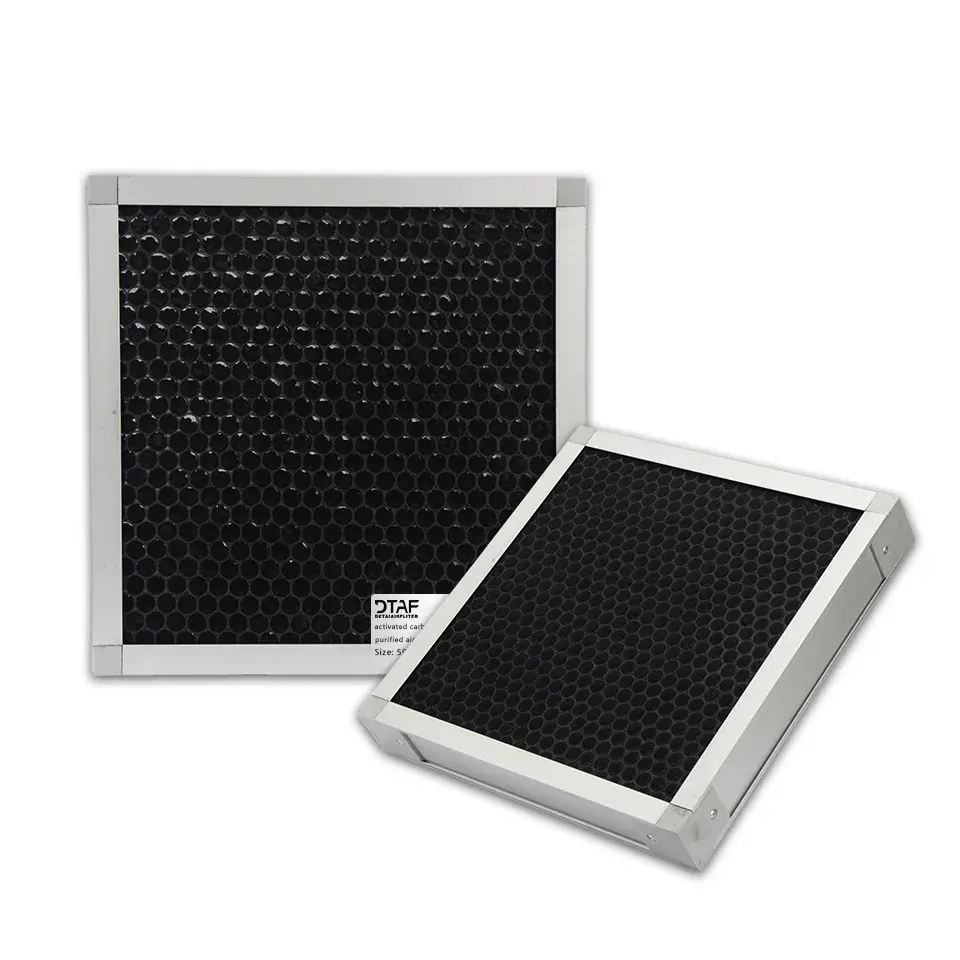
You will find activated carbon filter media wherever molecular gas removal is required. It sits in HVAC afterboards, cleanroom air handlers, and industrial exhaust trains that control odors and fumes. DTAF supplies it as granular carbon loaded into finished elements, as carbon-impregnated nonwoven for pleating, and as honeycomb blocks for duct stages needing high surface area. The formats are listed in the carbon filter range.
Source Certified OEM Filters on Low-MOQ Trial Orders
Which Carbon Media Formats Exist?
Activated carbon is not a single product. It is a family of formats, from powders and granules to blocks and composites, each engineered for one job.
Powdered and Granular Carbon
Powdered activated carbon (PAC) is a fine powder dosed into liquid batches or slurries. Its small particle size gives rapid adsorption, but it cannot be contained in a fixed bed, so it has no place in an airflow filter. Granular activated carbon (GAC) is the workhorse: irregular particles packed into a bed, or loaded into a cartridge, Panel, or bag. It is sold by mesh size, commonly 8×30 or 12×40.
Extruded and Pelletized Carbon
Uniform cylindrical pellets are made by extruding carbon powder with a binder. This is the preferred format for vapor-phase work such as industrial air filtration, where low dust, high mechanical strength, and predictable airflow matter. Consistent pellet shape packs evenly inside a housing, so pressure drop stays repeatable from one changeout to the next, unlike the irregular geometry of GAC.
Compressed Blocks and Honeycomb
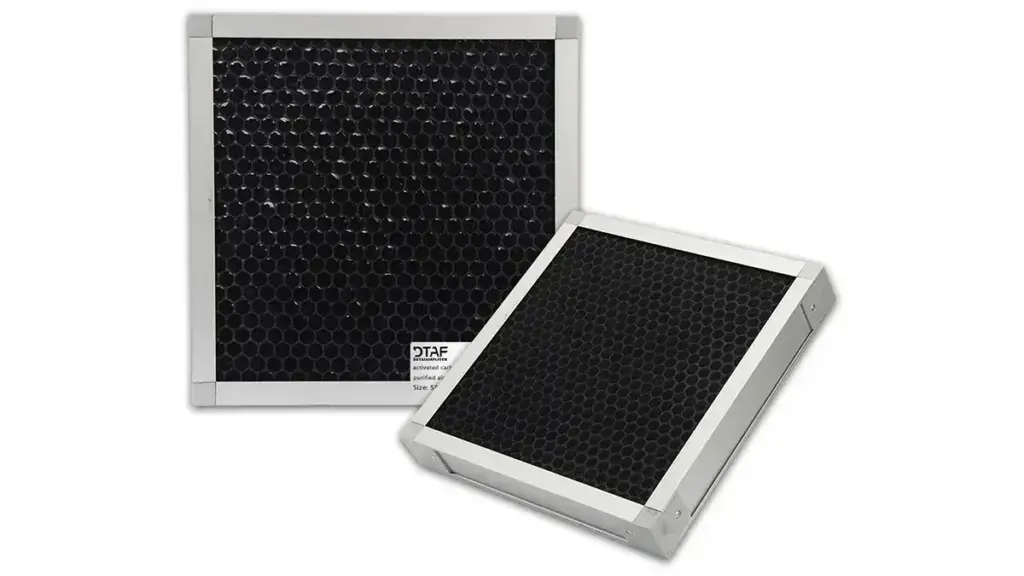
Blocks are rigid, porous structures formed by compressing carbon powder with a binder. They combine adsorption with mechanical filtration, capturing fine particulate that loose GAC lets through. Honeycomb blocks push the idea further. Extruded with through-channels, in our case from 1.5 mm to 8 mm, they give a large working surface at a low, predictable airflow penalty.
Impregnated and Composite Media
Impregnated carbon carries chemical reagents on its surface to destroy contaminants that plain carbon adsorbs poorly, which is essential for gases such as hydrogen sulfide. Composite media binds carbon particles into a substrate such as nonwoven felt, cloth, or foam. These are engineered to be cut, pleated, and sewn into custom elements rather than sold as loose media.
How Fabric, Felt, Foam, and Granular Carbon Differ?
These carbon media trade physical form for function. Granular gives bulk capacity, felt gives speed, fabric gives flexibility, and foam gives the lowest airflow resistance.
| Characteristic | Impregnated Fabric | Felt | Foam | Granular Carbon (GAC) |
|---|---|---|---|---|
| Structure and Airflow | Keeps the textile structure; flexible and formable for cut parts. | Nonwoven fibrous mat; high porosity, low diffusion resistance. | Open-cell polymer; lowest airflow resistance of the four. | Loose particles in a packed bed; highest system pressure drop. |
| Mechanism and Speed | Physical adsorption plus chemical capture from the impregnant. | Fastest adsorption kinetics; micropores face the gas stream directly. | Structural carrier; performance tracks the carbon loading. | Slower; molecules diffuse deep into granules and need dwell time. |
| Capacity and Form | Capacity set by loading; must stay flexible for cut-and-sew. | High surface area in a thin, lightweight, compact mat. | Lower carbon density, moderate capacity, shape-driven. | Highest capacity per volume; needs a heavier, deeper bed. |
| Typical Duty | Odor liners, inserts, protective layers in garments. | Compact filtration needing rapid VOC removal. | Low-resistance pads, appliance and duct filters. | Deep industrial stages. Long-residence polisher beds and loaded cartridges. |
Read the table as a decision shortcut, not a ranking. Foam and felt earn their place where the fan has little static pressure left. Fabric wins when the part must be sewn or shaped, and granular where bed depth is available to spend.
How Do Loading and Pore Structure Affect Performance?
In composite media, carbon loading is the share of carbon carried by the substrate. It sets capacity and service life. Pore structure decides which molecules the media can hold at all.
First, Settle What Carbon Loading Means
Datasheets use this term two different ways, and confusing them will cost you. In composite media, carbon loading is the mass fraction of activated carbon bonded to the substrate. In a bed already in service, the same phrase describes accumulated contaminant. They are opposite variables. Loading as a specification raises capacity; contaminant loading destroys it.
As a specification, loading drives everything else. Unser activated carbon filter cotton runs at 50% carbon content or higher, with benzene adsorption above 20%, in thicknesses from 1 mm to 25 mm. A carbon-impregnated foam screen runs at 45% or more with benzene adsorption of 22%. Raise the loading and you gain capacity per square meter. You also gain resistance and lose flexibility, so the number must be tuned rather than maximized.
Saturation, Poisoning, and Displacement
In service the carbon surface fills progressively, and fewer open sites means earlier breakthrough: the point where contaminant starts passing through. Reactive compounds can alter the surface chemically, causing irreversible poisoning. At high accumulated loads, competitive displacement occurs. A stronger-affinity molecule pushes trapped ones back into the airstream. A saturated filter can then become a source of the odor it was meant to remove.
Pore Structure, Form, and Fouling
The base carbon is the foundation, and its pore structure and physical form dictate capture. A carbon with pore volume above 0.6 cm3/g offers far more internal surface, which matters most when contaminants sit at low concentration. Körnig, pelletized, and fibrous forms produce different airflow dynamics, Druckabfall, and contact time. Physical fouling cuts performance short regardless of chemistry, when particulate coats the exterior and blocks the pores. That is why carbon stages always sit behind a particulate pre-filter.
Operating Conditions Tie It Together
- Humidity: Water vapor competes for the same sites, so a hydrophobic VOC adsorbs far worse in humid air than in dry air.
- Media matching: The same load breaks through at very different times on different carbons, so match the substrate to the gas.
- Bed depth: Deeper beds buffer concentration peaks, but resistance rises with them. Our plate-type carbon panels are specified from 50 Zu 90 Pa initial and change out at 180 Zu 220 Pa final.
How Should Pressure Drop and Airflow Compare?

Compare pressure drop at your real operating airflow, using performance curves. An isolated number is misleading and produces poor system design and unexpected energy cost.
Pressure Drop Is a Curve, Not a Number
Pressure drop and airflow are not independent values to cherry-pick from a datasheet. They are a paired curve. Push more air through any media and its resistance rises. Quoting a low figure for a felt without stating the test airflow is the classic way to make one product look better than it is. Comparing a foam at 0.5 m/s against a granular panel at 2.5 m/s is worse, because it hides the entire problem. For a designer, incomplete data produces undersized fans and higher energy bills. The same discipline applies to particulate media, as our HEPA filter pressure drop guide shows.
Metrics That Make Media Comparable
- Initial pressure drop at the system’s rated airflow, not an arbitrary test flow.
- Face velocity, which normalizes comparison between filters of different size and shape.
- The full curve across the intended operating range, from low flow to high.
- Change in resistance after dust loading and after the carbon is saturated.
The Trade-Off and a Method
There is always a trade-off. Low resistance protects airflow and saves fan energy, which matters in most air handling units. Higher resistance can be worth paying if it buys adsorption: denser packing or a finer grain lengthens residence time, provided the fan carries the load. The goal is best adsorption at the lowest drop at your flow.
- Fix the baseline: the actual operating airflow your system requires.
- Obtain the full pressure drop against airflow curve for each option.
- Read each curve at your target airflow and record the resistance there.
- Select the media that meets the adsorption duty within available static pressure.
Which Media Suit Odors, VOCs, and Acid Gases?
Standard carbon handles general odors and most VOCs. Reactive gases such as hydrogen sulfide or ammonia need chemically treated or hybrid media, removed by chemisorption.
General Odors and VOCs
Standard carbon is the go-to media for a wide range of organic compounds. Its porous structure traps solvent fumes, cooking odors, and smoke, and it handles VOCs such as benzene, toluene, and xylene, which readily adhere to internal surfaces. In air systems the granular route is a loaded stage rather than a bulk purchase. A plate-type carbon panel is available 25 Zu 100 mm thick in 592×592 and 575×575 frames, or as a V-bank module in the same housing footprint.
Acidic and Reactive Gases
Plain carbon is not universal. It performs poorly against reactive inorganic gases such as hydrogen sulfide, ammonia, and mercaptans, because they do not physically adsorb well. Those streams require impregnated media, treated with reagents that react with and neutralize the target compound through chemisorption. The reaction destroys the gas rather than storing it, which is why treated stages are specified for wastewater odor control, biogas upgrading, and sulfur-rich exhaust.
Mixed Contaminant Streams
When a stream carries VOCs plus difficult gases such as ammonia, ozone, or formaldehyde, one media will not cover it. Hybrid products blend standard carbon with other sorbents and impregnants in a single stage, each formulated for a defined pollutant profile. Formaldehyde in particular is weakly adsorbed by untreated carbon, so it needs a dedicated scavenger, and the US EPA formaldehyde overview explains the exposure problem behind that requirement. Where a single blend cannot carry the full load, staged chemical media is the answer. How an activated carbon filter works covers how those stages interact.
Which Supply Formats Fit Manufacturing?

The right supply format, whether bulk, converted rolls, or finished elements, depends on your production process, not on a single best option.
Bulk Granular and Pelletized Carbon
This is the classic route for makers of packed-bed products. If you fill pressure vessels, cartridges, or refillable housings, you buy carbon in bulk. It arrives in mesh sizes such as 8×30 or 12×40, in coconut shell, coal, or wood base, graded by activity and hardness. It suits designs needing large media volumes and field-serviceable filters, where media is replaced without swapping the housing.
Converted Rolls and Sheet Media
If your line pleats, laminates, slits, or die-cuts, bulk granules make no sense. You need carbon supplied as converted media: carbon-coated nonwoven, impregnated felt, or foam screen, with the carbon bonded to a substrate to form a stable sheet. Suppliers deliver rolls at widths and thicknesses matched to the machinery. This is how pleated panels and custom-cut mats get made at volume.
Finished Elements and Modules
This format suits builders who want to cut in-house media handling. Instead of raw carbon you buy ready-to-install components: blocks, sealed cartridges, bag filters, or panel stages at standard housing dimensions. It is the common choice for replacement filters, where dimensional consistency is not negotiable. The trade is flexibility for speed, standardized parts, and no carbon dust on the shop floor.
How to Specify Carbon Media in an RFQ
A detailed RFQ is your defense against misquoted media. Name the contaminants, the operating conditions, and the acceptance tests before you ask for a price.
Define the Duty Before the Media
Selection starts with the duty, not the carbon. Fix the phase first: vapor-phase work needs pelletized, honeycomb, or impregnated media managed for pressure drop. Then name the contaminants, since odors, VOCs, and acid gases demand different pore structures and surface chemistry. Then choose the form, whether a granular-loaded panel, a felt insert, or a foam stage, and state whether you are buying media or finished filters.
Lock the Physical Specifications
Vague requests produce inconsistent quotes and weak performance. These are the non-negotiables for any activated carbon filter media RFQ:
- Mesh or grain size: 8×30 and 12×40 balance adsorption rate against pressure drop. Naming it stops a supplier quoting a cheaper grain.
- Activity indicator: iodine number for micropore capacity, CTC value for vapor-phase duty. Set a floor; do not accept “high activity”.
- Moisture and ash: cap moisture at 5% so you pay for carbon, not water. Our honeycomb carbon is specified at 5% moisture or below.
- Mechanical strength: a hardness floor limits attrition and fines, and stack density tells you how much carbon is really in the block.
Conditions, Proof, and Lifecycle
A supplier cannot size media life without the operating reality. Give it upfront: Luftstrom, temperature, relative humidity, inlet concentration, performance objective, required outlet quality, and maximum allowable pressure drop. Then mandate proof. Ask for the activity and strength numbers above, named test methods rather than ad hoc claims, and a Certificate of Analysis for the lot shipped. Close with lifecycle: estimated service life at your conditions, whether regeneration is economic against virgin media, and disposal rules for spent carbon.
Häufig gestellte Fragen
What types of activated carbon media are used in air filters?
Air filtration uses four main formats. Granular carbon is loaded into panels, bags, and cartridges for odor and VOC control. Pelletized carbon suits beds needing low dust and predictable airflow. Impregnated nonwoven and felt are pleated or cut into elements. Foam gives the lowest resistance, and impregnated grades target gases such as ammonia.
What is the difference between fabric, felt, foam, and granular carbon?
They differ in structure and duty. Fabric is thin and flexible for cut-and-sew parts. Felt is a porous nonwoven mat with the fastest adsorption kinetics. Foam is open-cell and gives the lowest airflow resistance. Granular carbon is loose media packed into a bed, giving the highest capacity per volume but the greatest pressure drop.
How does carbon loading affect capacity and pressure drop?
Raising the carbon fraction on a substrate raises capacity and extends service life, but it also raises resistance and reduces flexibility. That is why composite media is tuned rather than maxed, commonly 45% to over 50% carbon by format. Specify the loading you need and the maximum pressure drop you can accept at your design airflow.
Which activated carbon media suits commercial HVAC systems?
Most HVAC odor and VOC duties use granular-loaded panels or V-bank modules, which balance capacity against the static pressure a building fan can spare. Where resistance is the binding constraint, impregnated felt or foam removes odors at a fraction of the drop, accepting shorter life in exchange.
When is impregnated carbon required for a target gas?
Specify impregnated carbon whenever the target gas is poorly captured by standard media. That includes hydrogen sulfide, ammonia, sulfur compounds, and mercury vapor, and it covers formaldehyde, which untreated carbon releases again. The impregnant reacts with and neutralizes the contaminant through chemisorption, so the gas is destroyed rather than temporarily stored.
Should filter makers buy bulk carbon or converted media?
Match the format to your process. Bulk granular or pelletized carbon suits filling packed beds and cartridges. Converted rolls of impregnated nonwoven, felt, or foam suit pleating and die-cutting lines. Finished elements suit builders who want dimensional consistency without in-house carbon dust handling.
Letzte Gedanken
Cheap activated carbon filter media looks economical on the purchase order and expensive everywhere else, in premature failure, energy overrun, and complaints you cannot trace. Holding to defined specifications for carbon loading, activity, grain size, and pressure drop at real airflow is what makes adsorption predictable. Your system’s integrity and your customers’ trust rest on the media inside.
Do not leave performance to a datasheet alone. Validate media against your own airflow and contaminant challenge before committing. Contact our technical team for a sample kit, or to review OEM requirements against our low-MOQ trial orders and 7-day sampling.