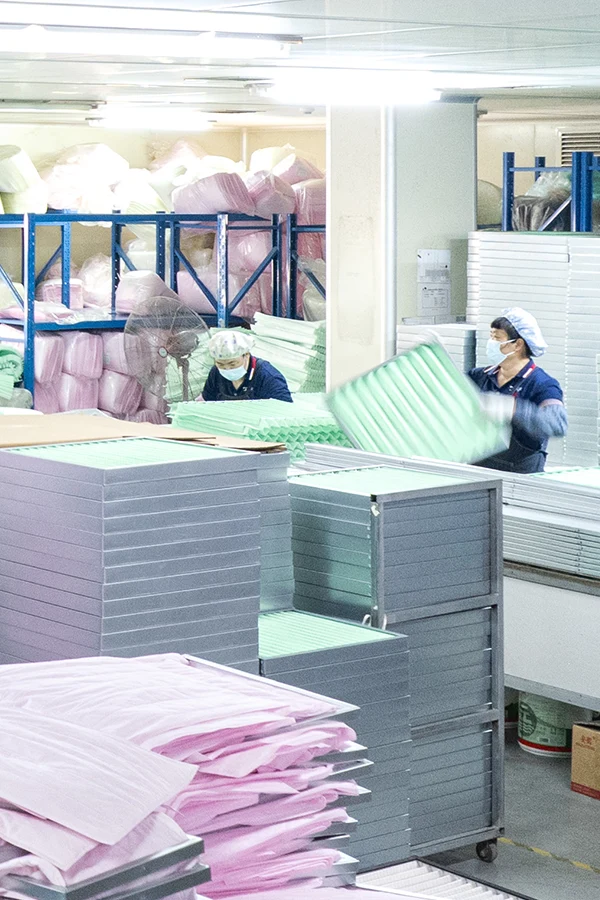
Specifying the right VOC carbon filter is the primary defense against premature media saturation and compliance failures. A mismatch between carbon pore structure and the target VOC profile, humidity, or airflow causes accelerated breakthrough. That drives up operating costs and creates real emissions risks.
This guide benchmarks carbon performance against industry standards for industrial air streams. It shows how empty bed contact time (EBCT), relative humidity, and VOC concentration determine a filter’s true working capacity and service life—the technical data needed for accurate system design.
How Does Activated Carbon Adsorb VOCs?
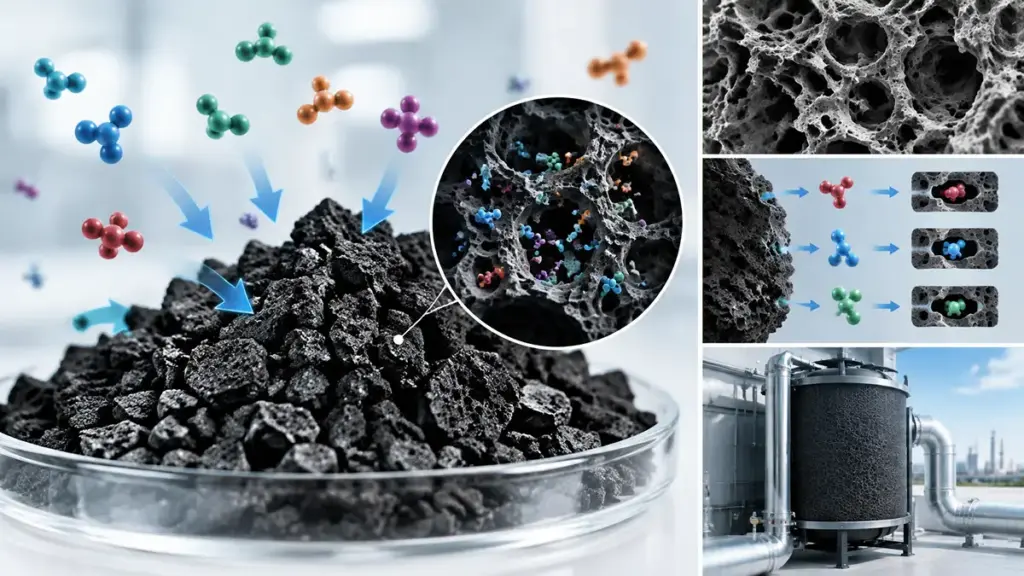
Activated carbon physically traps VOCs on an immense internal surface area. Performance hinges on matching the carbon’s pore structure to the specific VOC and controlling operating conditions.
The Fundamental Adsorption Mechanism
Instead of chemically destroying contaminants, activated carbon captures them through a physical process called adsorption. Volatile organic compounds (ЛОС) are held on the solid carbon surface by weak intermolecular attractions known as van der Waals forces. Their chemical structure is not altered; they stay in place until the carbon is replaced or regenerated. For the broader working principle in plain terms, our guide on how an activated carbon filter works covers it step by step.
Surface Area and Pore Structure
Effectiveness comes from an enormous internal surface area, typically between 800 and 1,500 m²/g. This surface exists inside a network of microscopic pores of varying sizes. Micropores trap individual VOC molecules. Mesopores and macropores act as transport highways, letting VOCs diffuse deep inside the carbon particle to reach an empty adsorption site.
The Adsorption Zone and Breakthrough
As contaminated air passes through the bed, VOCs are captured in a defined area called the “adsorption zone.” This zone forms at the air inlet and gradually migrates toward the outlet as upstream carbon saturates. Once the zone reaches the outlet face of the bed, “breakthrough” occurs: VOCs start passing through untreated. Breakthrough is the signal that the carbon must be replaced or regenerated.
Key Factors Affecting Adsorption Performance
Four variables decide whether a carbon bed performs or fails early. Getting any of them wrong cuts removal efficiency and hastens breakthrough.
- Contact time: air moving too fast gives VOC molecules too little time to diffuse into the pores, and efficiency drops.
- Temperature and humidity: adsorption is exothermic, so it works better at lower temperatures. Water vapor competes with VOCs for surface sites.
- VOC characteristics: carbon captures nonpolar compounds and higher-boiling-point vapors most readily.
- Carbon specification: pore size distribution must match the size and chemistry of the target VOC molecules.
Which VOCs and Odors Can Carbon Filters Target?
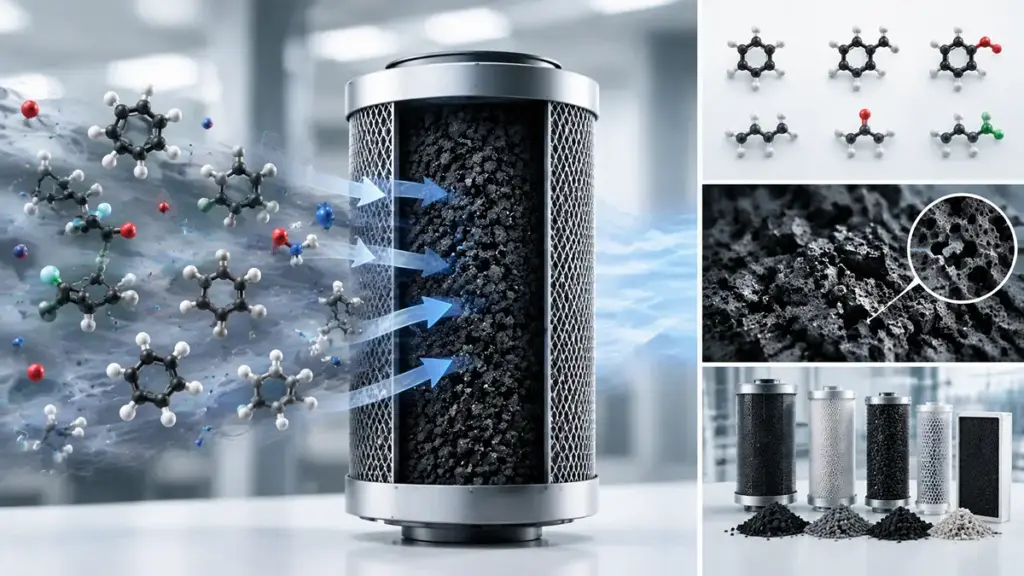
Carbon filters excel at removing specific gas-phase VOCs and odors, particularly aromatic hydrocarbons and solvents. Performance varies, requiring a match between the carbon media and target contaminant.
Commonly Targeted VOCs
A VOC carbon filter works best on specific chemical families, not on every contaminant. The targets are gas-phase organic compounds; particulate matter is handled by other media.
- Aromatic hydrocarbons: benzene, toluene, ethylbenzene, and xylene (BTEX), common in industrial and environmental streams.
- Solvent vapors: ketones such as acetone, various alcohols, and other hydrocarbons released by coatings, cleaning, and industrial processes.
- Aldehydes: formaldehyde is a frequent target in indoor air applications, and the US EPA formaldehyde overview explains why it remains a priority pollutant. Effective removal often requires specialized microporous media or activated carbon fiber (ACF).
- Chlorinated VOCs: standard carbon captures some; the most resistant compounds may need catalytic or impregnated media.
Odor Categories Carbon Filters Address
When an odor source is an organic vapor, carbon is the primary control media. It captures the molecules responsible for the smell.
- Solvent and paint odors from fresh paints, varnishes, coatings, and industrial printing.
- Cleaning agent vapors, including degreasers, disinfectants, and maintenance chemicals.
- Hydrocarbon odors from gasoline, diesel, and other fuel vapors.
- Off-gassing odors from new furniture, carpeting, adhesives, and renovation materials.
Where Carbon Works Well and Where It Does Not
Performance is a spectrum set by VOC chemistry and carbon properties. Plan media selection around these boundaries.
- Strong: most aromatic VOCs such as toluene, general solvent vapors, and many organic odor compounds.
- Moderate to strong: formaldehyde removal is achievable but depends heavily on media choice; standard grades are often insufficient.
- Limited: high-concentration streams overwhelm a carbon bed quickly, demanding very large systems or a different technology.
- Not designed for: gas-phase contaminants only. Carbon does not remove particulate matter, smoke particles, dust, or aerosols.
Matching Carbon Media to Specific Contaminants
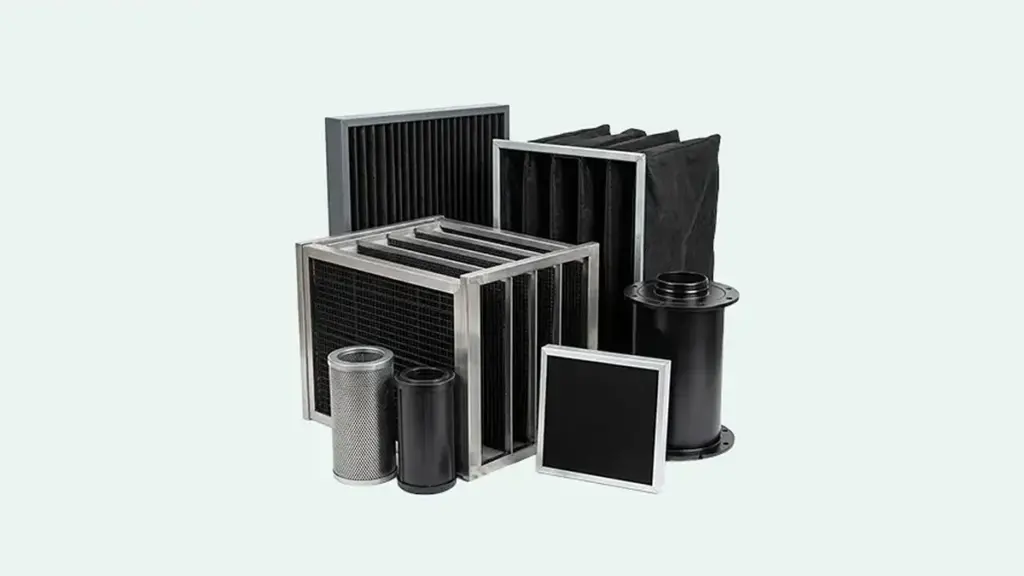
The raw material and manufacturing process set the pore structure, which sets performance. Matching the media to the application is the core of carbon selection; the activated carbon air filter guide covers the full type lineup.
- Coconut shell carbon: a high micropore volume suits small VOC molecules such as benzene in light-duty and indoor streams.
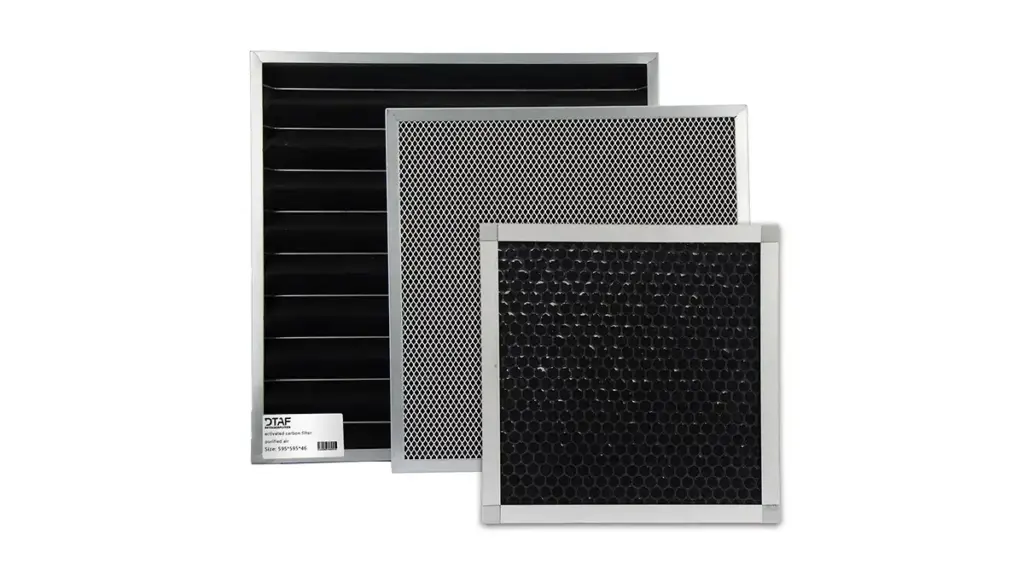
- Coal-based granular activated carbon (GAC): the workhorse for broad-spectrum VOC control in industrial exhaust.
- Pelletized carbon: cylindrical pellets offer a lower pressure drop, suitable for large packed beds at high airflow.
- Activated carbon fiber (ACF): very high external surface area, fast capture, and good regeneration potential.
Source Carbon Filters with Low MOQ Trial Orders
Why Do Pore Structure and Surface Chemistry Matter?
In activated carbon, pore structure dictates VOC capacity and access speed. Surface chemistry controls binding strength and selectivity, making both critical for real-world filter performance.
How Pore Structure Controls Capacity and Access
Total VOC adsorption capacity is tied to micropore volume—pores smaller than 2 nanometers that create the strong attractive forces needed to capture molecules. A headline surface area of 800–1,500 m²/g means little on its own. If the pore size does not match the target VOC, much of that area becomes useless. For removing low concentrations of contaminants, a narrow pore size distribution centered around 0.8–1.0 nm significantly boosts performance. Specify accessible micropore volume, not just a surface area number.
The Dual Role of Micropores and Mesopores
A well-designed carbon relies on two pore types working together. Micropores provide the capture sites and the bulk of total capacity. Mesopores (2–50 nm) act as highways, letting molecules diffuse rapidly to those sites. A hierarchical structure therefore delivers high capacity and fast adsorption rate—a crucial feature under dynamic airflow. Without enough mesoporosity, a bed becomes diffusion-limited: theoretical capacity stays high while real-world removal slows down.
How Surface Chemistry Drives Binding Strength
Pore size is not the whole story; surface chemistry determines how strongly VOC molecules bind. Oxygen-containing functional groups act as specific binding sites that increase adsorption of polar VOCs. A higher degree of graphitization strengthens π-π interactions, improving capture of aromatics such as benzene and toluene. Two carbons with identical pore structures can deliver very different results, especially at low concentrations where chemical affinity becomes the deciding factor.
Humidity Resistance Starts at the Surface
Real air streams always contain water vapor, which competes directly with VOCs for the same adsorption sites. Engineering the carbon surface to be more hydrophobic improves selectivity for VOCs and maintains performance in humid environments. Where humidity is a known factor, controlling surface chemistry is a specification item, not a detail to leave to chance.
How Do Airflow, Humidity, and Concentration Affect Performance?
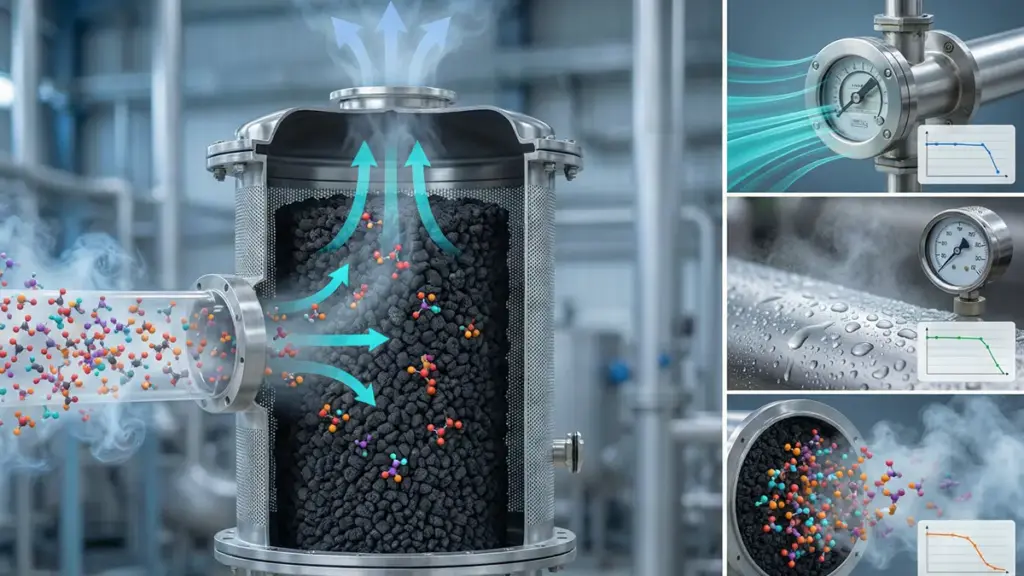
Расход воздуха, humidity, and inlet concentration are the three operating variables that set a VOC carbon filter’s real working capacity. Push any of them too far and breakthrough arrives early.
Airflow and Empty Bed Contact Time
Airflow rate and contact time move in opposite directions. Higher airflow shortens the residence time available for adsorption, cutting per-pass removal efficiency unless the bed was sized for it. Empty Bed Contact Time (EBCT) expresses this duration in seconds. Practical design guidance for air streams sits between 0.1 and 1.0 seconds. Light odor control may work near 0.1 seconds, while mixed-VOC removal usually needs 0.5–1.0 seconds. Most vapor-phase systems also hold face velocity between 0.15 and 0.45 m/s to stay ahead of premature breakthrough.
Sizing the Bed When Airflow Must Rise
You cannot simply turn up the fan and expect the same performance. The needed carbon volume is estimated as airflow rate multiplied by desired contact time; bed depth or cross-sectional area grows with it. System design then trades removal efficiency against pressure drop, equipment footprint, and cost. Our article on HEPA filter pressure drop explains how that balance affects airflow across a whole filtration train.
The Humidity Window
High relative humidity (RH) erodes working capacity because water vapor occupies adsorption sites that would otherwise hold VOCs.
- Performance loss becomes most significant as RH moves through the 60–80% range.
- A sharp drop in capacity is commonly reported once humidity climbs above 80% RH.
- Very dry air can also reduce VOC removal in some systems and weakens certain impregnated media.
- A 30–60% RH window is a common design target for conditioned supply air.
Concentration: Carbon Is a Dilute-Stream Technology
Inlet VOC load decides how fast the bed fills. Activated carbon is economically strongest on dilute streams, typically below roughly 1,000 ppm; design practice keeps adsorber inlets well under 10% of the lower explosive limit for safety. At very high concentrations the bed saturates within hours, and thermal oxidation or condensation becomes the cheaper option. Sharp concentration spikes shorten service life just as severely, so pre-dilution or staged beds protect the main carbon stage.
Practical Operating Guidelines
- Add upstream dehumidification where RH will consistently exceed 60–70%.
- Use staged filtration or a prefilter for high or fluctuating VOC concentrations.
- Expect shorter media life under high humidity, high load, or high airflow.
- In humid service, specify hydrophobic or moisture-resistant carbon grades.
When Is Impregnated Carbon Required?
Impregnated carbon is needed for reactive or polar gases like ammonia and formaldehyde. Standard carbon is typically sufficient for common non-polar VOCs, hydrocarbons, and industrial solvents.
Standard Carbon Covers Most VOC Duty
Plain activated carbon handles most common industrial air streams through physical adsorption. Van der Waals forces capture non-polar VOCs inside the pore network. This is highly effective for BTEX compounds, industrial solvents, hydrocarbons, and general odor control. For polishing a broad mix of standard organic compounds, plain carbon is usually all the media the system needs.
Reactive and Inorganic Gases Need Chemisorption
Plain carbon has almost no capacity for contaminants that will not stick through physical adsorption alone. These gases require a chemical reaction. Impregnated media carries specific reagents that bind them through chemisorption:
- Acid gases: hydrogen sulfide (H₂S) and mercaptans, common in wastewater and biogas applications.
- Alkaline gases: ammonia (NH₃), frequent in agricultural and chemical manufacturing settings.
- Inorganic vapors: mercury vapor, which needs sulfur-impregnated media for chemisorptive capture.
If your stream contains any of these, impregnation is the correct first specification, not a later workaround. Наш chemical air filters are built for exactly these duty cases.
Polar and Low-Molecular-Weight Compounds
Формальдегид, methanol, and other light polar VOCs bind weakly to the nonpolar surface of standard carbon. Their small size and high volatility defeat physical adsorption alone. An impregnated grade raises the media’s affinity for these specific compounds, enabling a stronger bond and effective capture.
Difficult Chlorinated VOCs
Some chlorinated compounds resist simple adsorption, especially where strict outlet emission limits apply. Media impregnated with a strong oxidizer such as potassium permanganate (KMnO₄) offers a different pathway. Instead of only trapping the molecule, it chemically breaks the compound down through oxidation, protecting compliance where standard carbon would break through.
How Can Breakthrough and Saturation Be Managed?
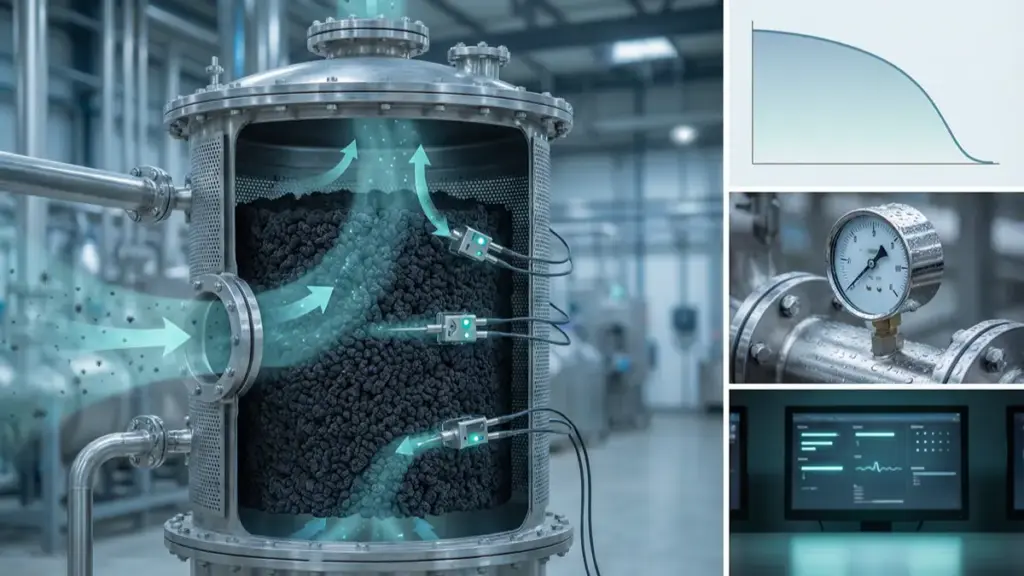
Managing carbon filter life requires proactive system design and data-driven monitoring. Relying on fixed schedules or waiting for performance to drop leads to inefficiency and compliance risks.
Breakthrough Is Not the Same as Saturation
It is a common mistake to use breakthrough and saturation interchangeably. Breakthrough occurs the moment outlet VOCs exceed your facility’s target limit—often long before the media is fully saturated. What matters operationally is working capacity: the practical amount of VOC a filter captures under your specific conditions before breakthrough. Higher VOC loads, humidity, and temperature will always shorten that window.
Factors That Shorten Service Life
- High VOC concentration: heavier loads fill adsorption sites faster, accelerating saturation.
- High relative humidity: water vapor competes for the same sites, cutting capacity and life.
- High airflow rate: faster airflow shrinks EBCT, giving VOCs less time to be captured.
- Elevated temperature: heat weakens adsorption and can drive captured VOCs back into the airstream.
- Contaminant mixtures: competing VOCs shift breakthrough patterns and reduce effective capacity.
Monitoring That Actually Works
- Inlet and outlet VOC measurement: the most accurate read on removal efficiency and confirmed breakthrough.
- Breakthrough sensors: automated systems that alarm at the onset of breakthrough for timely replacement.
- Pressure drop trending: useful for dust clogging, but carbon can saturate with almost no ΔP change.
- Fixed-schedule changeouts: blind to real process load—you either waste media or risk emissions.
Design and Operational Controls
- Design generous contact time: a longer EBCT gives VOC molecules more opportunity to be captured.
- Condition the airstream: upstream dehumidification or cooling preserves the carbon’s capacity.
- Run a lead-lag configuration: the lead bed carries the load while the lag bed polishes and guards emissions.
- Set data-based changeout triggers: define the threshold from your compliance limit, characterize the real load, and apply a 2–3x safety factor.
How to Specify a VOC Carbon Filter
A correct VOC carbon filter specification defines the exact contaminant, airflow, and target contact time. This ensures predictable performance and avoids premature media saturation.
Writing a specification is not picking a part number from a catalog. It is defining the operational reality the filter must handle. One missing parameter, such as humidity or the exact solvent mixture, turns months of media life into weeks. The table below lists what a working VOC carbon filter specification must state.
| Parameter Category | Key Specifications to Define |
|---|---|
| Core Operating Parameters |
|
| Carbon Media Selection |
|
| Bed Sizing and Capacity |
|
| System and Maintenance |
|
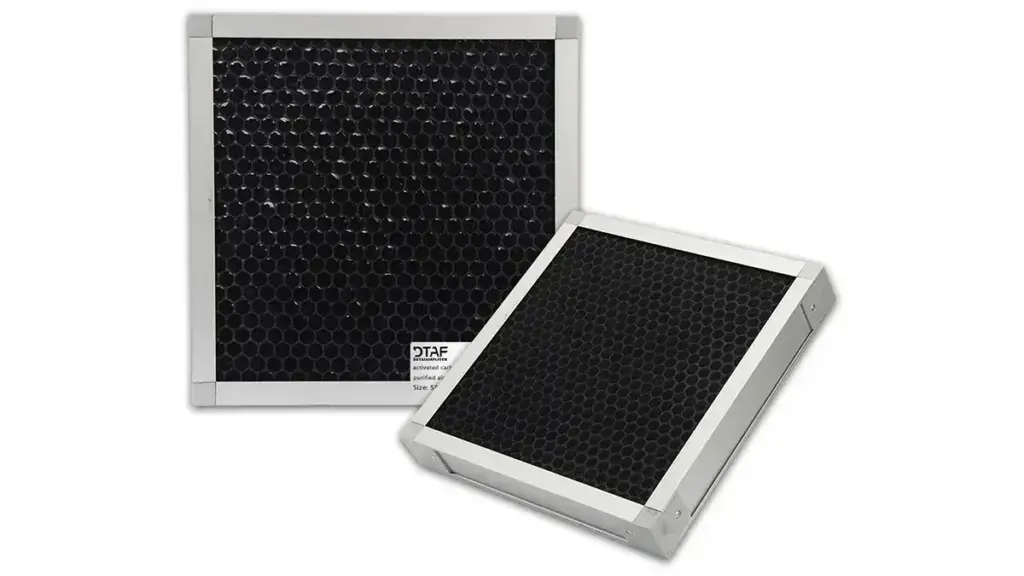
A complete specification sheet is the blueprint for predictable VOC control. It gives vendors the data to size a system correctly and gives you a basis for verifying performance after installation. Наш plate-type activated carbon air filter page documents the as-built parameters behind this approach.
Часто задаваемые вопросы
Do activated carbon filters remove all chemical gases?
No. Carbon is effective for many VOCs and organic odors, but performance varies by compound. Standard activated carbon struggles with very small, highly polar, or reactive gases such as ammonia and formaldehyde. High humidity and elevated temperature further reduce capture efficiency.
Which VOC properties affect activated carbon adsorption?
Carbon captures larger, less polar, and less volatile compounds most effectively. Molecular size must align with the carbon’s pore distribution, and higher-boiling-point vapors adsorb more strongly. Small, highly polar VOCs such as formaldehyde are the hardest cases for standard carbon.
How do humidity and temperature affect VOC removal?
Both have a strong impact. Water vapor competes with VOCs for adsorption sites, and losses become significant above roughly 60–80% relative humidity. High temperature weakens adsorption because the process is exothermic, and can release previously captured VOCs back into the airstream.
When is impregnated activated carbon required?
Impregnated carbon is necessary when contaminants will not adhere through physical adsorption. That includes inorganic gases such as ammonia and hydrogen sulfide, mercury vapor, and problem VOCs like formaldehyde. Added chemical reagents remove these compounds through chemisorption instead of simple trapping.
How is carbon breakthrough monitored in an industrial system?
Breakthrough is monitored by measuring VOC concentration at the adsorber outlet, typically with a downstream PID or a fixed TVOC alarm. A rise in outlet concentration means the media can no longer remove contaminants. Pressure drop alone is not a reliable saturation indicator.
Final Thoughts
Specifying a VOC carbon filter from generic data sheets invites operational risk and premature media failure. The parameters outlined here—from accessible micropore volume to working capacity—are non-negotiable for predictable performance. Our factory standard is built on these exact metrics to ensure your system meets compliance, not just a price point.
Theoretical data must be validated against your own operating conditions. Submit your process parameters for a technical review, or request media samples for evaluation. Contact our team to align your specification with a predictable filtration solution.