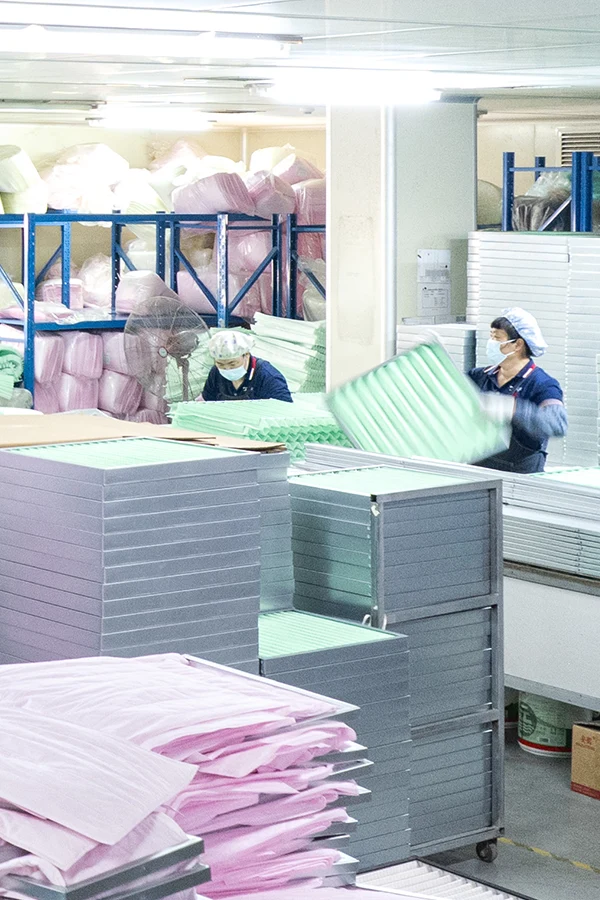
Failing to manage HEPA filter pressure drop directly inflates operational budgets through excessive fan energy consumption and premature filter replacement. This oversight turns a routine maintenance item into a significant financial liability, compromising both system performance and lifecycle costs.
This analysis provides the industry-standard framework for evaluating filter performance based on total cost of ownership. We examine critical data points, including initial resistance (typically 100–250 Pa) and terminal pressure drop (commonly specified at 375–500 Pa), to show how design specifications directly impact energy use and filter service life.
What Is HEPA Filter Pressure Drop?
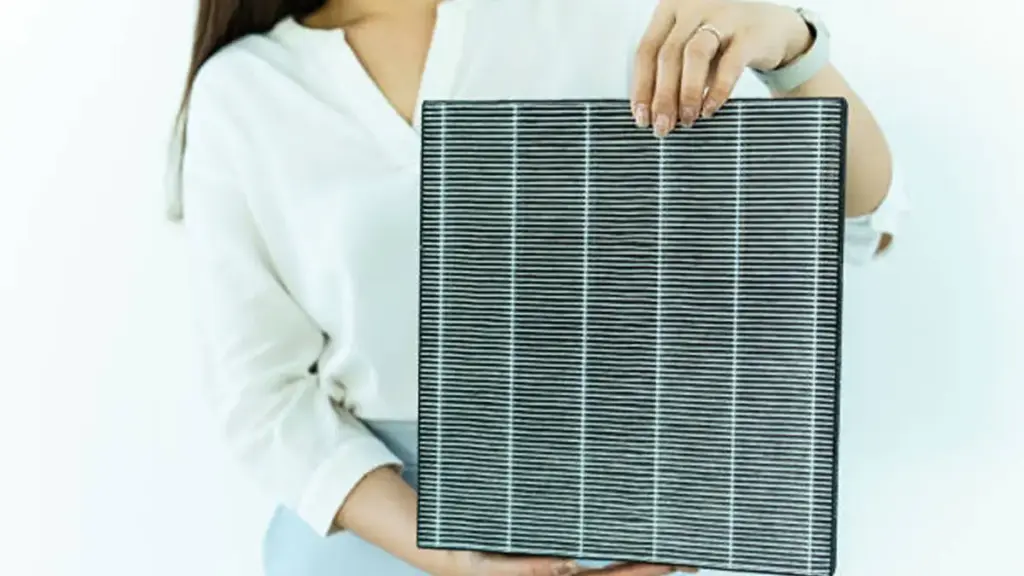
HEPA filter pressure drop is the airflow resistance a filter creates. Monitoring this value is the industry standard for managing energy costs and scheduling filter replacements before performance degrades.
How Pressure Drop Is Measured and Interpreted
HEPA filter pressure drop is simply the resistance to airflow caused by the filter media. We measure it as the pressure difference between the upstream (dirty) side and the downstream (clean) side. In the field, this is done with a manometer or a pressure transmitter, with readings expressed in Pascals (بنسلفانيا) or inches of water gauge (in. w.g.).
A low initial pressure drop is a good sign, as it means the fan uses less energy to push air through the system. As the filter operates, a steadily rising pressure drop indicates that it’s working as intended by capturing particles and increasing its resistance.
Typical Pressure Drop Ranges for HEPA Filters
Pressure drop values follow a predictable lifecycle from installation to replacement. While exact numbers depend on the specific system, filter grade, and rated airflow, the common operational benchmarks are summarized below.
| Lifecycle Stage | Typical Range | What It Means |
|---|---|---|
| New / Clean Filter | 100–250 Pa (0.4–1.0 in. w.g.) | Baseline resistance after installation. A lower value reduces fan energy from day one. |
| Higher-Grade (ح14) وسائط | Usually 200–300 Pa | Denser media trades higher initial resistance for greater particle capture efficiency. |
| Mid-Life Operation | 250–400 Pa | A normal, gradual rise caused by accumulated particle loading. |
| Terminal / Replacement | 375–500 Pa (1.5–2.0 in. w.g.) | Typically 1.5–2× the initial clean value; the specified change-out point. |
Key Factors That Affect Pressure Drop
Four main variables dictate a HEPA filter’s resistance. Understanding them is key to diagnosing system performance and predicting filter lifespan.
- Airflow Rate: Pushing more air through the filter (increasing the face velocity) directly raises its resistance. Doubling the airflow doesn’t just double the resistance; the relationship is often non-linear.
- تصفية وسائل الإعلام: The density, thickness, and design of the filter material are the primary drivers of initial resistance. Higher-efficiency media is generally more restrictive.
- Particle Loading: This is the most significant factor over time. The accumulation of captured dust and contaminants is the main reason pressure drop increases during the filter’s service life.
- System Design: The filter’s resistance doesn’t exist in a vacuum. The frame, housing, and seals all add to the total system pressure drop that the fan must overcome.
Which Design Factors Create Resistance?
Resistance stems from the filter’s media density, physical structure, airflow speed, and captured dust. The entire filter assembly, not just the media, contributes to pressure drop.
Filter Media and Structural Construction
The primary source of resistance is the filter media itself—thicker or denser media with tightly packed fibers forces air through a more complex path and increases pressure drop. But it’s not just the media: the physical frame and the inlet and outlet passages generate their own resistance. Pleat geometry is a critical design factor; engineers use it to maximize media surface area within a set volume, which lowers the face velocity and, in turn, the overall resistance.
Airflow Velocity and Dust Loading
Pushing air through a filter at a higher face velocity inherently increases resistance. As the filter does its job, it captures particles and a “dust cake” forms on the media surface. Over the filter’s service life, this layer of accumulated dust can become the single largest contributor to total pressure drop. The type of contaminant also matters; sticky or liquid aerosols can cause resistance to rise much faster than dry, solid particles.
The Trade-Off Between Efficiency and Resistance
There’s a constant trade-off between filtration efficiency and airflow resistance. Filters with higher efficiency ratings, like HEPA, often use denser media to capture smaller particles. This inherently increases the filter’s initial resistance. The goal of HEPA filter design isn’t the absolute lowest resistance—it’s meeting the particle capture standard with the minimum pressure drop that design allows. A more open media would lower resistance but would likely fail to capture the required percentage of fine particles.
As a filter loads with dust, the accumulated particles can sometimes act as an additional filtration layer, slightly increasing overall capture efficiency. But for HEPA filters that are already extremely efficient out of the box, this gain is marginal. The significant rise in pressure drop remains the primary and most reliable indicator that a filter has reached the end of its service life.
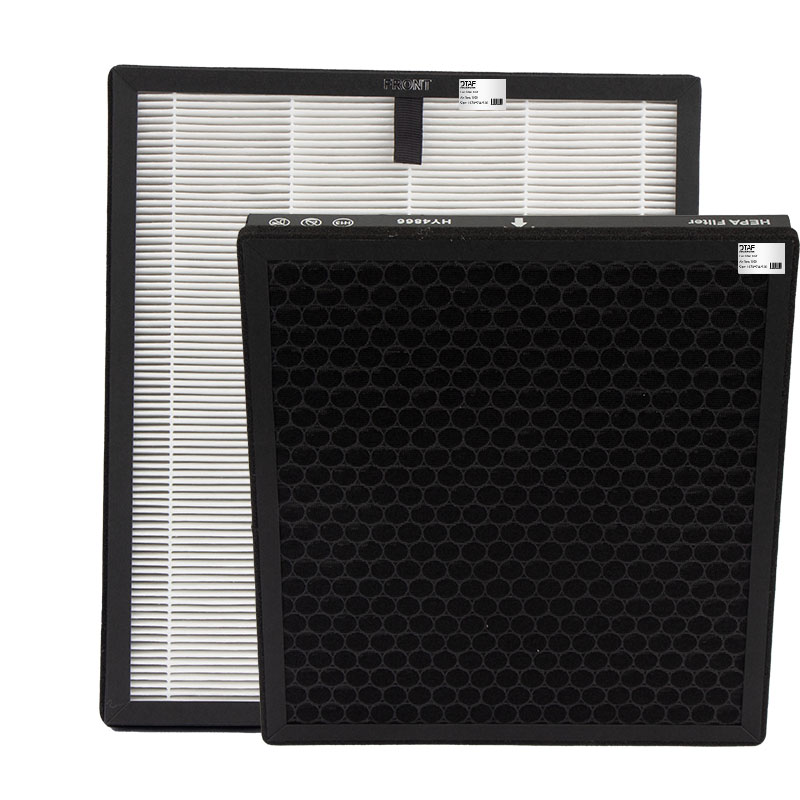
How Does Pressure Drop Change During Filter Loading?
A filter’s pressure drop starts low and rises predictably as it works. This loading curve is a direct signal for maintenance, telling you when it’s time for replacement.
From Clean Baseline to Final Loaded State
A new filter starts with a clean baseline pressure drop, its inherent resistance to airflow when fresh out of the box, as summarized in the lifecycle table above. As the filter does its job capturing particles, its media becomes progressively clogged, increasing the resistance. This causes the pressure drop to rise steadily throughout its service life, until it reaches the predetermined terminal limit that marks the filter as fully loaded and ready for replacement.
The Phases of Particle Loading
Particle capture isn’t a single event; it happens in stages. Initially, particles embed themselves deep within the filter media in a process called depth loading. During this phase, the pressure drop tends to increase at a steady, almost linear rate. Once the deeper pores are full, particles start building up on the filter’s upstream surface. This eventually leads to the formation of a surface “dust cake,” which marks a shift in loading behavior. As this cake develops, it can cause a more rapid, non-linear spike in pressure drop as the filter approaches its saturation point.
Factors That Influence the Rate of Increase
Not all filters load at the same speed. Several operational factors dictate how quickly the pressure drop rises.
- Air Velocity: Pushing air through the filter at a higher velocity accelerates particle capture and, consequently, speeds up the rate at which pressure drop increases.
- Particle Characteristics: The nature of the contaminant matters. The size, shape, and composition of the dust particles directly affect how they block airflow paths within the media.
- رطوبة: High humidity can change the game, especially with hygroscopic particles like salt. Moisture can alter the structure of the dust cake, sometimes making it more open and other times making it denser, which in turn changes the loading curve.
What the Loading Curve Means for Maintenance
The pressure drop trend is your most reliable indicator of filter health and performance. A steadily rising reading shows that the filter is capturing contaminants as designed, and the standard change-out trigger is covered in the replacement section below. The trend is also a diagnostic tool. A sudden, sharp spike might not be normal loading but could signal an upstream problem, like a clogged prefilter. An unusually high reading can also point to a system that is undersized for its workload. Conversely, a reading that stays near zero could indicate a system leak, filter bypass, or a malfunctioning sensor.
How Does Resistance Affect Airflow and Fan Energy?
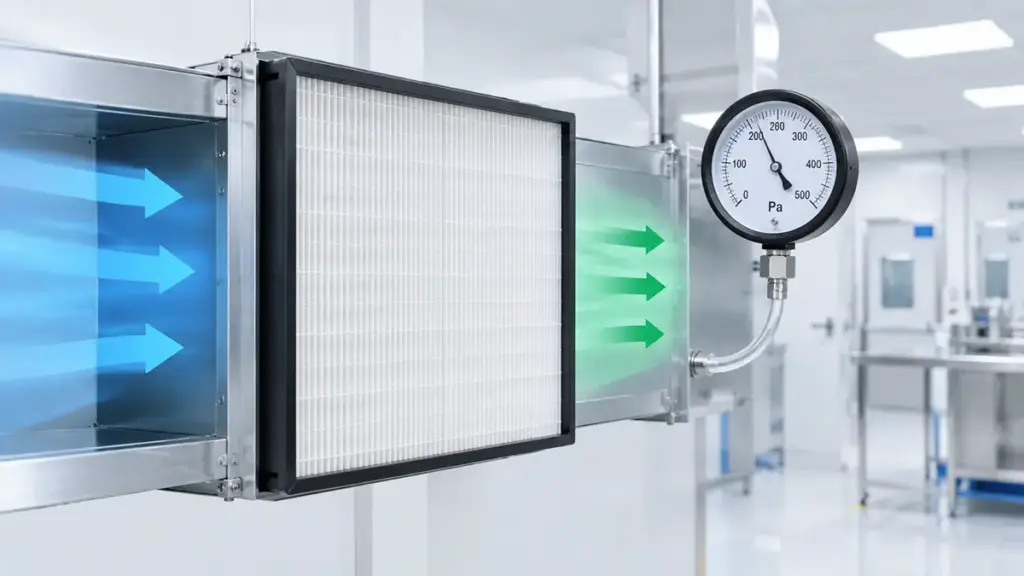
Higher filter resistance reduces airflow or forces the fan to work harder, increasing energy use. It’s a direct trade-off between airflow, مقاومة, and power consumption.
The Inverse Relationship Between Resistance and Airflow
Filter resistance, also known as pressure drop, is the force needed to move air through the filter media. The relationship between resistance and airflow is fundamental: for a fan running at a fixed speed, higher filter resistance reduces the airflow volume delivered. If you need to maintain a specific airflow, the fan must generate higher static pressure to overcome that increased resistance. This is especially critical with HEPA filters, as even a brand-new, clean one presents a substantial initial resistance, far higher than what standard HVAC filters impose.
Impact on Fan Energy Consumption
Pushing air through a more resistant filter forces the fan to work harder and consume more electricity—and this isn’t a one-time cost. As particles accumulate during the service life, the fan’s energy demand rises continuously. If the fan in the air handling unit cannot produce the required pressure to compensate, the airflow delivery drops and system efficiency plummets. The penalty grows more pronounced as the filter approaches its terminal resistance value, the point at which it is considered fully loaded and ready for replacement.
System Design and Maintenance Considerations
Because of their inherent high resistance, air handling systems designed for HEPA filtration require fans specifically selected for their high-static pressure capabilities. You can’t just swap a standard filter for a HEPA and expect it to work. This is why attempting to retrofit HEPA filters into standard commercial HVAC systems usually fails; the existing fans simply cannot overcome the high resistance, leading to severely compromised airflow and poor system performance. For a broader framework on specifying filters within a validated cleanroom system, انظر لدينا cleanroom HEPA filter specification guide.
How Can Filter Design Reduce Lifecycle Cost?
Smart filter design cuts long-term expenses by reducing energy use and extending service life. This focus on total cost of ownership beats chasing a low initial purchase price.
Lowering Pressure Drop to Reduce Energy Consumption
Pressure drop, which is the resistance a filter creates to airflow, is the main driver of fan energy costs in any HEPA filtration system. A filter designed with a lower initial resistance and a slower rate of pressure increase as it loads with dirt will consume significantly less energy. For continuous-duty systems, even a small reduction of 0.1 in. w.g. in pressure drop can translate into hundreds of dollars in annual energy savings for each filter.
Optimizing Filter Media and Construction
The physical construction of a filter has a direct impact on its operating cost. Designs that use more effective media area, such as those with deeper pleats, allow the same volume of air to pass through with less resistance. Well-designed, uniform pleat geometry also ensures that dust loads evenly across the entire filter surface. This prevents premature clogging in certain spots, which slows the rise in pressure drop and extends the filter’s useful life.
Extending Filter Service Life
A longer-lasting filter means fewer replacements, which cuts down on material and labor costs. One of the most effective strategies is implementing staged filtration, where a less expensive prefilter captures larger particles before they can reach and clog the final HEPA filter. Filters with greater dust-holding capacity can also operate much longer before reaching their maximum pressure drop limit. This approach is most effective when changeouts are based on actual pressure drop readings from a gauge, not a fixed calendar schedule, which often leads to replacing filters that still have plenty of life left.
Focusing on Total Cost of Ownership
For HEPA systems, fan energy often represents the single largest share of the total lifecycle cost, making the filter’s initial purchase price a smaller part of the overall financial picture. A filter that seems cheap upfront can quickly become the more expensive option if its poor design leads to higher pressure drop or a shorter service life, driving up long-term operational expenses. The correct way to select a filter is by evaluating its total cost of ownership—factoring in energy, replacement materials, and the labor required for changeouts.
What Data Should Buyers Compare?
To compare HEPA filters, look past the efficiency rating. Focus on pressure drop, airflow test conditions, and media area to understand true performance and lifecycle costs.
When you’re evaluating two HEPA filters, the efficiency rating tells only part of the story. The real differences in operating cost, service life, and system compatibility are hidden in the pressure drop specifications. Scrutinizing the data sheet is critical to making a sound investment.
| Comparison Metric | What to Look For |
|---|---|
| Initial and Final Pressure Drop | Lower initial resistance (clean state) and a clearly defined final resistance (replacement point). The gap between these two values indicates potential service life. |
| Rated Airflow and Face Velocity | Ensure pressure drop values are tested at the exact same airflow (CFM or m³/h). A small change in velocity can drastically alter resistance. |
| Filter Dimensions and Media Area | The total square footage of filter media, not just the frame size. More media area usually means lower resistance and a longer lifespan. |
| Efficiency Class and Test Standard | An identical test standard (على سبيل المثال, في 1822) and efficiency class (على سبيل المثال, H13 vs. ح14). Comparing filters tested under different rules is misleading. |
Initial and Final Pressure Drop
Initial pressure drop is the filter’s resistance when it’s brand new. This is your baseline, and a lower number means your fan uses less energy from day one. Final pressure drop is the manufacturer’s recommended replacement point, often around twice the initial value. Analyzing the ratio between these two figures gives you a solid estimate of the filter’s dust-holding capacity and potential service life.
Rated Airflow and Face Velocity
A pressure drop specification is meaningless without its corresponding airflow rate. Resistance increases significantly with higher airflow, or face velocity. When you evaluate datasheets from different suppliers, confirm the pressure drop was measured at identical airflow conditions—a filter that looks superior might simply have been tested at a lower airflow, creating a false impression of performance.
Filter Dimensions and Media Area
The physical construction of the filter directly impacts resistance. A filter with more media area—often achieved with deeper or more tightly packed pleats—will have a lower pressure drop for the same volume of air. Don’t just compare the outer frame dimensions; look for the specification on total media surface area, which often translates into a longer service life and better energy performance.
Efficiency Class and Test Standard
For a valid comparison, ensure all filters are rated to the same standard, like EN 1822. The term “هيبا” is too broad—as the U.S. EPA notes, it commonly describes filters capturing 99.97% of particles—so industrial procurement should be based on specific efficiency classes, such as H13 versus H14. A higher efficiency class generally comes with a higher initial pressure drop; for a deeper comparison of the two most common grades, انظر لدينا H13 vs H14 filter analysis. Mismatched standards or classes will lead you to make inaccurate assumptions about both filtration and airflow resistance.
When Should a HEPA Filter Be Replaced?
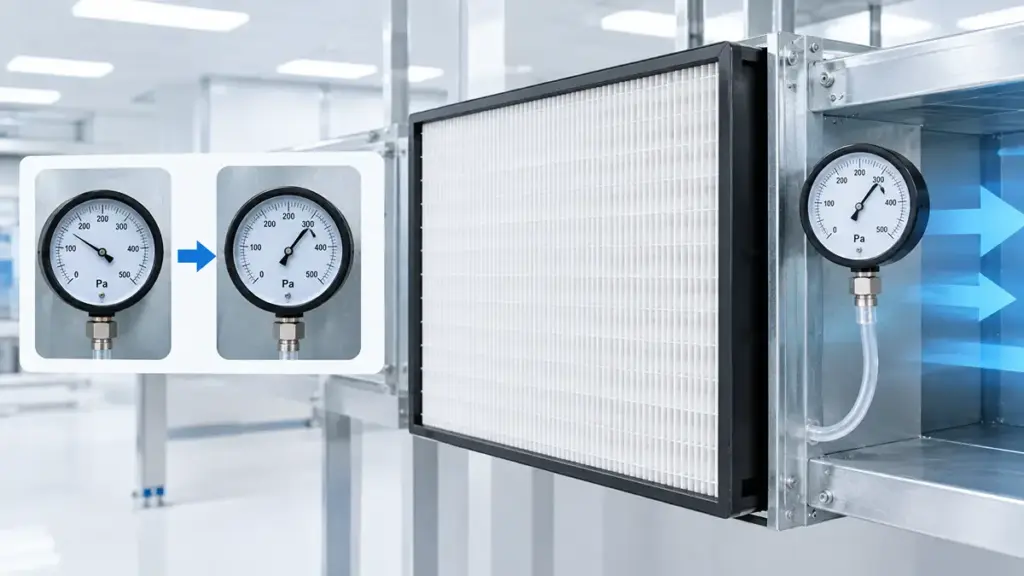
Replace a HEPA filter when its airflow resistance, or pressure drop, doubles from its initial clean baseline. This signals that particle loading is increasing fan energy and reducing efficiency.
The Primary Indicator: Increased Pressure Drop
The main signal to replace a HEPA filter isn’t a calendar date, but a measurement of its resistance to airflow, known as pressure drop. As a filter loads with contaminants, its pressure drop rises. The common industry rule is to replace the filter when its pressure drop reaches twice (2x) its initial value recorded right after installation. Some facilities opt for a more aggressive 1.5x threshold to better balance energy costs against filter lifespan. The typical values behind these thresholds are summarized in the lifecycle table above.
Immediate Replacement Triggers Beyond Pressure
A high pressure drop reading isn’t the only reason for a change-out. A filter requires immediate replacement under several other conditions.
- The filter media is physically damaged, with visible punctures, tears, or other defects.
- The filter fails a required integrity or leak test, which is a common practice in cleanrooms and pharmaceutical settings.
- The HVAC system or fan filter unit (ففو) can no longer maintain the required airflow volume, even when the fan is operating at its maximum speed.
Establishing a Baseline and Monitoring Process
Effective filter management relies on a clear process and accurate data. Without a baseline, you’re just guessing.
- Immediately after installing a new filter and balancing the system, measure and record its initial pressure drop. This number is your baseline.
- Use a calibrated manometer or differential pressure gauge to track the pressure drop at regular intervals (على سبيل المثال, monthly or quarterly).
- Maintain a dedicated log for each filter that includes the installation date, the initial baseline pressure, and all subsequent readings and test results.
الأسئلة المتداولة
What is a normal initial pressure drop for an industrial HEPA filter?
A typical initial pressure drop for a new industrial HEPA filter at its rated airflow is between 0.4 و 1.0 inches of water gauge (in. w.g.), which is approximately 100 ل 250 Pascals (بنسلفانيا). This value serves as a baseline for tracking how much the filter has loaded with contaminants over its service life.
Why does HEPA filter pressure drop increase over time?
Pressure drop increases as the filter captures and accumulates airborne particles like dust and aerosols. These captured particles build up within the filter media and on its surface, forming a ‘dust cake’ that obstructs airflow and raises resistance. This gradual increase is a normal sign that the filter is performing its function.
Does higher HEPA efficiency always mean higher resistance?
لا, higher efficiency does not automatically mean higher resistance. While there can be a trade-off, modern filter designs using advanced media and greater surface area can achieve higher particle capture efficiency without a significant increase in pressure drop. Resistance is influenced by media type, pleat design, and face velocity, not just the efficiency rating.
How does pressure drop affect fan energy and airflow?
As pressure drop increases, the system’s fan must work harder. In a variable-speed system, the fan will ramp up to maintain the target airflow, consuming more energy. In a constant-speed system, the fan cannot overcome the added resistance, causing the overall airflow to decrease.
At what pressure drop should a HEPA filter be replaced?
A HEPA filter is typically replaced when its pressure drop reaches about twice its initial (clean) value. For many industrial applications, this terminal pressure drop is around 1.5 ل 2.0 inches of water gauge (in. w.g.) أو 375 ل 500 Pascals (بنسلفانيا). Replacement prevents excessive energy consumption and ensures adequate airflow is maintained.
How should pressure drop be measured and recorded in a cleanroom system?
Pressure drop should be measured using a calibrated differential pressure gauge connected to ports on the upstream and downstream sides of the filter. Readings should be taken at consistent operational airflows and recorded regularly in a log. This log should track the filter’s ID, installation date, initial pressure drop, and subsequent readings to monitor loading trends and predict replacement needs.
While generic filters offer a lower initial price, this analysis shows that pressure drop is the key driver of total ownership cost. Relying on an undefined standard exposes your operations to escalating energy bills and compromised airflow. Adhering to a strict pressure drop specification is the most reliable way to secure both performance and long-term financial efficiency.
Don’t guess on performance—verify it with data. Request our technical datasheets to run a direct comparison against your current filters. Contact our team to discuss your specific system requirements, OEM specifications, or to arrange for a sample unit.