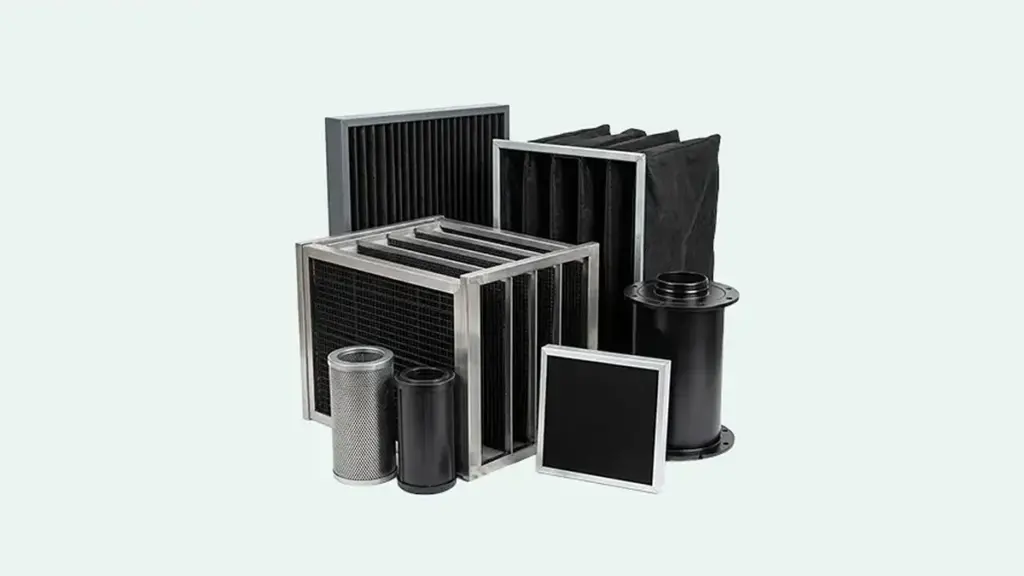
Selecting the right activated carbon filter configuration decides whether your system removes odors and gases on budget, or burns fan energy fighting resistance it was never sized for. A panel adsorber, a bag unit, and a V-bank module can carry identical carbon. They deliver very different contact time, holding capacity, and pressure profile.
This guide compares five air-side formats—panel, bag, V-bank, honeycomb, and cylindrical—and shows how carbon mass, airflow, and pressure drop interact. It closes with the data a manufacturer needs to quote a working system rather than a box of carbon.
What Is an Activated Carbon Filter Configuration?
An activated carbon filter configuration is the arrangement of carbon media, frame, and airflow path in one gas-phase unit. It sets contact time, contaminant capacity, and resistance.
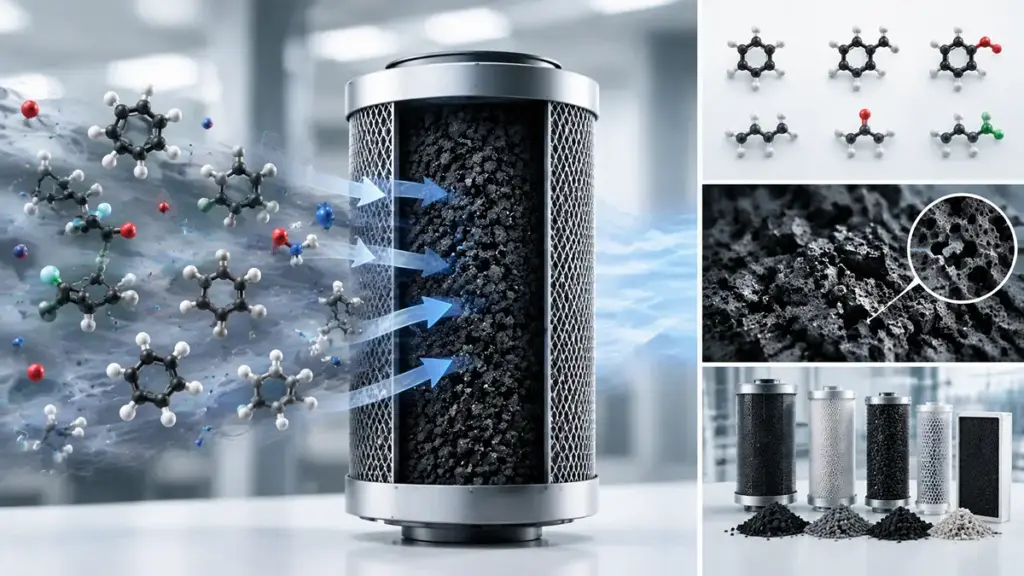
A configuration is more than the carbon itself. It sets how air reaches the media, how long it stays, and how much force the fan spends pushing it through. Pair it wrongly and the media saturates early or starves the airstream. Our explanation of how an activated carbon filter works covers the mechanism in detail.
Three Elements Define Every Format
Every air-side unit combines three elements in different proportions.
- Media form: Pelletized or granular carbon, extruded blocks, impregnated felt, carbon-loaded cotton, or coated foam. Each carries a different carbon mass and resistance curve.
- Frame and housing: Cardboard, galvanized or stainless steel, aluminum, or plastic. The frame sets the seal method, allowable bed depth, and whether the unit is disposable.
- Flow path: Straight-through for panels, depth-loading for bags and V-banks, radial or cross-flow for cartridges. Path length drives contact time more than media weight alone.
Four Parameters You Must Balance
Four numbers decide whether a format performs.
- Face velocity: Air volume per unit of media area. High velocity cuts contact time, so molecules pass without bonding.
- Contact time: Bed depth divided by face velocity, in seconds. Gas duty needs a longer path than particulate filtration at the same airflow.
- Carbon load: Mass per frame. Our plate-type activated carbon air filter comes in 25, 46, 50, 60, 70, and 100 mm depths, which is how load is adjusted without changing the air handler.
- Pressure drop: That series runs 50–90 Pa clean against a recommended 180–220 Pa at changeout, inside 5–55 °C and 35–65% relative humidity.
How Do Panel and Pleated Carbon Filters Work?
Panel filters force air through a flat carbon bed at low resistance. Pleating packs more media into the same frame, trading airflow area for capacity and dust holding.
What Carbon Does, and What It Cannot
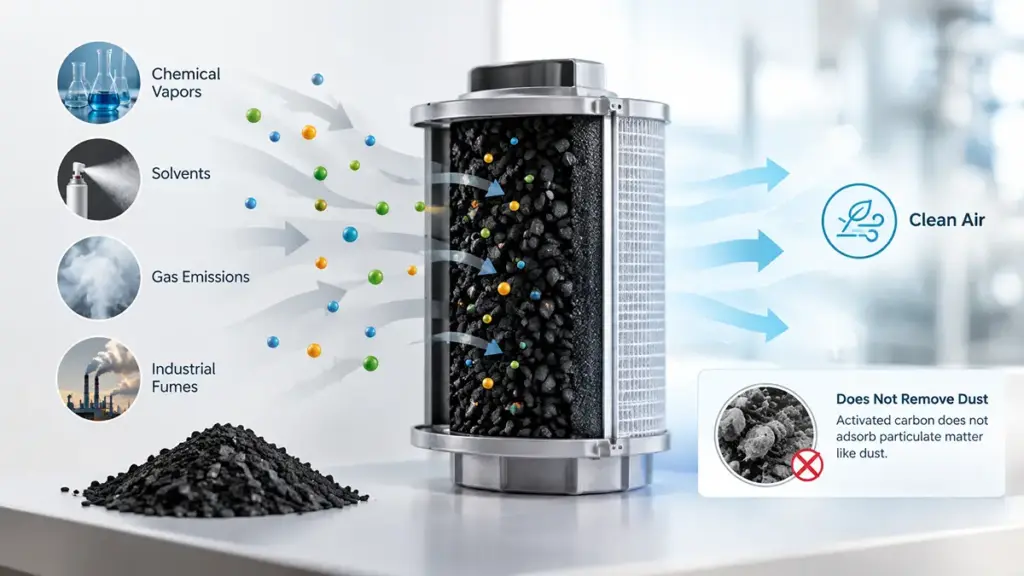
Carbon removes gas molecules by adsorption: contaminants collect on an internal pore surface measured in hundreds of square meters per gram. It does not destroy them, and it does nothing for particles, which is why a carbon stage normally sits behind a particulate pre-filter. Carbon quantity is the commercial question for any activated carbon filter configuration. The US EPA states that activated carbon filters can be effective, provided there is a large amount of material in the filter. Carbon weight is a specification line, not a footnote.
Panel Construction and Airflow
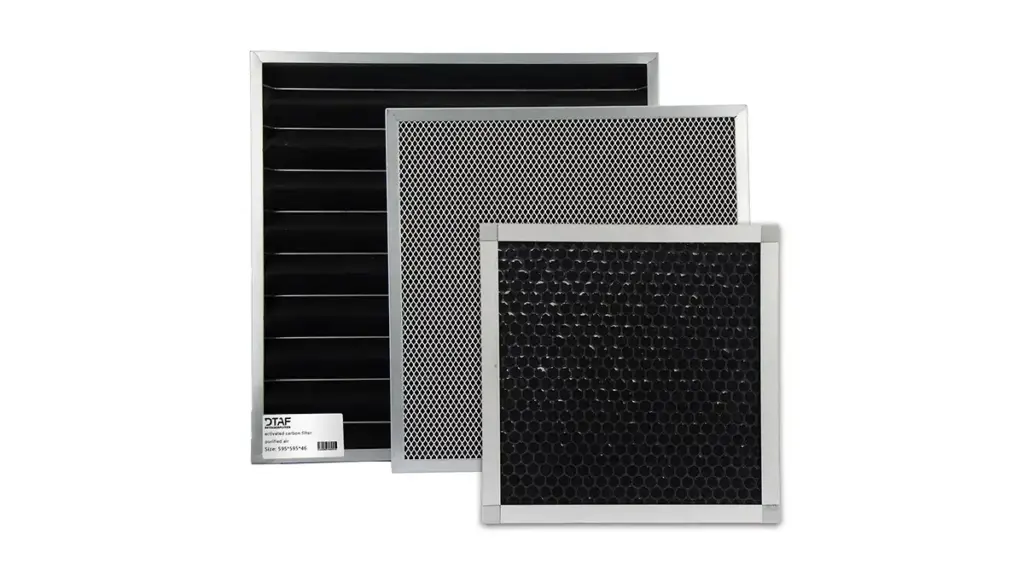
A panel holds a flat carbon bed inside a rigid frame, with permeable facing or screen on both sides. Air crosses the bed once, perpendicular to the face. The path is short, so resistance stays low and the unit drops into an existing grille, cabinet, or air handler slot without fan modifications.
The trade-off is capacity. A 25 mm panel holds less carbon than a 100 mm panel of the same face, and it exhausts sooner under continuous VOC load. Panels are the default where odor strength is moderate, changeout is scheduled, and the slot is shallow.
Pleating as a Capacity Strategy
Pleating folds media into an accordion profile, so a frame exposing 0.35 m² of flat face can present two to three times that area. On gas-phase products this usually means carbon-impregnated fleece pleated between supports, sometimes combined with a particulate layer in one element.
Two consequences follow. Dust capacity rises and the service interval lengthens. Resistance per unit of face area also rises, so check a pleated element against the fan curve rather than assuming it drops into a panel slot. DTAF builds pleated combination elements to OEM drawing; our stocked carbon formats are panel, bag, honeycomb, cartridge, and impregnated media.
When Are Bag and V-Bank Carbon Filters Used?
Bag formats buy dust holding and long intervals. V-bank modules buy media surface per square metre of installed face, which is what high-airflow systems need to keep resistance flat.
V-Bank Modules for High Airflow
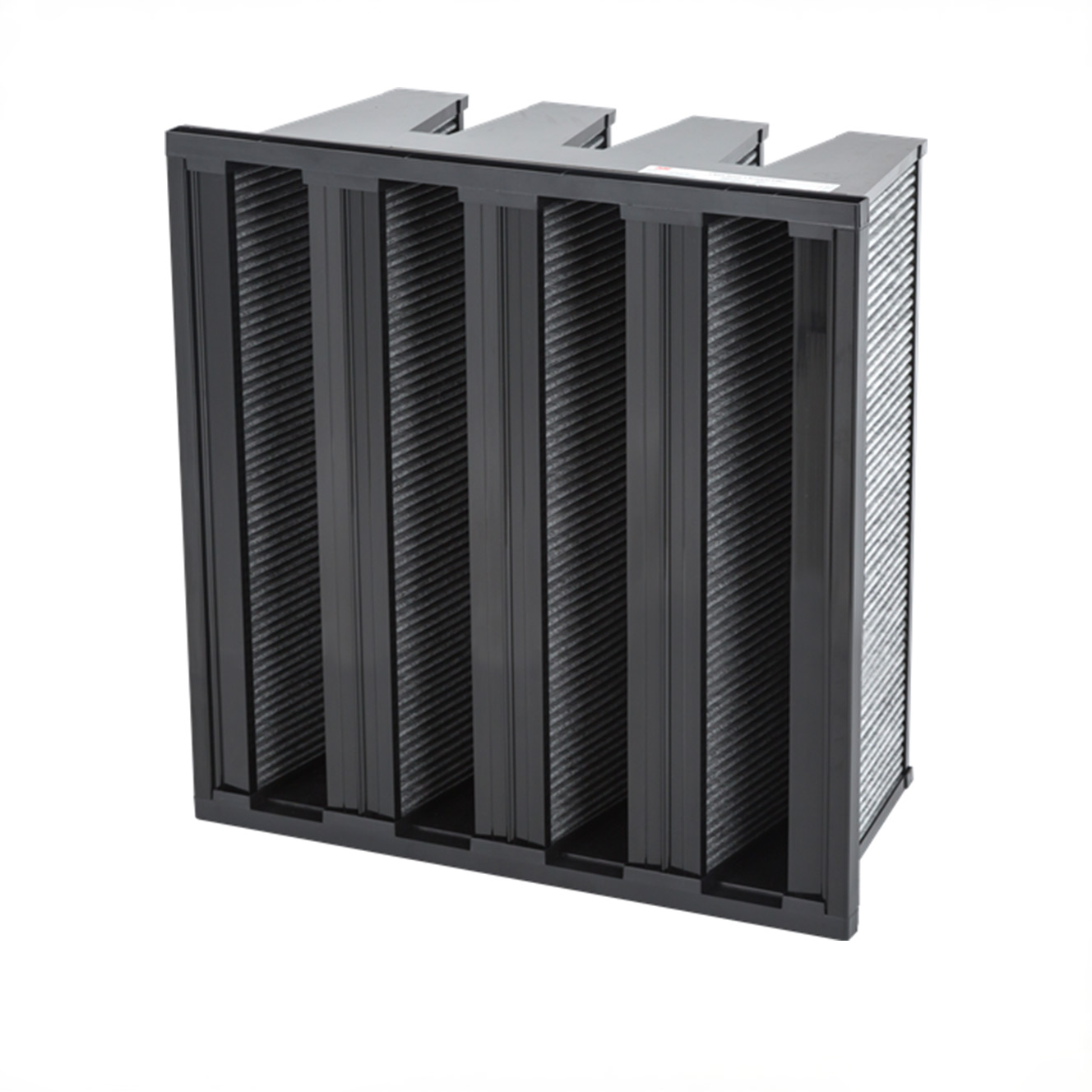
A V-bank assembly stands media panels on edge in a V profile inside a frame. The geometry exposes far more face to the airstream than the footprint suggests, so velocity through the media falls even while total airflow rises. Lower velocity means lower resistance and a slower path to saturation.
Gas-phase duty in that geometry normally runs on chemical media rather than loose granules, targeting acidic gases, ozone, and nuisance odors. Our chemical air filter uses activated carbon felt and is specified for laboratories, electronics plants, food and pharmaceutical sites, where off-gas is continuous rather than occasional.
Bag Units for Combined Dust and Odor Load
A bag-type unit suspends pockets of carbon-bearing media from a header frame. Air enters through the header and fills the pockets, so loading spreads over a large area and dust collects deep inside rather than sealing the face.
That suits streams carrying lint, fibers, or coarse dust alongside odors, where a flat panel would blind in weeks. Our bag-type activated carbon filter sets the bag count to raise filtration area while holding resistance down, the same arithmetic a V-bank solves with a different frame.
Where These Two Formats Get Specified
- Data centers: Corrosive gas reaching boards and contacts drives chemical and V-bank media selection.
- Hospitals and laboratories: Solvent, disinfectant, and specimen odors that a HEPA stage cannot touch.
- Airports and transit hubs: Engine exhaust with NOx and SOx loads at very high supply volumes.
- Manufacturing cells: Solvent vapors, coating fumes, and mixed dust from printing and finishing lines.
How Do Honeycomb Carbon Filters Hold the Media?
A honeycomb holds carbon inside a cell structure or on the cell walls. Core, retainers, and facing screens together stop media shedding and air bypass.
Three Ways to Keep Carbon in Place
- Extruded blocks: Carbon powder bound into a monolith with straight parallel channels, supplied in hole sizes from 1.5 to 8 mm. The block is self-supporting, so channel geometry is fixed at manufacture.
- Cell-packed trays: A paper or aluminum honeycomb filled with granular or pelletized carbon, closed with mesh on both faces. Carbon mass per tray is adjustable, which is why this form suits custom loads.
- Coated substrates: Carbon bonded onto channel walls. The thinnest option and the lowest capacity, used where depth is the binding constraint.
What the Retention System Buys
Frame, mesh, adhesive, and support grid are not packaging. They keep channel openings clear, which lets a honeycomb move air at low resistance, and lock media so it cannot shift, fracture, or shed granules downstream. A single migration path creates bypass, and bypass shows up as odor returning days after installation. Uniform distribution also holds contact time steady across the face.
Ask which of the three constructions a vendor is quoting, and whether the facing mesh is rated for your velocity. That one answer usually explains a two-to-one price gap between nominally identical modules. For a wider comparison of formats, see our activated carbon air filter guide.
When Do Cylindrical or Inline Carbon Filters Fit?
Cylindrical describes the shape of the element. Inline describes where it mounts in the duct. Many products are both, which is why the terms get confused in enquiries.
Shape Is Not Mounting
A cylindrical element is a round cartridge or canister sitting inside a housing, plenum, or terminal. An inline unit installs in series with the duct run, so all airflow passes through it. Round cartridges dominate inline fittings because duct is round, yet a cylindrical element can equally serve as a polishing stage inside a rectangular cabinet. Specify geometry and path separately.
Cylindrical Elements Inside a Housing
Cartridge and cylinder formats are the stocked round option in our carbon range, alongside panel and bag forms. Typical duties include:
- Polishing stages that clear moderate VOC or odor load after a primary filter takes the bulk.
- Elements dropped into air handler terminals, equipment enclosures, and cabinet ventilation inlets.
- Round-duct protection for downstream equipment, where a flanged canister swaps without opening the air stream.
Inline Mounting When There Is No Room for a Housing
Inline configurations become the practical answer when a separate adsorber cannot fit. The element joins the duct run and the existing fan pulls air through it.
- Servicing: A spigot-mounted element unclamps and swaps without dismantling a housing or breaking a plenum seal.
- Path: Continuous airflow with no plenum mixing, which protects contact time in short runs.
- Limit: Small face area caps both carbon mass and dust tolerance, so an inline element needs a pre-filter upstream in any dirty stream.
How Do Carbon Mass and Pressure Drop Compare?
Carbon mass sets capacity. Airflow sets how fast that capacity is consumed. Pressure drop is the bill your fan pays for both.
| Parameter | Effect on Performance | Practical Consequence |
|---|---|---|
| Carbon mass | Adds pore surface, extending capacity and time to breakthrough. | Needs deeper beds or heavier frames, which the fan pays for. |
| Airflow velocity | Shortens contact time and raises resistance across the media face. | More fan power and energy cost; early breakthrough if pushed. |
| Media form | Carbon cotton sits low in a frame’s resistance band; honeycomb panels sit high. | One 592 × 592 frame can differ by tens of pascals on media choice. |
| Changeout limit | Final resistance marks where a unit stops being useful. | Our plate-type series is rated 180–220 Pa against 50–90 Pa clean. |
Mass Buys Service Life, Not Efficiency
Doubling the carbon behind the same face roughly doubles available adsorption sites, so the unit lasts about twice as long at a fixed contaminant load. It does not raise removal percentage at a given velocity; that is a contact-time question. Loading is specified differently by form. Our carbon cotton is rated at no less than 50% carbon content with benzene adsorption of at least 20%. Foam screen media is rated by impregnation percentage.
Extra mass arrives either as thickness or as a denser charge. Thickness is the cheaper route into an existing frame, which is why the plate-type range is offered in six depths up to 100 mm rather than one.
Why Velocity Controls Your Energy Bill
Resistance climbs steeply with face velocity through a packed bed. Pushing 1,000 m³/h through a frame rated for 500 m³/h roughly doubles clean-side pressure drop and halves contact time. The fan answer is more static pressure: more energy, more noise, and in retrofits more than the motor can deliver.
Two checks prevent this. Confirm the vendor publishes initial resistance at a stated airflow rather than a single “low” figure. Then confirm design airflow sits inside the frame’s rated range with margin. Read published resistance as a starting condition, not a changeout rule: our plate-type data states that saturation is best determined by gas detection, with pressure drop for reference only.
How to Settle the Trade-off
Work from the constraint that binds first. A fixed air handler opening forces face area, so buy life through depth and impregnated media. Limited fan static pressure forces low-resistance geometry, so buy life with parallel units rather than one deeper bed. An unknown or spiky contaminant load favors modular formats that swap without ductwork changes.
Which Configuration Fits Each HVAC or Industrial Application?
Match the activated carbon filter configuration to the binding constraint. A shallow slot calls for panels, a high-volume airway calls for V-bank, a dirty or intermittent stream calls for bags or cartridges.
Commercial and Light-Industrial Air Handling
Offices, schools, retail, and ward air usually need odor and light VOC control at modest strength. Panel and pleated carbon elements sized to the existing grille fit this duty, because they add a gas stage without re-engineering the handler. Keep a pre-filter ahead of the carbon stage; it is the cheapest way to keep dust from blinding the media.
Building materials, cleaning products, and occupancy all contribute to indoor VOC levels, and concentrations swing with ventilation rate. Specify for the worst hour, not the average.
High-Volume and Corrosive-Gas Environments
Data centers, airports, and transit terminals move enormous volumes and face gas loads that damage equipment rather than annoy occupants. Gaseous corrosion of contacts and boards is a recognized failure mode. The gas stage there is normally V-bank geometry, because nothing else supplies the required media area at acceptable resistance.
Museums and archives are similar: acid gases and aldehydes degrade collections slowly, so consistent low-velocity contact matters more than raw capacity.
Process Exhaust and Laboratory Duty
Process streams break away from HVAC logic. Loads are stronger, often hot, and frequently contain compounds plain carbon will not hold, which is where impregnated media earns its place. Low-volume fume-cupboard extraction suits drum or cartridge adsorbers. Continuous heavy solvent duty needs a designed bed with a measured breakthrough curve, quoted from data.
Retrofits Into Ductwork That Cannot Be Rebuilt
Most gas-phase retrofits fail on static pressure, not on chemistry. Where the fan has no spare head, choose the format with the largest face area the duct will accept, then specify media weight to suit. Slim coated substrates and carbon-fleece panels are the usual answers, since they add adsorption surface with a limited resistance penalty.
Treat regeneration claims with the same care. Any scheme that heats loaded media to release captured VOCs needs a controlled vent path outdoors; routing that stream back into supply air reverses the purpose of the install.
What Data Does Your Carbon Filter RFQ Need?
A quote request for an activated carbon filter configuration should hand the vendor six items: airflow, contaminant list, target outlet level, pressure budget, mounting envelope, and duty conditions.
A vague enquiry produces a vague proposal, and the error surfaces after installation as odor that never stops or a fan that cannot hold design flow. Supply these six data points and a manufacturer can size the bed, choose the activated carbon filter configuration, and state a predicted service interval.
Process and Performance Data
- Airflow: Average and peak volume, plus static pressure available at the mounting point. State units once and keep them consistent.
- Contaminant list: Named compounds where known, with inlet concentration. Solvent, ammonia, ozone, and sulfur species behave differently on the same carbon.
- Target outcome: Required outlet concentration or the odor threshold you must satisfy, plus the standard your project is audited against.
- Duty conditions: Temperature range, relative humidity, and upstream dust load. High humidity competes with target VOCs for pore space.
Mechanical and Commercial Scope
- Envelope: Nominal size, available depth, frame material, and how the unit seals against the housing.
- Maintenance model: Disposable element or cleanable frame with replaceable media, plus the changeout interval your budget allows.
- Documentation: Test report per batch, resistance at stated airflow, CE and RoHS statements, and third-party reporting where the project requires it.
- Supply terms: Trial quantity, then repeat volume. DTAF accepts low-MOQ trial orders on standard panel and pocket formats, with 50–100 units the practical floor for fully custom OEM dimensions.
Water-Phase Duty Is a Separate Specification
Granular carbon in pressure vessels, empty bed contact time measured in minutes, backwash expansion, and NSF or AWWA certification belong to liquid treatment rather than to the air-side formats above. DTAF supplies air filtration only. If your project includes a water stage, quote it separately with vessel material, influent analysis, and service plus peak flow.
Get Certified Air Filters from Low-MOQ Trial Orders
Frequently asked questions
Which configuration handles the highest airflow?
V-bank geometry. Standing the media on edge exposes several times the face area of a panel in the same footprint, so velocity through the media falls while total system airflow rises. Extruded honeycomb blocks come second where the load is gas-only and space is tight, because straight channels keep resistance low.
Is a deeper carbon bed always the better choice?
No. A deeper bed adds capacity and extends service life, but it also adds resistance and demands fan head you may not have. Where the fan is already at its limit, several shallow units across a larger face usually outperform one deep bed. Settle the pressure budget before choosing depth.
Can I compare pressure drop across different designs?
Only at identical airflow and identical face area, and only in the same condition. A clean panel figure and a loaded bag figure are not comparable, and neither is a datasheet number measured at a test flow your system never runs. Always ask at what airflow the published resistance was measured.
Do carbon filters remove dust as well as odors?
Not reliably. Carbon captures gas molecules on its internal pore surface, while particles are a separate job for a particulate media. Combination elements exist and do hold some dust, but the carbon stage blinds early if it carries the load. Put a pre-filter ahead of any gas-phase configuration.
A configuration decision is a systems decision. Every format above works; what differs is whether yours fits the airflow, the pressure budget, and the contaminant. Confirm the numbers against your own air handler before ordering, and ask for resistance data measured at your flow.
Send the six data points from the RFQ section, and our engineers will size your activated carbon filter configuration. We state a predicted service interval and return a factory-direct quote within 12 hours.