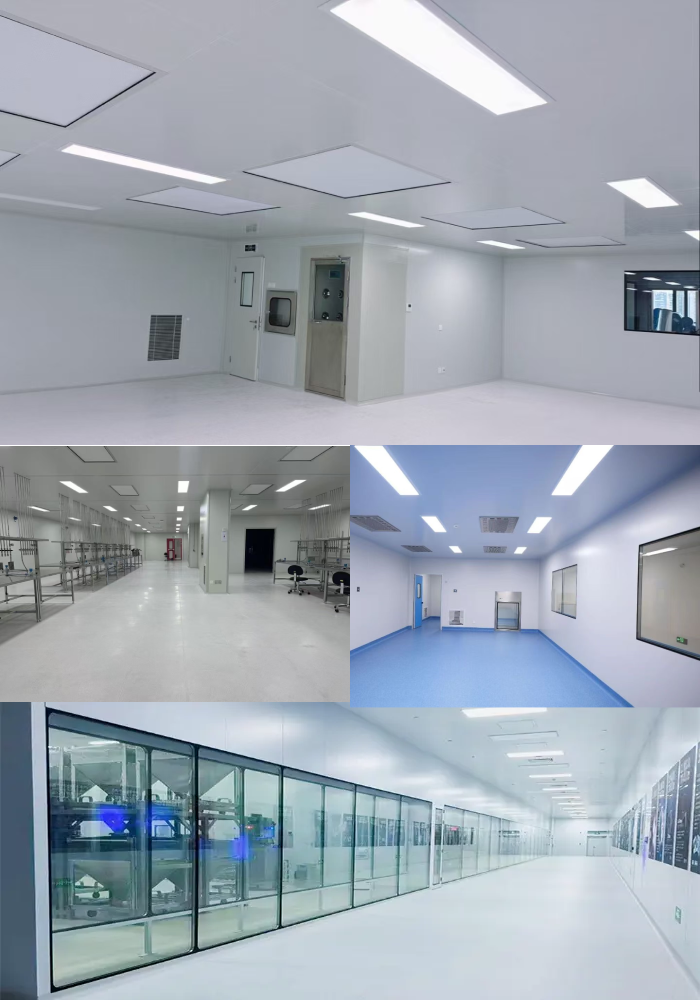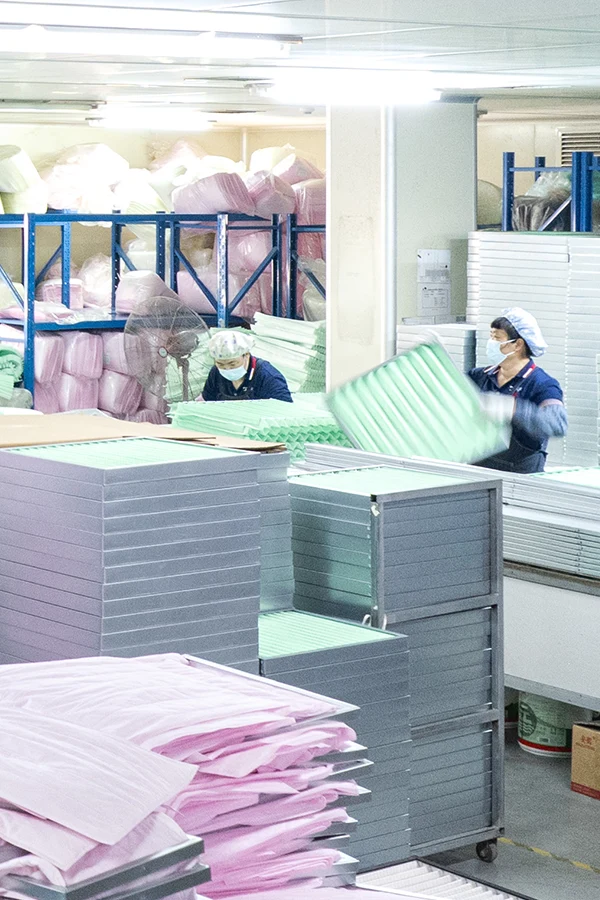
The fiberglass vs PTFE HEPA filter decision directly impacts cleanroom energy consumption and contamination risk. Selecting media based on initial purchase price, without considering environmental factors, often leads to higher operational costs and unscheduled downtime due to premature filter failure.
This fiberglass vs PTFE HEPA filter analysis benchmarks PTFE against the industry-standard fiberglass media, comparing performance on critical operational metrics. We evaluate how differences in filtration mechanism—depth-loading versus surface-loading—directly influence initial pressure drop, chemical resistance, and ultimately, your total cost of ownership.
What Is Fiberglass HEPA Filter Media?
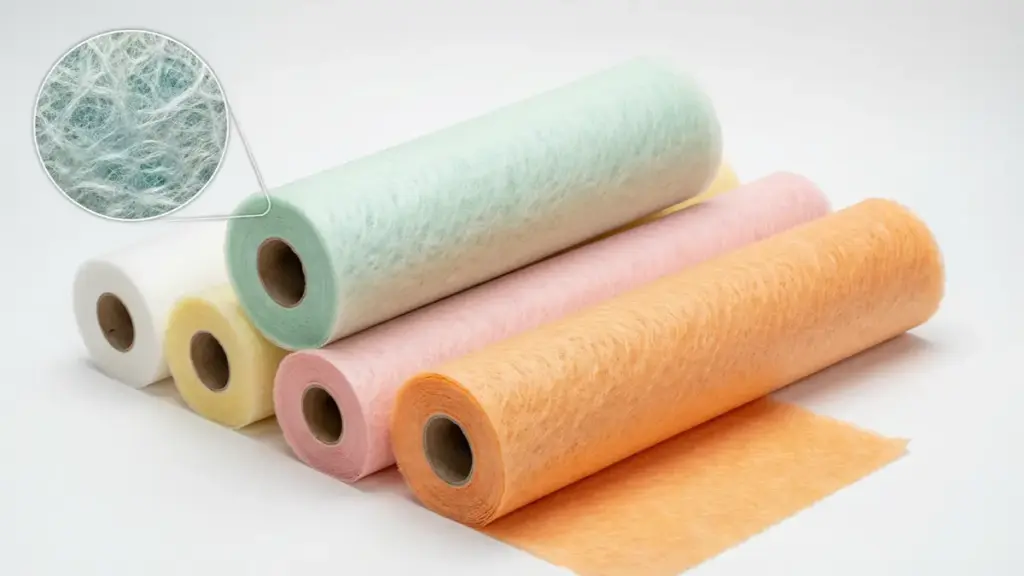
Fiberglass HEPA media is the industry standard for high-purity air filtration. It excels at capturing submicron particles but requires careful handling and can present higher airflow resistance.
Core Composition and Manufacturing Process
The core of this material is a nonwoven medium composed of micro-fine borosilicate glass fibers. Manufacturers produce it using a wet-laid process, which is similar to papermaking. This method creates a dense, tangled web of fibers ideal for trapping airborne contaminants. Resin or acrylic binders are often added during manufacturing to give the media structural integrity and make it suitable for pleating. This finished material is the primary component responsible for particle capture in both HEPA and ULPA filters.
Filtration Mechanism and Efficiency Ratings
Fiberglass media doesn’t work like a simple sieve. It captures particles through a combination of physical mechanisms: interception, impaction, and diffusion. This multi-pronged approach is particularly effective at capturing particles around the 0.3-micron size, which is notoriously difficult to filter. This capability allows the media to achieve high-efficiency ratings like H13 (99.95% efficient) and H14 (99.995% efficient). The entire design is a trade-off, balancing extremely high particle removal against maintaining an acceptable level of airflow resistance, also known as pressure drop.
Physical Properties and Handling
On its own, fiberglass media is quite fragile. It must be handled carefully during the filter assembly process, especially during pleating. The material is formed into deep or mini-pleat packs, a design that maximizes the total filtration surface area packed into a standard frame. This increased area enhances its dust-holding capacity and extends service life. Compared to some synthetic alternatives like PTFE, fiberglass media can exhibit a higher initial pressure drop. To address specific operational challenges, manufacturers also offer specialized versions with enhanced resistance to high humidity.
Common Applications in Controlled Environments
Due to its proven performance, fiberglass HEPA media is a go-to choice for environments where air purity is non-negotiable. Its most common applications include:
- Final filtration in cleanrooms for semiconductor and electronics manufacturing.
- HVAC systems within hospitals, pharmaceutical labs, and biotechnology facilities.
- Air purification for food and beverage processing to prevent product contamination.
- Industrial processes that require the removal of fine dust, smoke, and soot from the airstream.
What Is PTFE HEPA Filter Media?
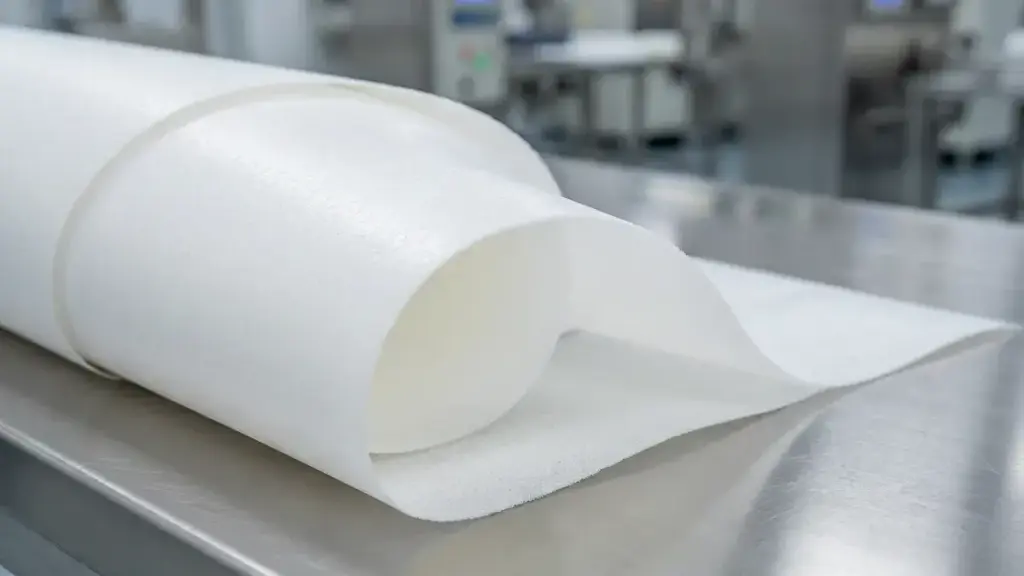
PTFE media provides HEPA filtration with lower airflow resistance and superior durability in humid or chemical environments, trading higher initial cost for better operational performance.
When standard fiberglass isn’t enough, operators turn to PTFE HEPA filter media. This advanced material provides high-efficiency filtration for critical applications where performance under harsh conditions is non-negotiable.
Definition and Filtration Mechanism
PTFE HEPA filter media consists of a microporous expanded polytetrafluoroethylene (ePTFE) membrane. This membrane has an engineered node-and-fibril microstructure, creating incredibly small and uniform pores. Unlike fiberglass which traps particles throughout its depth, PTFE functions almost entirely through surface filtration. Contaminants are captured on the media’s surface, preventing them from embedding deep within the filter. For structural integrity, this membrane is often laminated to a nonwoven synthetic spunbond support layer.
Core Performance Characteristics
The primary benefits of using PTFE media come down to four key characteristics:
- It consistently achieves high-efficiency particle capture, meeting stringent HEPA and ULPA standards for submicron particles.
- It operates with a lower pressure drop compared to fiberglass media at similar efficiency ratings, which directly translates to lower fan energy consumption.
- The material is naturally hydrophobic, giving it excellent resistance to moisture and water that can cripple fiberglass filters.
- It exhibits strong chemical resistance, making it the default choice for chemically aggressive or corrosive industrial environments.
Comparison with Traditional Fiberglass Media
Despite PTFE’s advantages, fiberglass remains a common standard in many life-science and pharmaceutical applications due to its long history of use and extensive qualification data. Another key difference is that PTFE is a synthetic fluoropolymer with very low shedding characteristics. This reduces the risk of the filter itself becoming a source of contamination, a critical factor in microelectronics and high-purity manufacturing.
Common Applications
PTFE HEPA media is specified for applications where performance and reliability are critical. Common uses include:
- Cleanrooms for semiconductor and microelectronics manufacturing.
- Critical air filtration systems in pharmaceutical, laboratory, and food processing facilities.
- Industrial dust collection systems for fine powder handling, such as in cement production and pneumatic conveying.
- High-purity environments, including medical gas lines and inlet protection for vacuum pumps.
Get Certified Air Filters from 1 Unit
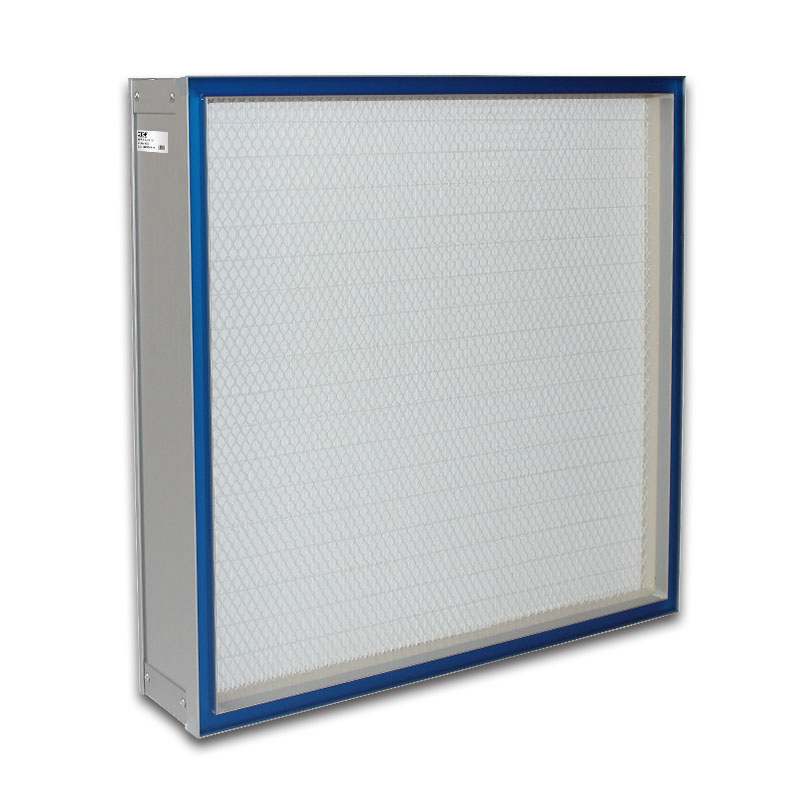
How Do Fiberglass and PTFE Filtration Mechanisms Differ?
Fiberglass is a depth filter, capturing particles throughout its media. PTFE is a surface filter, trapping them on its membrane. This single distinction drives every performance difference.
Depth Filtration (Fiberglass) vs. Surface Filtration (PTFE)
The core difference between these two materials is where they capture particles. Fiberglass media operates as a depth filter. It uses a thick, tangled mat of glass microfibers to trap contaminants throughout its entire volume, not just on the front face. Think of it like a sponge absorbing dirt.
PTFE media, on the other hand, functions as a surface filter. It employs a microporous membrane that stops particles at or very near its surface. This fundamental distinction—capturing particles inside the media versus on top of it—is the source of all other performance variations between the two.
Particle Capture Physics and Efficiency
In fiberglass filters, capture relies on interception, where a particle simply follows the airstream and bumps into a fiber. Inertial impaction catches larger particles that cannot change direction with the air, and diffusion captures very small particles that move erratically.
PTFE filtration is dominated by direct capture at its uniformly sized pores, much like a sieve. Diffusion and interception also play a role in retaining fine particles. Because of its highly engineered structure, PTFE often has a smaller Most Penetrating Particle Size (MPPS). This means it can be extremely efficient at capturing the ultrafine particles that other media might miss.
Operational and Material Characteristics
PTFE is inherently hydrophobic, meaning it repels water. It also offers high chemical resistance, which makes it the superior choice for moist or harsh chemical environments where other media would degrade. In contrast, fiberglass provides purely mechanical filtration. Its performance is stable and predictable, as it does not rely on electrostatic charges that can dissipate over time.
The uniform membrane of PTFE also ensures highly consistent initial filtration efficiency from one filter to the next, reducing variability in critical applications.
How Do Efficiency and Pressure Drop Compare?
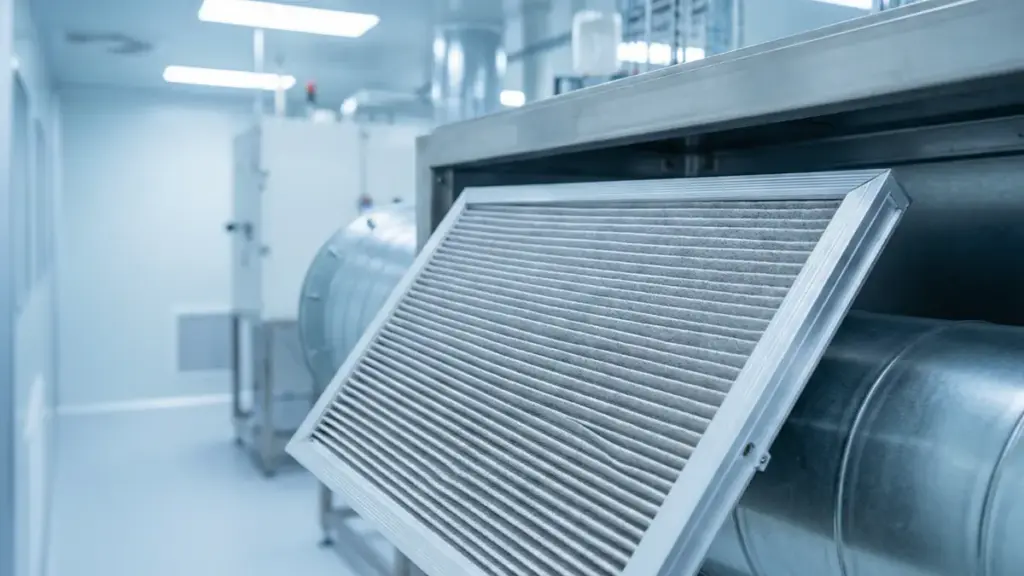
Both PTFE and fiberglass media provide similar HEPA efficiency. PTFE’s key advantage is a lower initial pressure drop, which reduces fan energy use over the filter’s life.
Filtration Efficiency: A Close Match
When it comes to particle capture, both PTFE and fiberglass media can be engineered to meet or exceed demanding HEPA and ULPA standards. For properly constructed filters, the performance is often nearly identical, with both capable of removing well over 99.97% of particles at 0.3 micrometers. The real distinction between them isn’t about which one can achieve peak efficiency, but rather about other operational characteristics like airflow resistance and how they handle real-world conditions.
Initial Pressure Drop: A Clear Advantage for PTFE
PTFE media consistently shows a lower initial pressure drop, or airflow resistance, compared to traditional fiberglass. Fiberglass uses a dense, randomly tangled web of fibers that forces air through a complex, restrictive path. In contrast, the smooth, microporous membrane of PTFE allows air to flow across its surface with much less effort. This directly reduces the strain on system fans and is a significant point of differentiation right out of the box.
Impact on Energy Consumption and Operating Costs
The lower pressure drop of PTFE translates directly into reduced fan energy consumption and lower electricity bills. While PTFE filters typically come with a higher upfront purchase price, the cumulative energy savings can result in a lower total cost of ownership over the filter’s service life. This long-term financial benefit is why PTFE is frequently specified for energy-intensive environments like cleanrooms, pharmaceutical labs, and high-purity manufacturing facilities where operational efficiency is paramount. To quantify that trade-off for your own system, our guide to HEPA filter pressure drop explains how initial and terminal resistance set real change-out intervals.
How Do Moisture and Chemical Resistance Compare?
PTFE excels in humid or corrosive settings due to its hydrophobic and inert nature. Fiberglass is a cost-effective option best suited for dry, chemically mild environments.
Moisture Resistance in Humid Environments
PTFE media is inherently hydrophobic, so it naturally repels water. This quality allows it to maintain its intended filtration performance even in high-humidity conditions without absorbing airborne moisture that could impede airflow.
Fiberglass media, in contrast, can absorb moisture from the air. This absorption can weaken the binder and distort the fiber matrix, which increases the filter’s pressure drop and reduces the stability of the airflow.
Because PTFE does not retain water, its surface is far less prone to developing mold or bacterial growth compared to fiberglass media that may become damp in humid service.
Resistance to Chemicals and Corrosive Vapors
In environments with acids, alkalis, and other corrosive vapors, PTFE demonstrates excellent chemical resistance. Its inert molecular structure makes it highly suitable for these aggressive operating conditions.
While fiberglass offers good chemical resistance for many applications, it is not as universally inert as PTFE. This is particularly true in airstreams where both corrosive agents and high humidity are present together, as the combination can degrade the glass fibers.
Facility managers often select PTFE for applications where chemical exposure and moisture are both significant concerns, as it effectively handles both challenges.
Impact on Performance and Filter Stability
In humid or wet conditions, a PTFE filter delivers a more stable pressure drop and a more predictable service life. Its performance doesn’t change because the media does not absorb water from the airstream.
Fiberglass performs very well in dry applications but can become less stable when significant moisture is introduced. This potential instability can affect the long-term reliability of the filtration system.
Ultimately, the choice depends on the operating environment. PTFE is the premium material for humid or chemically aggressive settings. Fiberglass remains a practical and cost-effective option for controlled, dry conditions.
How Do Dust Loading and Service Life Differ?
Fiberglass HEPA filters use depth-loading for greater dust capacity and longer life. PTFE filters are surface-loading, which can cause pressure drop to rise faster as dust accumulates.
Pressure Drop Behavior Over Time
Because fiberglass media distributes dust throughout its depth, the pressure drop tends to rise more gradually over the filter’s life. Air still has multiple paths to navigate even as the media loads up. PTFE media often shows a different pattern. Once a layer of dust forms on its surface, airflow is more directly restricted. This can lead to a faster, sometimes steeper, rise in pressure drop. In high-dust environments, a PTFE filter may reach its terminal pressure drop limit much sooner than a comparable fiberglass filter.
Dust-Holding Capacity and Practical Service Life
Fiberglass filters are generally recognized for having a greater dust-holding capacity, which often translates directly to longer service life before a replacement is necessary. The depth-loading mechanism simply allows the filter to hold more particulate before it becomes clogged. The service life of a PTFE filter is highly dependent on the application, especially the dust type and how effective any pre-filtration stages are. While some specific studies show engineered PTFE can match the holding capacity for certain particles like soot, fiberglass typically provides longer change-out intervals in general-purpose, dusty applications.
Which Filter to Choose Based on Application Needs
Your application’s priorities should guide your choice. Select fiberglass HEPA filters when maximizing dust-holding capacity and achieving longer service life are the main goals, particularly in stable and dry conditions. Choose PTFE HEPA filters for applications demanding stable high efficiency and superior resistance to chemicals or moisture. In that case, be prepared to manage pressure drop through careful monitoring or adequate pre-filtration. In any system, tracking the differential pressure across the filter remains the most practical and reliable indicator for determining when a filter has reached the end of its useful life.
Which Applications Suit Fiberglass or PTFE Media?
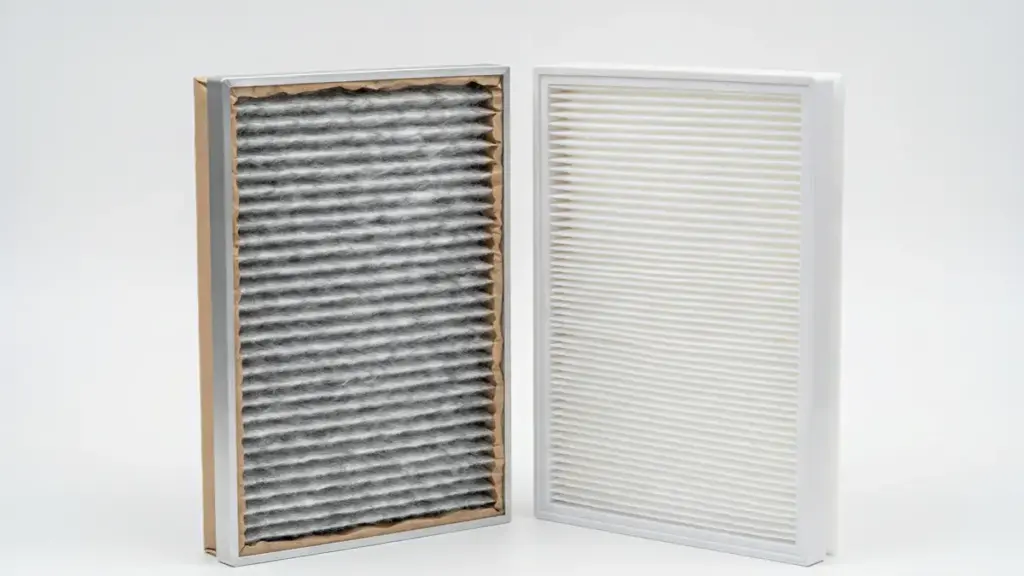
Fiberglass is for dry, cost-sensitive jobs. PTFE is essential for humid, corrosive, or energy-critical applications where long-term reliability is the goal.
When to Choose Fiberglass Media
Fiberglass media is the established standard for many high-efficiency applications, but its performance depends heavily on the environment. It excels when conditions are stable and controlled.
- It’s ideal for dry, climate-controlled environments such as semiconductor cleanrooms and electronics manufacturing facilities.
- Use it as a cost-effective solution for general cleanrooms and medical facilities that have no significant chemical or moisture risk.
- Fiberglass is best suited for budget-conscious projects needing high-efficiency filtration in a stable environment.
- Avoid using it in applications with high humidity or corrosive chemicals, as moisture and aggressive agents can degrade its performance and structural integrity.
When to Choose PTFE Media
PTFE media is the superior choice when operational conditions are harsh or unpredictable. Its chemical and physical properties provide a level of reliability that fiberglass cannot match in challenging settings.
- It is essential for humid or corrosive environments, including pharmaceutical factories, chemical plants, and food processing areas.
- PTFE delivers stable, long-term performance in contamination-sensitive applications like biotechnology and sterile manufacturing.
- Its lower initial resistance reduces fan energy consumption, offering a lower total cost of ownership in systems designed for long-duration use.
- This media is the preferred choice for advanced-node semiconductor facilities where preventing any form of micro-contamination is critical.
A HEPA Filter Media Selection Checklist
Choose fiberglass for dry, cost-sensitive jobs. Pick PTFE for humid, corrosive, or energy-critical applications where total cost of ownership outweighs the initial purchase price.
Deciding between fiberglass and PTFE media comes down to a direct trade-off between upfront cost and long-term operational resilience. Both achieve HEPA-grade efficiency; their behavior under humidity, chemical exposure, and dust loading is entirely different. This checklist breaks down the decision points based on your specific application needs.
| Decision Factor | Fiberglass Media | PTFE Media |
|---|---|---|
| Environmental Humidity & Moisture Resistance | Select for dry applications. Fiberglass media is vulnerable to performance loss from moisture absorption, which can increase pressure drop. | Choose for high-humidity environments or where direct water exposure is a risk. PTFE media is hydrophobic and repels water. |
| Chemical & Corrosion Tolerance | Opt for this media when chemical exposure is minimal and controlling the upfront filter cost is the priority. | Use for air streams containing acidic, basic, or other chemically aggressive compounds due to its excellent corrosion resistance. |
| Energy Efficiency & Pressure Drop | Starts with a higher initial pressure drop. This is an acceptable trade-off if purchase price is more critical than long-term operating costs. | Features a lower initial pressure drop, which can reduce fan energy consumption throughout the filter’s service life. |
| Upfront Cost vs. Total Cost of Ownership | Offers a lower initial purchase price, making it the default choice for budget-constrained projects in controlled settings. | Has a higher upfront cost but can provide a lower total cost of ownership through energy savings and longer life in demanding conditions. |
| Durability & Expected Service Life | A practical choice for standard, non-corrosive environments where planned, periodic filter replacement is part of the maintenance schedule. | Prioritize for applications demanding longer service intervals and greater durability, particularly in harsh or unpredictable conditions. |
Frequently Asked Questions
Which is better for cleanrooms, fiberglass or PTFE HEPA media?
Neither media is universally better; the operating environment decides. Fiberglass serves dry, climate-controlled cleanrooms reliably at a lower purchase price, which covers most semiconductor and general cleanroom use. Specify PTFE where humidity, chemical vapors, or fan energy costs dominate. Many facilities standardize on fiberglass and reserve PTFE for the problem zones.
Why are PTFE HEPA filters more expensive than fiberglass?
PTFE media is an engineered microporous membrane. Producing ePTFE, stretching the fluoropolymer into a controlled node-and-fibril structure and laminating it to a spunbond support, costs far more than the wet-laid, papermaking-style process used for fiberglass. The premium buys lower airflow resistance and durability in harsh conditions, which often reverses the cost advantage over the filter’s service life.
Can fiberglass or PTFE HEPA filters be cleaned and reused?
No. Final HEPA filters are single-use regardless of media; water or physical cleaning disrupts the fiber matrix or membrane and destroys the rated efficiency. In pulse-jet industrial dust collectors, compressed air can release dust from a PTFE surface, but cleanroom HVAC filters cannot be restored. Extend their life with pre-filtration and replace at terminal pressure drop.
Do fiberglass HEPA filters shed glass fibers into the airstream?
Not through normal airflow when the media is intact. The microfibers are bonded into a cured mat, and finished filters pass integrity scans before shipment. Fiber release becomes a risk only if the media is bent, crushed, or torn during handling or installation. This is why fiberglass media requires careful pleating and why filters are leak-tested after fitting.
Do both media meet the same HEPA efficiency classes?
Yes. Efficiency classes rate the finished filter, not the media. Filters built from fiberglass or PTFE can each be verified at H13 (99.95% at MPPS) or H14 (99.995%) under EN 1822. Media selection changes pressure drop, moisture tolerance, and service behavior, not which grade is attainable, so always request test documentation for the specific filter you purchase.
Final Thoughts on Filter Media Selection
The fiberglass vs PTFE HEPA filter choice isn’t a cost decision; it’s a risk management calculation for your entire facility. While standard fiberglass performs in controlled environments, using it in humid or corrosive applications invites premature failure and system contamination. Our factory standards ensure you get the documented performance needed to protect your process and your reputation.
The correct specification depends entirely on your operating environment and total cost of ownership model. We recommend requesting media samples to validate performance against your specific airflow and pressure drop requirements. Contact our technical team to discuss OEM configurations or to secure a copy of our full filtration catalog.