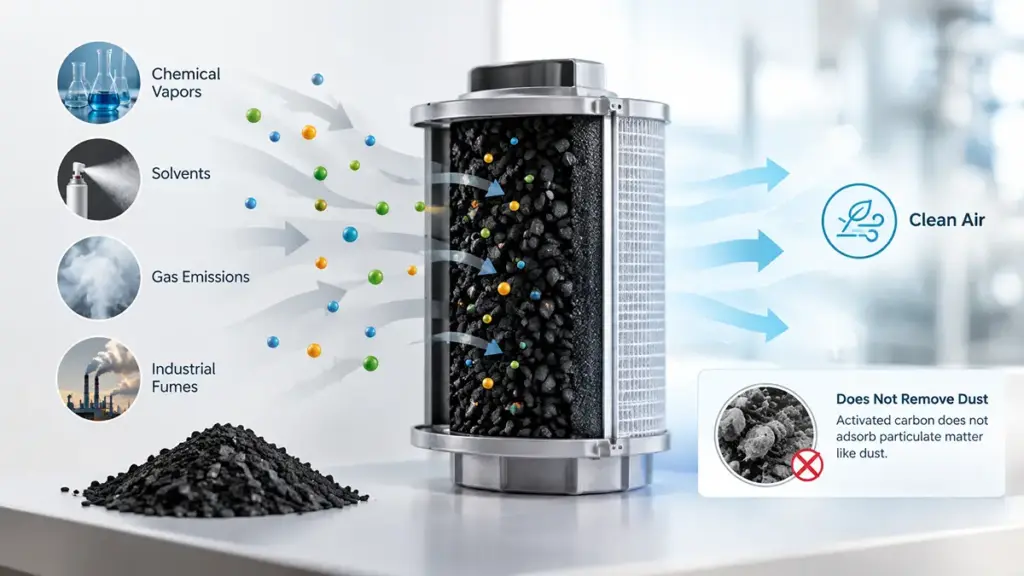
An activated carbon filter for HVAC systems handles what ordinary dust filtration cannot: odors, volatile organic compounds, and chemical vapors carried on the air stream. The media is carbon processed into a vast internal pore surface. Gas molecules collect inside those pores by adsorption while the air passes through.
Selection fails in a few predictable ways. A filter sized for dust ignores the gas load entirely. A deep carbon bed starves the fan. A saturated panel stays in its rack because nobody defined when it is spent. This guide walks through diagnosis, format choice, airflow and pressure-drop checks, contact time, prefiltration, and replacement planning for offices, hotels, and malls.
When Does Commercial HVAC Need Carbon Filtration?
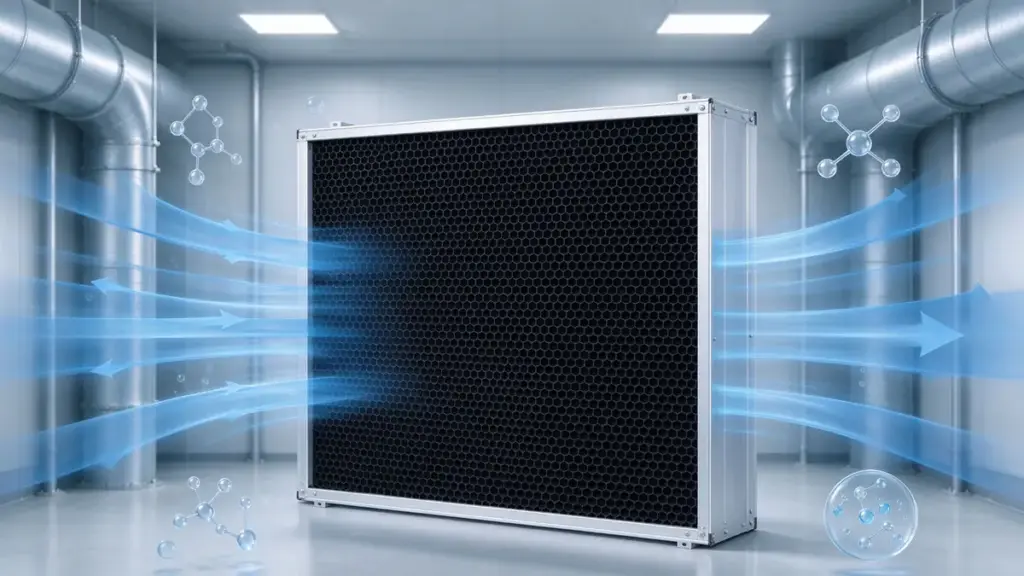
Carbon filtration earns its place when odors or gases are the complaint, and only after source control and ventilation have been assessed.
Start with the symptom, not the product. Panel and pocket filters capture particles; they do nothing for the food-court smell that follows tenants to the elevator or the solvent note in a newly fitted office. Gas-phase problems need an activated carbon filter for HVAC air streams, and they need it sized for the actual pollutant.
Four signals point to a genuine gas-phase load:
- Odor complaints that persist after routine cleaning and standard HVAC maintenance
- New construction or refurnishing periods, with rising off-gassing from carpets, adhesives, and furniture
- Street-level air intakes that pull in kitchen exhaust or traffic fumes
- Restroom or trash-room odors drifting into occupied space despite healthy airflow
Fix the source before buying filtration. Seal the kitchen exhaust duct, store cleaning chemicals properly, and specify low-emitting finishes at the next refit. Increase outdoor air where the energy penalty is acceptable. Carbon treatment is the step that handles the residual load, the portion left after source control and ventilation have done their work.
Set expectations honestly. Activated carbon does not capture dust, smoke particles, or microbes. It targets gases and vapors. A building that wants cleaner air should combine carbon with particulate filtration, not substitute one for the other.
In practice, carbon earns its keep at a handful of positions: lobby and entrance sections handling street air, restaurant and cafeteria supply paths, restroom return points, loading-dock intakes, and office floors during a construction season next door. Each position concentrates a different gas, so a mixed-property portfolio often needs two media grades rather than one universal panel.
Which Pollutants Occur in Offices, Hotels, and Malls?
Each building zone contributes a different gas load, and the pollutant mix, not the room name, decides the media.
Offices accumulate volatile organic compounds (VOCs) and formaldehyde from carpet adhesives, particleboard furniture, paints, and cleaning products. The EPA reports that indoor concentrations of many VOCs are frequently higher than outdoor levels. These sources emit at low concentration around the clock, so the filter runs against a steady load rather than a spike.
Hotels mix kitchen odors, restroom gases such as hydrogen sulfide and ammonia, and chlorine-based cleaning agents around laundry and pool areas. Standard carbon handles most food and restroom odors. Alkaline-impregnated media works the acidic chlorine compounds down far more reliably.
Malls add food-court grease smoke, off-gassing bursts from new store fit-outs, and street air drawn through entrance doors. Vehicle exhaust carries acid gases that plain carbon adsorbs poorly, which is where acid-impregnated or chemically modified grades earn their cost.
DTAF’s plate-type activated carbon air filter is specified against a defined gas list: VOC, TVOC, formaldehyde, benzene series, odors, acid gases, ammonia, hydrogen sulfide, and ozone. Impregnated variants extend what each panel can handle. Acid-impregnated media works ammonia and amines down, alkali media targets acid gases, and potassium-permanganate media handles ozone from copier rooms and electrostatic equipment.
For the mechanism behind these matches, see our breakdown of how activated carbon filters adsorb VOCs, odors, and chemical gases.
Which Carbon Filter Formats Fit HVAC Systems?
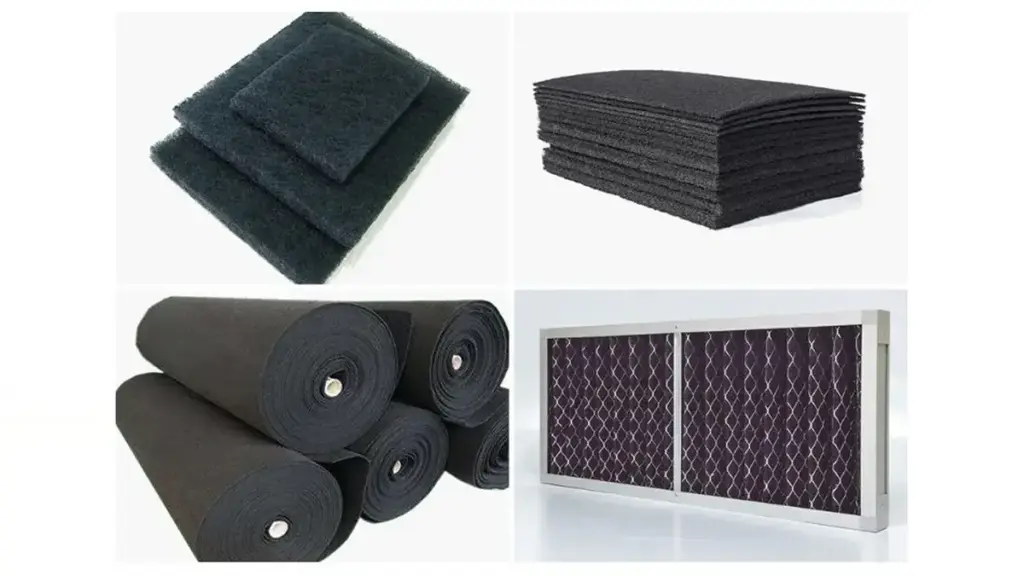
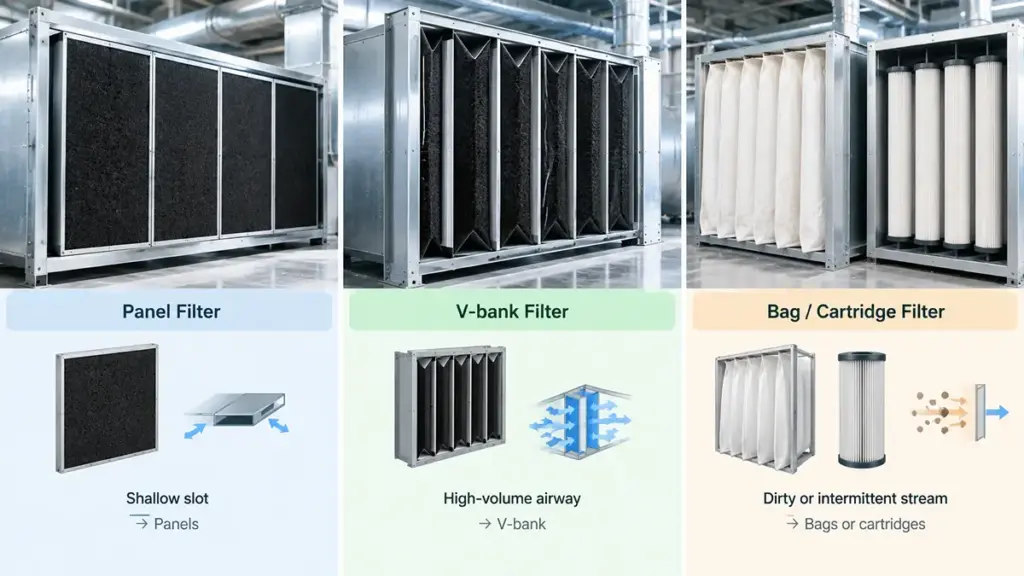
Panel, honeycomb, V-bank, and cartridge formats all fit air handlers; gas load, rack depth, and fan pressure make the choice.
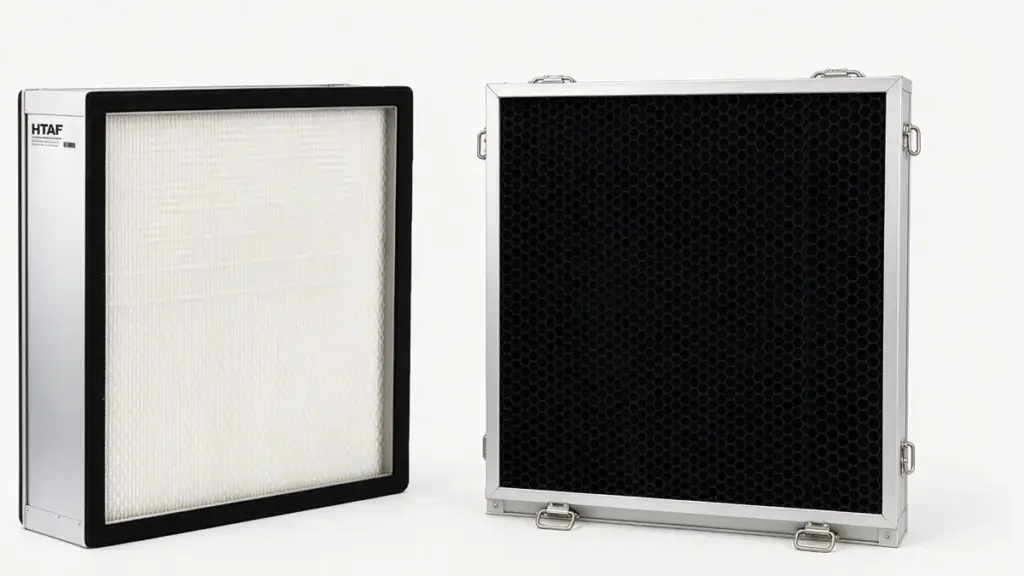
Four activated carbon filter formats cover most commercial HVAC service. Their working ranges are listed on the activated carbon air filters page, and each behaves differently once installed in a real air-handling unit (AHU).
| Format | Carbon media | Initial resistance | Best fit |
|---|---|---|---|
| Pleated carbon panel | Impregnated nonwoven media | ≤ 45 Pa | General odors, light VOCs |
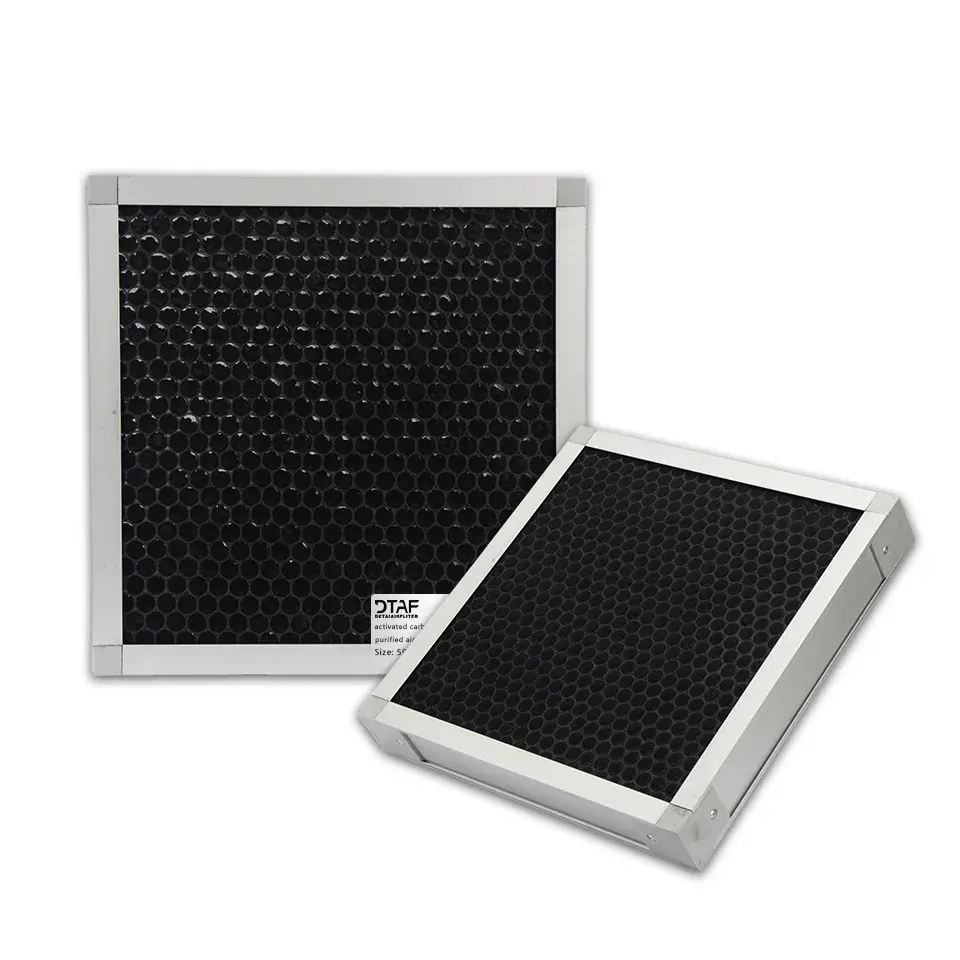
| Honeycomb carbon panel | Granular activated carbon | ≤ 60 Pa | Heavy VOC loads, formaldehyde |
| Carbon V-bank filter | Impregnated synthetic media | ≤ 80 Pa | Commercial odors, airborne gases |
| Inline / cylinder cartridge | Pelletized carbon | ≤ 120 Pa | Industrial exhaust, side streams |
Panels are the retrofit default. They drop into existing 592×592 mm grids and rack hardware without modification. Honeycomb panels hold granular carbon in a structured cell, trading a little resistance for more gas capacity in the same footprint.
V-bank and compact filters spread the media across angled cells, keeping resistance low while passing high air volumes. DTAF rates its carbon V-bank at up to 3,400 m³/h per frame. Cylindrical cartridges fit inline duct positions where a flat rack does not exist.
Media choice matters as much as shape. Granules, pellets, impregnated fabric, felt, and foam carry different pressure-drop and capacity behavior. Our comparison of activated carbon filter media sets them side by side.
How Should Airflow and Pressure Drop Be Evaluated?
Match the filter’s full-life resistance against the air handler’s static-pressure budget at the design airflow.
Before comparing media or brands, pull the fan curve and the residual static pressure at the filter section. A carbon stage works only if the fan pushes the design airflow through it, at clean resistance and still at the point where the filter is due for change-out.
Read resistance as a range, not a single number. DTAF plate-type carbon panels start at 50–90 Pa clean and carry a recommended final resistance of 180–220 Pa. Carbon-cotton panels sit at the low end of that band and honeycomb panels at the high end.
Oversizing is a real risk. A deeper, carbon-heavier panel looks like better performance on a spec sheet. If it pushes total resistance beyond the fan margin, supply airflow drops, rooms drift from setpoint, and the fan draws more power chasing the temperature. Every activated carbon filter for HVAC duty has to sit inside the fan’s static budget at the design airflow.
Check the rack itself: available depth, gasket sealing against bypass, and how the filter gets serviced. Panels come in 25, 46, 50, 60, 70, and 100 mm depths. A carbon stage behind a sealed access panel that nobody opens will stay in service long past its useful life.
Face velocity is the quiet variable in this calculation. Carbon panels are rated at the air moving through the filter face at design conditions. Push more air through the same face and resistance climbs faster than the airflow does, while contact time collapses. When a rack looks undersized for the air volume, adding a second filter bank usually beats accepting a deeper panel at higher velocity.
Source Certified Carbon Filters on Low-MOQ Trial Orders
How Much Carbon and Contact Time Are Needed?
Air-side contact is measured in fractions of a second; bed depth and face velocity, not carbon weight alone, set removal.
Gas moves through the bed quickly. Contact time is the bed depth divided by the face velocity, and in air filtration it is a fraction of a second, not a dwell measured in minutes. Thicker media and slower air give gas molecules more chances to stick inside the pore surface.
That is why thickness is a specification decision, not a default. When the activated carbon filter for HVAC service is specified too thin, odor breakthrough arrives early; specified too deep, the fan pays for it. The 25–100 mm range lets you match bed depth to the actual load. A heavily used lounge justifies depth; a lobby with occasional perfume notes does not.
Environment sets the ceiling on capacity. The media works best between 35–65% relative humidity. Sustained humidity above that band lets water molecules compete for the pores and cuts usable adsorption capacity. The standard operating window is 5–55 °C.
Carbon quality sits underneath all of this. Two panels of identical thickness can hold very different capacity if one uses a low-grade, high-dust carbon. Media is graded by internal surface and by adsorption tests against reference gases. DTAF’s carbon cotton, for example, publishes a carbon content of at least 50% with benzene adsorption above 20%. Ask any supplier for adsorption data on your target gas, not a generic efficiency percentage.
Sizing questions borrowed from water treatment cause confusion here. Granular-carbon water vessels are sized by empty-bed contact time measured in minutes, with backwash hydraulics and NSF/ANSI certification behind them, a different product class entirely. DTAF supplies air-side filtration; liquid applications should go to a water-treatment specialist.
How Should Prefiltration and Replacement Be Planned?
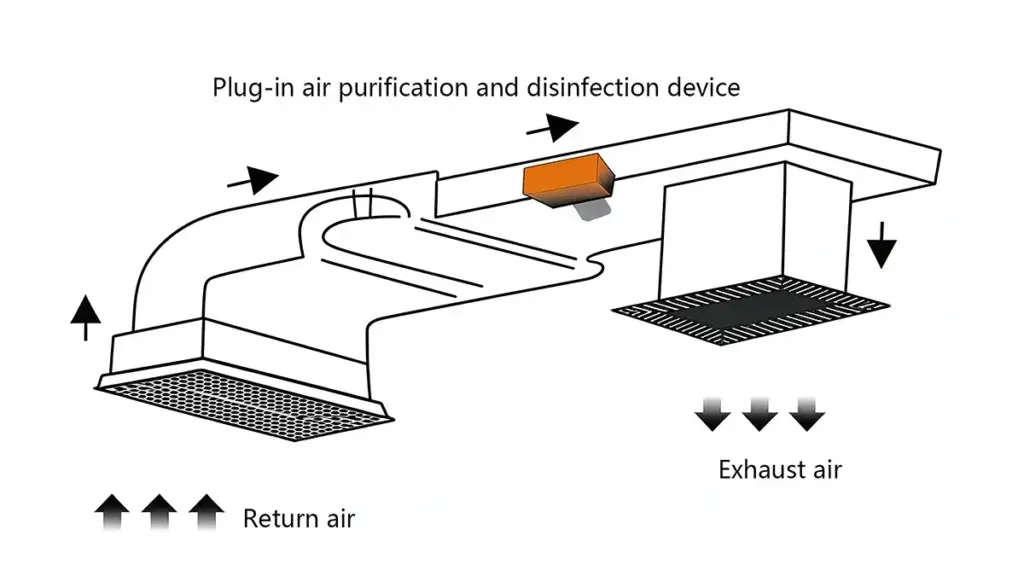
A particulate prefilter protects the carbon bed, and gas detection, not the calendar, decides replacement.
Carbon beds fail early when they catch dust first. The EPA guide to air cleaners is explicit that activated carbon addresses gases and odors rather than particles. Without a prefilter, lint and dust load the media surface and block the pores that should be adsorbing vapor.
So the sequence matters. Panel or pocket prefilters take the particulate load upstream. The carbon stage sits behind them, typically in the final filter section ahead of the supply fan. The prefilter runs on its own replacement schedule, always earlier than the carbon.
Prefilter grade follows the dust load. A standard panel prefilter protects carbon in ordinary office and retail service. Pocket filters add dust-holding capacity where construction work or heavy traffic raises the intake load. This pairing decision moves the carbon’s service life more than any marginal upgrade to the carbon itself.
Replacement should follow saturation, not the season. DTAF’s published specification states plainly that saturation is best determined by gas detection, with pressure drop serving as reference only. A carbon panel can pass air freely while adsorbing nothing at all. Odor breakthrough at the diffusers, or a rising TVOC reading downstream, is the true end-of-life signal.
Log the load pattern while you are in there. Mall filtration sees holiday crowds and food-court peaks; offices see cleaning-night spikes and quarterly refits. A quarterly inspection against those records turns replacement from guesswork into a schedule.
Commercial HVAC Carbon Filter Specification Checklist
A complete RFQ names the format, media, sizes, resistances, and target pollutants before price is discussed.
Send the following fields to any supplier, including us, and compare quotes on identical terms. A lower price often means a lighter bed or thinner media, not a better factory.
| Item | What to provide |
|---|---|
| Building and zone | Offices, hotel kitchens, mall food courts; the specific complaint |
| Target pollutants | VOC, formaldehyde, odors, acid gases, ammonia, hydrogen sulfide, ozone |
| Format and size | Panel, honeycomb, V-bank, or cartridge; 592×592, 575×575, 1175×575, 610×610 mm or custom |
| Media type | Granular honeycomb, carbon cotton, or acid-, alkali-, permanganate-impregnated |
| Airflow and static pressure | Design airflow per unit; residual pressure at the filter section |
| Operating conditions | Temperature 5–55 °C; humidity 35–65% RH optimal |
| Frame material | ABS plastic, galvanized steel, aluminum, stainless steel, moisture-proof cardboard |
| Quantity terms | Low-MOQ trial orders for standard panels; 50–100 units for fully custom OEM |
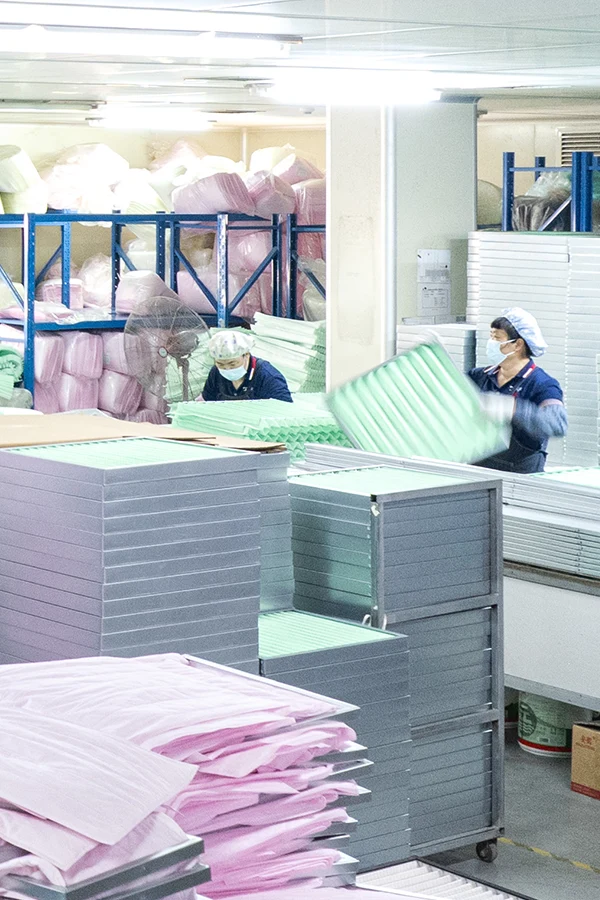
DTAF’s engineers return a factory-direct quote within 12 hours, produced from a 100,000-class cleanroom facility with EN1822 testing capability. Custom sizes, frames, and media combinations are standard OEM/ODM work, not special requests.
Close the specification with two practical fields: how spent carbon will be detected, and how the crew will reach the rack. A TVOC sensor at the supply outlet and a documented access route keep the whole plan honest long after commissioning day.
Frequently Asked Questions
Do commercial HVAC systems need activated carbon filters?
Only when gas-phase pollutants are the real complaint. If the problem is dust, the answer is particulate filtration. If tenants report odors, off-gassing, or chemical notes that persist after cleaning and ventilation checks, a carbon stage is the correct tool. Many buildings run perfectly well without one.
Which activated carbon filter type is best for commercial HVAC?
Panels fit standard racks and retrofit work. Honeycomb panels add gas capacity in the same footprint for heavier VOC loads. V-bank formats pass the highest airflow at moderate resistance, and cartridges handle inline duct positions. Match the format to the rack and the fan margin first, then choose the media for the gas.
How does a carbon filter affect HVAC pressure drop and fan energy?
Expect initial resistance of roughly 45–120 Pa depending on format, with change-out at the recommended final range. Plate-type panels, for example, run 50–90 Pa clean and 180–220 Pa final. If the fan has no static margin for that rise, airflow and comfort fall long before the carbon is spent.
Can a carbon filter replace a particulate prefilter or HEPA filter?
No. Carbon captures gases and odors, not particles. Skipping the prefilter also destroys the carbon faster, because dust loads the media surface and blocks the pore structure. The correct sequence puts particulate filtration upstream, with the carbon stage treating the cleaned air behind it.
Where should an activated carbon filter be installed in an air-handling unit?
Behind the particulate prefilter, in the final filter section, upstream of the supply fan. That placement keeps dust off the carbon and lets the fan move treated air into the ducts. Return-duct and inline positions also work when the air handler has no spare filter section.
How should replacement intervals be determined for commercial HVAC systems?
By detection, not by calendar. Pressure drop is only a reference, because a saturated carbon bed can still pass air freely. Watch for odor breakthrough at the diffusers or a rising TVOC reading downstream, inspect quarterly against known load seasons, and change the prefilter on its own tighter schedule.